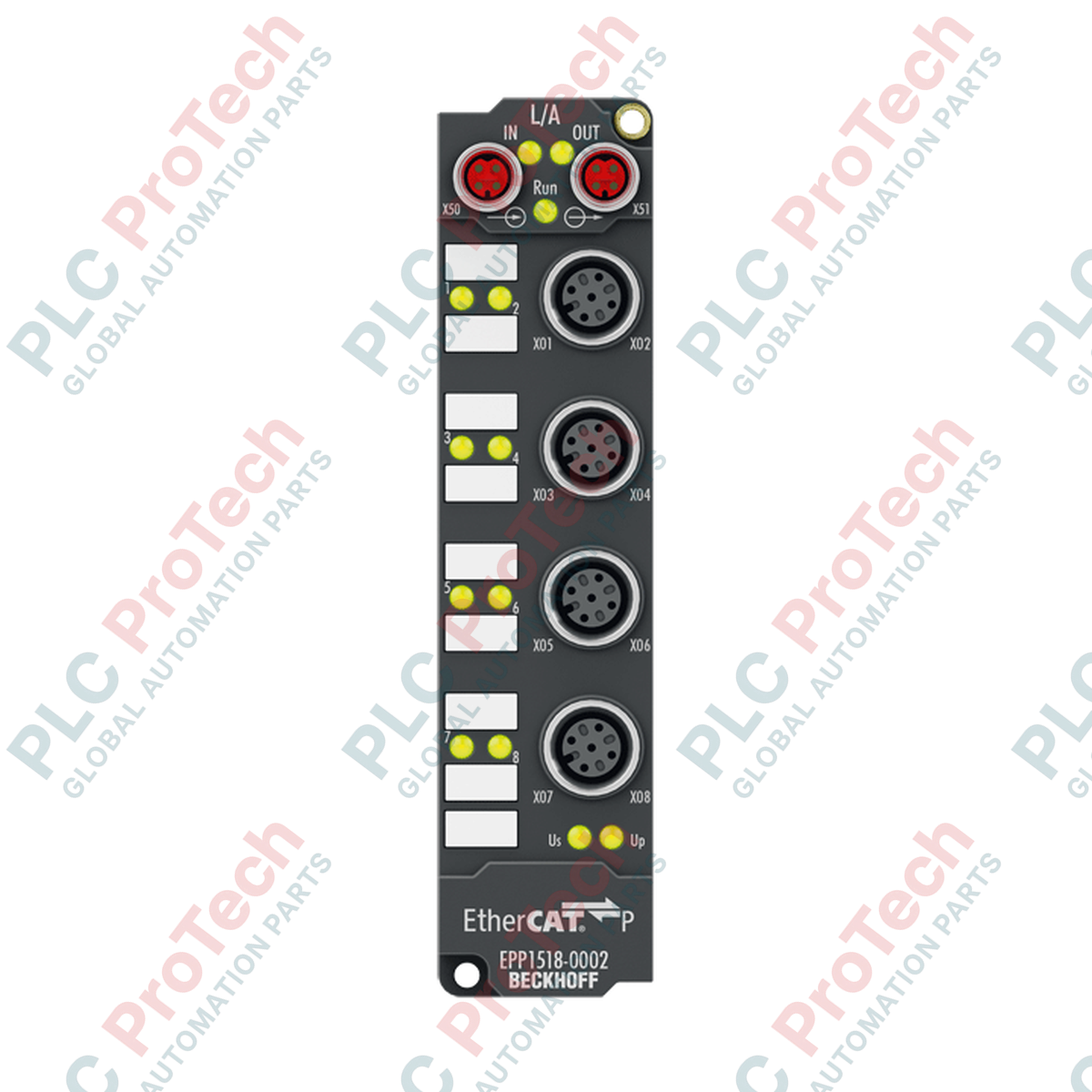
Description
Facilitant l’intégration directe des capteurs dans les architectures de commande décentralisées, le module d’interface industriel BECKHOFF EPP1518-0002 fournit huit entrées numériques dans un boîtier classé IP67. Ce boîtier EtherCAT P intègre la communication et l’alimentation (Us et Up) dans un système compact à connecteurs M8 à codage P, réduisant ainsi la complexité du câblage sur site. Fabriqué avec une technologie d’encapsulation robuste, l’appareil est conçu pour être monté directement sur la machine, sans armoire électrique, afin d’assurer une transmission rapide des données et une synchronisation temporelle de haute précision grâce aux horloges distribuées (DC) intégrées.
Fonctionnalités
-
8 entrées numériques : permet la connexion directe de capteurs 24 V CC avec des options flexibles de configuration du filtre.
-
Comptage à grande vitesse : comprend 2 entrées configurables comme compteurs bidirectionnels 32 bits fonctionnant à des fréquences allant jusqu’à 1 kHz.
-
Automatisation à câble unique : utilise la technologie EtherCAT P avec codage P et connecteurs M8 pour combiner l’alimentation du système et des capteurs, la tension périphérique et la télémétrie EtherCAT.
-
Protection de niveau industriel : boîtier étanche classé IP65, IP66 et IP67 pour un fonctionnement fiable dans les environnements humides, poussiéreux et soumis à de fortes vibrations.
-
Intégration TwinCAT : entièrement compatible avec les systèmes d’ingénierie TwinCAT pour le diagnostic, la surveillance d’état et la configuration des paramètres.
Applications
-
Lignes d’assemblage décentralisées : montage standardisé directement sur la machine, à proximité des vannes pneumatiques et des capteurs de proximité.
-
Manutention et convoyeurs : acquisition fiable et à grande vitesse des signaux d’entrée des capteurs de tri et de suivi, même en présence de fortes vibrations.
-
Bancs d’essai automobiles : acquisition de signaux multisenseurs avec synchronisation à la microseconde grâce aux horloges distribuées.
Tableau des spécifications techniques
| Paramètre |
Valeur de la spécification |
| Fabricant |
Beckhoff |
| Référence du modèle |
EPP1518-0002 |
| Protocole produit |
EtherCAT P |
| Nombre d’entrées |
8 (2 configurables comme compteurs bidirectionnels 32 bits) |
| Connexion d’interface de bus |
2 x prise M8, blindée, à vis, codage P |
| Type de port d’entrée |
M12 x 1, 5 broches, codage A |
| Tension d’entrée nominale |
24 V CC (-15 % / +20 %) |
| Tension du signal logique « 0 » |
-3 à +5 V CC (EN 61131-2, type 3) |
| Tension du signal logique « 1 » |
11 à 30 V CC (EN 61131-2, type 3) |
| Courant nominal d’entrée |
Typ. 3 mA (EN 61131-2, type 3) |
| Plage de configuration du filtre d’entrée |
Réglable, de 0 à 100 ms |
| Alimentation des capteurs |
À partir de la tension de commande Us, max. 0,5 A pour 4 capteurs (protégé contre les courts-circuits) |
| Consommation de courant (Us) |
Typ. 100 mA |
| Isolation électrique |
500 V RMS |
| Plage de températures de fonctionnement |
-25 à +60 °C |
| Plage de températures de stockage |
-40 à +85 °C |
| Indice de protection |
IP65, IP66, IP67 (conforme à la norme EN 60529) |
| Poids |
Env. 165 g |
| Poids d’expédition (calculé) |
0,45 kg |
Connexions et interfaces
| Port du connecteur |
Broche de borne |
Affectation des signaux |
| M8 codé P (alimentation et EtherCAT) |
Broche 1 |
Us (alimentation du système et des capteurs +24 V CC) |
| Broche 2 |
Up (alimentation des actionneurs/périphériques +24 V CC) |
| Broche 3 |
GNDs (masse du système/des capteurs) |
| Broche 4 |
GNDp (masse des actionneurs/périphériques) |
| M12 codé A (ports d’entrée numériques) |
Broche 1 |
Alimentation des capteurs +24 V CC (Us) |
| Broche 2 |
Signal d’entrée B (canaux 2, 4, 6, 8) |
| Broche 3 |
Masses (masse des capteurs) |
| Broche 4 |
Signal d’entrée A (canaux 1, 3, 5, 7) |
| Broche 5 |
Terre fonctionnelle (FE) / Blindage |
Observations techniques empiriques
Modèles alternatifs et compatibilité
Le EPP1518-0002 appartient spécifiquement à la famille EtherCAT P. Il est physiquement incompatible avec les boîtiers standard EtherCAT de la série EP qui utilisent un détrompage Ethernet M8 standard. Si vous convertissez un système EtherCAT standard en EtherCAT P, vous devez utiliser un répartiteur d’intégration tel que l’EP9224-0037 afin de faire transiter en toute sécurité l’alimentation et les nœuds réseau standard vers l’infrastructure réseau codée P.
Pièges liés à l’application et remarques techniques
Lors de la mise en série de plusieurs modules EPP, calculez la chute de courant cumulée sur les deux bus Us (système) et Up (périphériques). Bien que chaque canal local d’alimentation des capteurs soit protégé contre les courts-circuits jusqu’à 0,5 A, la surcharge des lignes d’alimentation M8 principales provoquera des chutes de tension internes sur le bus et déclenchera des états de défaut de sous-tension consignés dans le maître TwinCAT. Utilisez le logiciel TwinCAT System Manager pour calculer les courbes de tension avant la mise en service sur site.
Conseils de mise en service et de câblage
Assurez-vous que toutes les connexions M12 et M8 inutilisées sont obturées avec les capuchons de protection en plastique IP67 appropriés. Laisser les ports ouverts dans des environnements de traitement humides ou mouillés compromet l’étanchéité de l’ensemble du bloc de modules et peut provoquer des courts-circuits intermittents entre les broches d’alimentation des capteurs et de masse.
Directives d’installation
AVERTISSEMENT CRITIQUE : Vérifiez que toutes les alimentations en amont et de terrain sont complètement hors tension avant de brancher ou de débrancher des câbles M8 ou M12. Le branchement à chaud des lignes d’alimentation codées P peut endommager les broches de contact par arc électrique, dégrader la communication et entraîner une défaillance du module.
1
Fixez directement l’appareil au châssis ou aux profilés de votre machine à l’aide de deux vis M3. Assurez-vous que la surface de montage est propre et plane afin d’éviter les contraintes de torsion sur le boîtier IP67.
2
Raccordez le câble EtherCAT P entrant à la prise M8 supérieure codée P, en serrant fermement la bague de couplage afin de préserver l’intégrité de l’étanchéité.
3
Raccordez les capteurs numériques aux prises d’entrée M12. Programmez dans TwinCAT des paramètres de filtrage d’entrée numérique appropriés (de 0 à 100 ms) selon le type de capteur afin d’éviter les problèmes de rebond des contacts mécaniques.