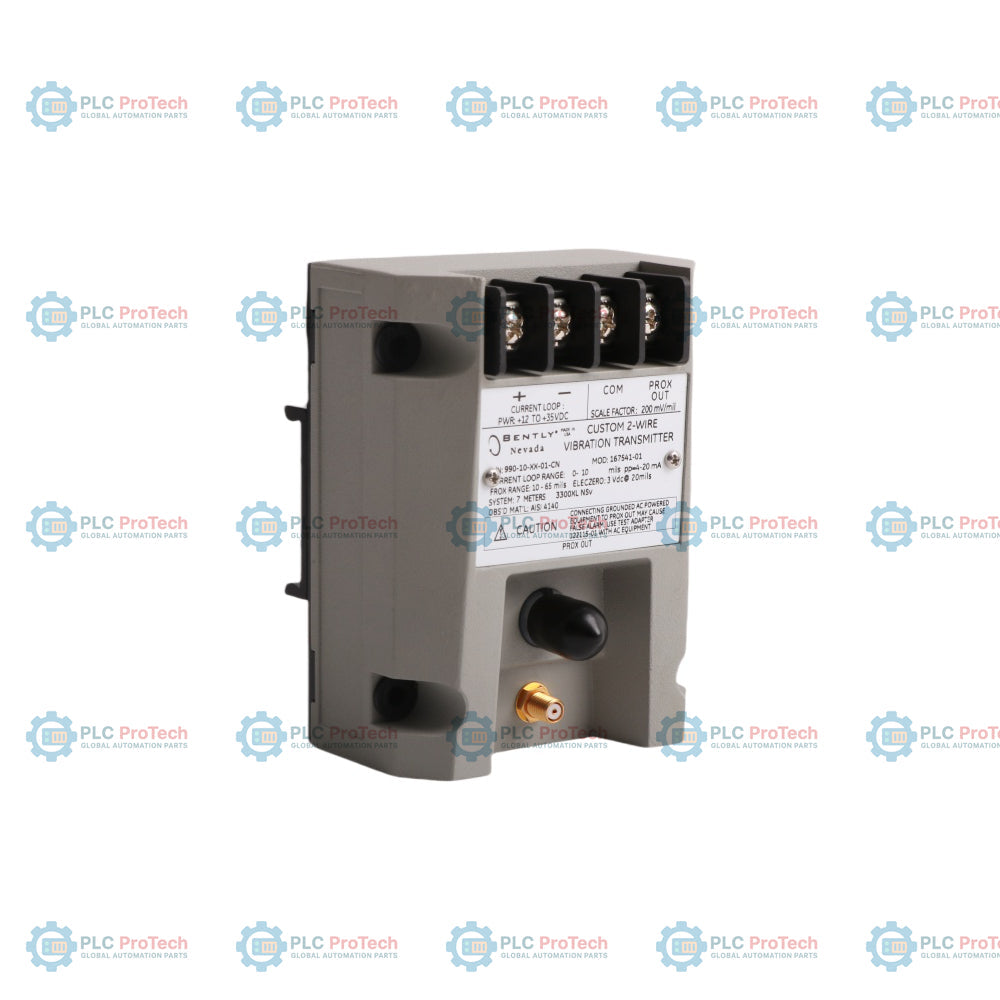
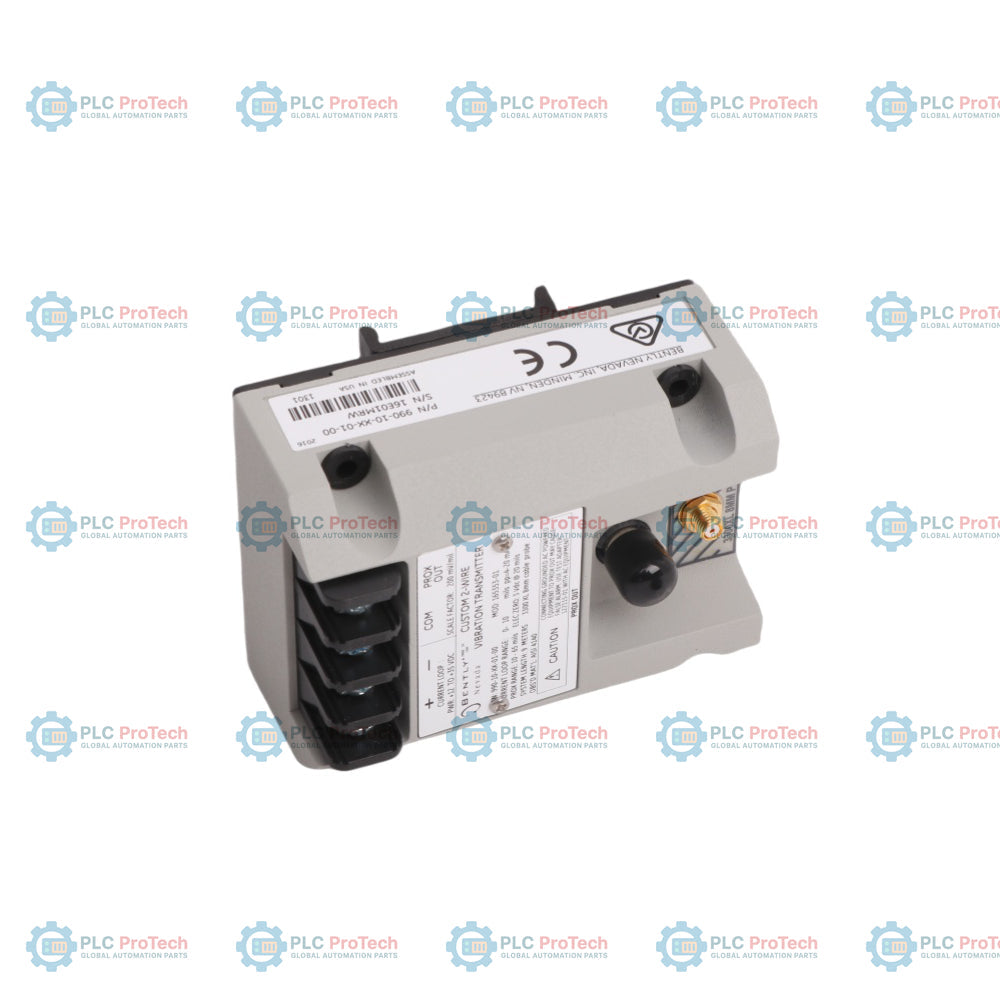
Le 990-10-50-01-05 est un émetteur de vibration à deux fils alimenté par boucle, conçu pour fournir un signal de vibration proportionnel simple de 4 à 20 mA directement à un système de contrôle de machines. Ce Émetteur de vibration 990 intègre un capteur Proximitor dans une seule unité, acceptant l’entrée d’une sonde de proximité 3300 NSv et de son câble d’extension assorti. Il conditionne le signal du transducteur en unités d’ingénierie d’amplitude de vibration crête à crête appropriées, permettant une protection économique des machines par alarme, logique et suivi global des vibrations sans nécessiter d’un capteur de proximité externe.
Caractéristiques
Capteur Proximitor intégré éliminant le besoin d’un boîtier externe ou d’un conditionneur de signal séparé.
Bornes PROX OUT et COM non isolées avec connecteur coaxial fournissant une sortie de signal de vibration dynamique et de tension de gap pour le diagnostic.
Potentiomètres de zéro et d’étendue non interactifs sous l’étiquette de l’émetteur pour un réglage facile de la boucle.
Broche d’entrée de test dédiée permettant une vérification rapide de la sortie du signal de boucle via un générateur de fonctions externe.
Circuit intégré Not OK/Désactivation du signal empêchant les fausses alarmes ou les sorties de boucle élevées causées par des connexions lâches ou une sonde de proximité défectueuse.
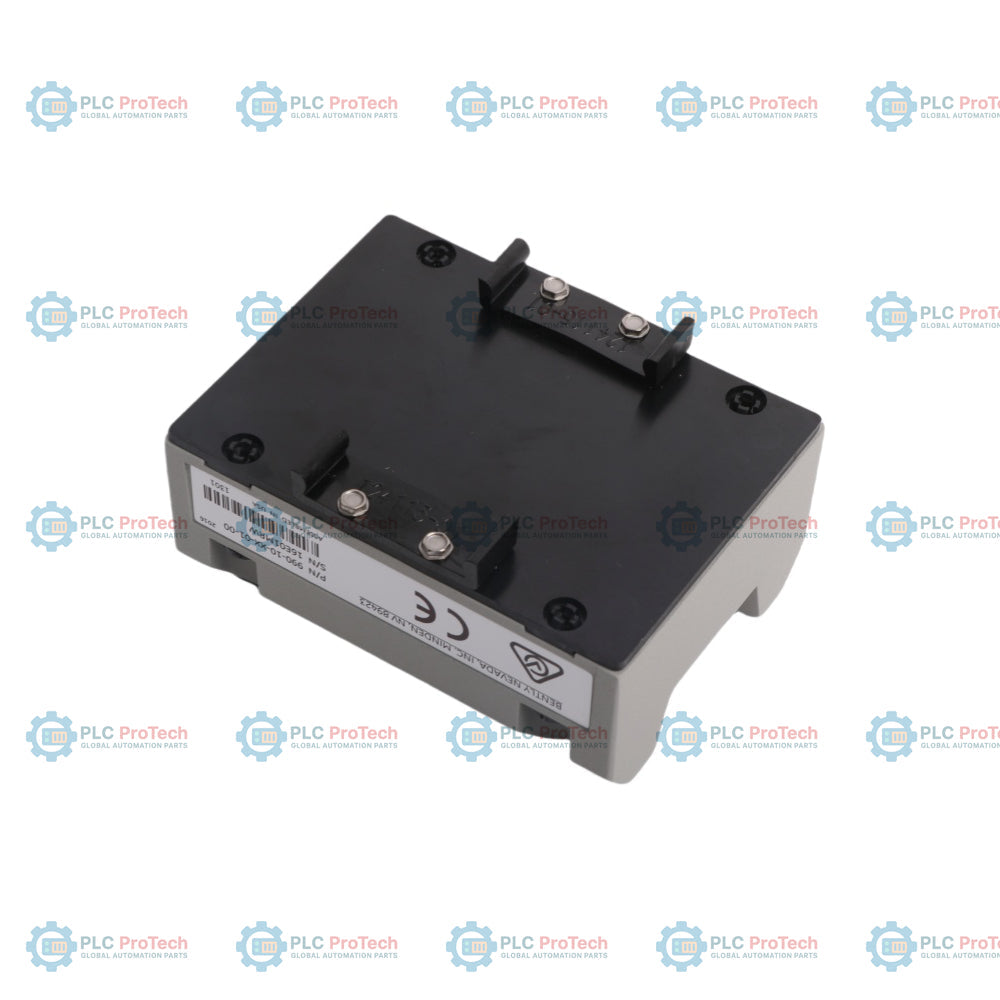
Double flexibilité de montage avec options standard pour clips de rail DIN 35 mm ou vis de montage sur cloison.
Construction moulée assurant une performance fiable dans des environnements à forte humidité jusqu’à 100 % de condensation.
La sortie chute à moins de 3,6 mA dans les 100 µs en cas de défaut ; restauration en 2-3 secondes
Inhibition à la mise sous tension
Sortie maintenue à moins de 3,6 mA pendant 2 à 3 secondes après la mise sous tension
Impédance de sortie Prox
Impédance de sortie de 10 kOhm calibrée pour une charge de 10 MOhm
Niveau de bruit typique
50 mV crête à crête
Taille minimale de la cible
Acier AISI 4140 de 9,5 mm (0,375 po) de diamètre
Longueur maximale du câble
3 mètres (10 pieds) pour la sortie du capteur Proximitor (connecteur BNC)
Température de fonctionnement (transmetteur)
-35 à +85 Celsius (-31 à +185 Fahrenheit)
Température de stockage (transmetteur)
-52 à +100 Celsius (-62 à +212 Fahrenheit)
Température de fonctionnement/de stockage (sonde)
-52 à +177 Celsius (-62 à +351 Fahrenheit)
Humidité relative
100 % condensation, non submergé (avec protection du connecteur coaxial)
Matériau de la pointe du transducteur
Sulfure de polyphénylène (PPS)
Matériau du boîtier du transducteur
Acier inoxydable AISI 303 ou 304 (SST)
Type de câble de sonde
Coaxial 75 Ohm, isolé en fluoroéthylène propylène (FEP)
Résistance à la traction
222 N (50 lbf) boîtier de la sonde au câble de la sonde, maximum
Poids du transmetteur
0,43 kg (0,9 lbm)
Poids total du système
0,82 kg (1,8 lbm) typique
Connexions et interfaces
Broche / Terminal du connecteur
Fonction
SORTIE PROX
Signal dynamique de vibration et de tension d'écart non isolé (BNC/Terminaux)
COM
Terminal de référence commun pour l'alimentation de boucle et le diagnostic
+
Entrée positive de l'alimentation de boucle (+12 à +35 Vcc)
-
Retour négatif de l'alimentation de boucle / sortie de courant 4-20 mA
TEST
Broche d'entrée de test pour la vérification du signal du générateur de fonctions externe
Prise coaxiale
Connexion directe au câble d'extension d'accord 3300 NSv
Directives d'installation
Réglage de l'écart de la sonde
La sonde de proximité doit être mécaniquement espacée entre 0,5 et 1,75 mm (20 et 55 mils) de la surface cible lors de l'installation. Cela garantit que la sonde fonctionne entièrement dans sa plage linéaire et permet au transmetteur de générer avec précision la sortie pleine échelle de 4 à 20 mA.
Limites d'engagement du filetage
Lors de l'installation de la sonde dans un trou de montage fileté, ne dépassez pas la longueur d'engagement maximale standard de l'industrie de 1,5 fois le diamètre nominal du filetage. Pour un filetage 1/4-28, l'engagement maximal est de 0,375 pouces ; pour un M8x1, il est de 12 mm. Dépasser ces limites peut provoquer un blocage mécanique et annuler la garantie. Pour les sondes 1/4-28, un foret de taraudage #3 ou plus grand est recommandé.
Isolation du signal et diagnostics
Le connecteur coaxial PROX OUT fournit un signal de transducteur dynamique pour le diagnostic mais n'est pas isolé de la boucle 4 à 20 mA. Bien qu'il puisse se connecter directement à un équipement de test isolé et alimenté par batterie, l'utilisation d'un adaptateur de test externe (comme l'adaptateur de test 990/991) est fortement recommandée lors de la connexion à un équipement alimenté en courant alternatif tel que les oscilloscopes. Cela préserve l'isolation de la boucle et évite les fausses alarmes ou la dégradation de la boucle.
Protection contre l'humidité
L'émetteur est construit en potting et est conçu pour supporter jusqu'à 100 % d'humidité condensante. Cependant, les connecteurs coaxiaux de la sonde et du câble d'extension doivent être protégés physiquement contre l'infiltration de liquide pour maintenir la calibration et l'intégrité du signal.
Conformité et certifications
CSA : Classe I, Division 2
ATEX : Zone 0, Zone 2
Marine : Approbation maritime ABS
FAQ
La sortie de boucle 4 à 20 mA peut-elle être utilisée pour analyser la phase de vibration ou établir des alarmes d'écart ?
Non. La sortie de boucle 4 à 20 mA fournit uniquement des données globales d'amplitude de vibration crête à crête. Elle ne peut pas capturer la phase de vibration ni prendre en charge des fonctions avancées de surveillance telles que les alarmes d'écart, les alarmes de phase, Danger Bypass ou Trip Multiply.
Que se passe-t-il avec la sortie de boucle si le câble de la sonde de proximité est déconnecté ou coupé ?
L'émetteur dispose d'un circuit Not OK/Signal Defeat. En cas de défaut ou de connexion lâche, le signal de boucle chute à moins de 3,6 mA en moins de 100 microsecondes pour éviter des sorties élevées ou de fausses alarmes machines. Il se rétablit en 2 à 3 secondes une fois la condition de défaut résolue.
Un capteur Proximitor externe est-il nécessaire lors de la commande de cet émetteur ?
Non. L'unité intègre un capteur Proximitor entièrement intégré à l'intérieur du boîtier de l'émetteur. Il se connecte directement au câble d'extension de sonde 3300 NSv sans nécessiter de conditionneur de signal intermédiaire.
Technical Datasheet (PDF)Complete specifications and technical drawings.
Expédition express mondiale
Livraison standard : 4 à 6 jours ouvrables via DHL, FedEx et UPS.
Expédition express : Expédition le jour même pour les commandes en stock passées avant 14h00 (GMT+8).
Couverture mondiale : Service dans plus de 150 pays, avec livraison rapide en Arabie Saoudite et aux Émirats Arabes Unis.
Retours et garantie
Garantie de 30 jours : Retours acceptés pour les produits en stock dans leur emballage d'origine scellé en usine.
Garantie de 12 mois : Chaque composant industriel est couvert par notre garantie technique professionnelle.
Les commandes sont traitées et livrées du lundi au vendredi (hors jours fériés).
Pour connaître l'éligibilité complète, les frais de restockage et les détails des retours internationaux, veuillez consulter notre site officiel
Politique de remboursement et de retour
.
Les données de maintenance relient les ordres de travail, les signaux des capteurs, l'historique des actifs, les coûts et les connaissances des techniciens. Bien utilisées, elles améliorent la...
Cet article explique comment les actionneurs électriques intégrés, tels que la série e-Actuator de SMC, transforment le contrôle de mouvement industriel en remplaçant les systèmes pneumatiques et...
Cet article explique comment les systèmes PLC réalisent les opérations mathématiques de base telles que l'addition, la soustraction, la multiplication, la division, le modulo et l'exponentiation dans...
L'article explique plusieurs fonctions avancées de logique booléenne utilisées en programmation d'automates programmables industriels (API) au-delà des opérations de base ET, OU et NON. Il couvre...
La logique booléenne est la base de tout programme PLC. Des commandes machines simples aux systèmes d'automatisation industrielle complexes, les portes logiques déterminent comment les contrôleurs...
Les pare-feux industriels jouent un rôle crucial dans la cybersécurité OT, protégeant les réseaux PLC, DCS et SCADA grâce à la segmentation, au contrôle des entrées/sorties et à l’intégration IDS/IPS...
Choisir une sélection entraîne un rafraîchissement complet de la page.