Description
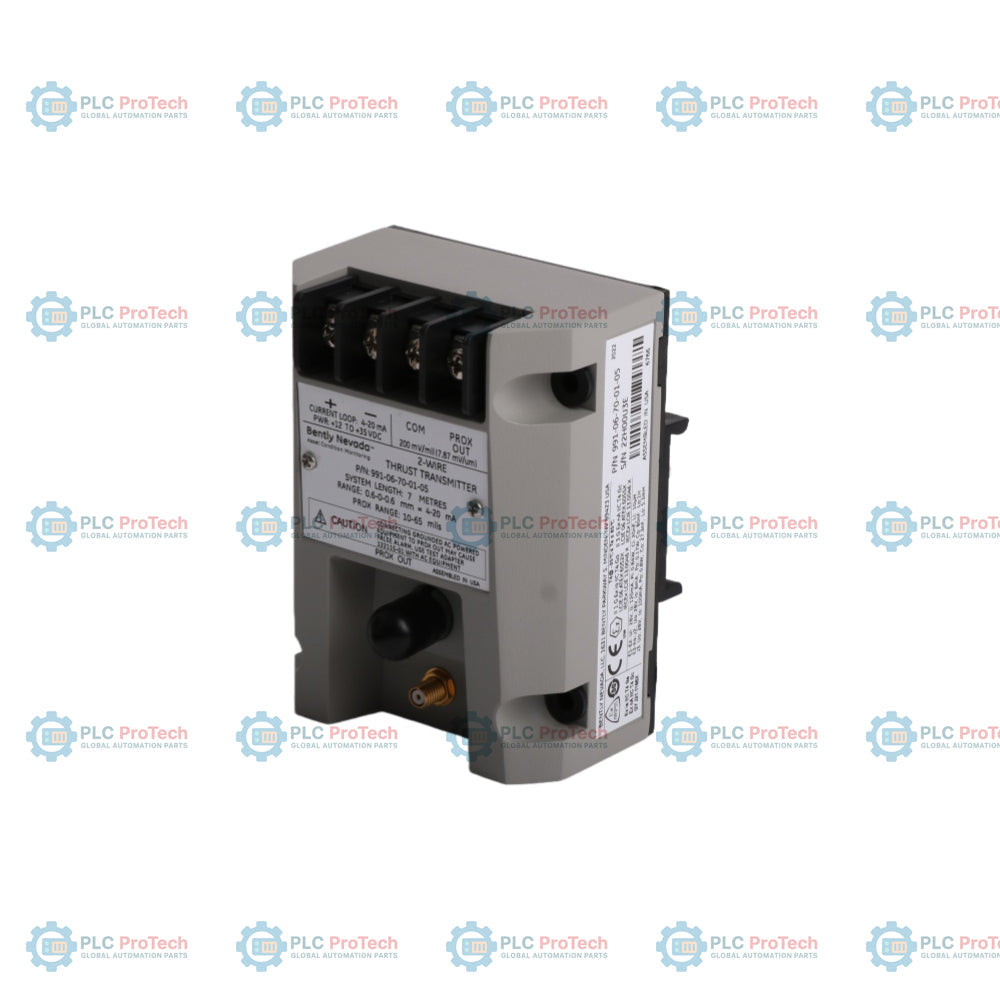
Le Bently Nevada 991-06-70-01-CN est un transmetteur de poussée 991 bifilaire alimenté par la boucle, conçu pour mesurer la position axiale de l’arbre et le déplacement de poussée des machines tournantes. Le transmetteur traite les signaux bruts d’un système de sondes de proximité compatible et les conditionne en une sortie stable de 4 à 20 mA CC directement proportionnelle au mouvement mécanique. Cette conception permet une intégration directe aux automates programmables, aux architectures DCS ou aux systèmes SCADA sans nécessiter de rack dédié de surveillance de la protection des machines. Elle fournit une surveillance continue et économique des équipements industriels critiques nécessitant le suivi du déplacement axial afin de prévenir une défaillance catastrophique des paliers de poussée.
Caractéristiques
- L’architecture bifilaire alimentée par la boucle réduit le câblage sur site et les coûts d’installation.
- La sortie analogique standard de 4 à 20 mA CC se connecte directement aux systèmes de contrôle-commande des procédés.
- La prise BNC en façade fournit un signal de tension brute mis en mémoire tampon pour les diagnostics et les collecteurs de données portables.
- La technologie de détection par courants de Foucault sans contact garantit un fonctionnement durable sans usure.
- Conception compacte et peu encombrante, adaptée au montage direct sur rail DIN haute densité.
Applications
- Surveillance du déplacement axial de poussée des compresseurs centrifuges
- Suivi de la position du rotor des turbines à vapeur et à gaz
- Alignement de l’arbre des pompes d’alimentation de chaudières haute pression
- Diagnostic de l’usure des paliers de poussée des réducteurs industriels
- Positionnement de l’arbre des ventilateurs à tirage forcé et à tirage induit
Informations de commande
- 991 : transmetteur de poussée
- 06 : compatibilité avec la sonde de proximité 3300 XL de 8 mm et une plage linéaire de 1,0 mm
- 70 : option de longueur de système de 7,0 mètres
- 01 : option de montage sur rail DIN de 35 mm
- CN : option d’homologation certifiée conforme aux normes régionales ou nationales spécialisées (Chine/NEPSI/GB)
Spécifications techniques
| Paramètre |
Spécification |
| Fabricant |
Bently Nevada |
| Pays d’origine |
États-Unis |
| Type de produit |
Transmetteur de poussée |
| Signal de sortie |
4 à 20 mA CC |
| Alimentation électrique |
17 à 30 VCC |
| Plage linéaire |
1,0 mm (environ 40 millièmes de pouce) |
| Température de fonctionnement du transmetteur |
-35 à +85 degrés Celsius (-31 à +185 degrés F) |
| Température de stockage du transmetteur |
-51 à +100 degrés Celsius (-60 à +212 degrés F) |
| Température de fonctionnement de la sonde |
-52 à +177 degrés Celsius (-62 à +351 degrés F) |
| Matériau du boîtier |
Acier zingué ou polymère structurel |
| Base de montage |
Montage sur rail DIN de 35 mm (ou configuration de montage sur cloison) |
| Poids du transmetteur |
0.43 kg (0.9 lbm) |
| Poids total du système |
0.82 kg (1.8 lbm) typique |
| Encombrement / dimensions de la base |
100.1 mm x 73.9 mm (3.94 po x 2.91 po) |
| Disposition des trous de montage (cloison) |
69.9 mm x 63.5 mm (2.75 po x 2.50 po) |
| Hauteur (avec clip DIN) |
53.3 mm (2.10 po) |
| Hauteur (corps uniquement) |
42.6 mm (1.68 po) |
| Diamètre du trou de montage |
5.8 mm (0.23 po), 4 emplacements |
Connexions / interfaces
| Broche du connecteur |
Fonction |
| +4-20mA / +VTX |
Alimentation positive / entrée de la boucle de courant |
| -4-20mA / -VTX |
Alimentation négative / retour de la boucle de courant |
| PROX |
Entrée du conducteur central de la sonde de proximité |
| COM |
Borne de référence commune / blindage coaxial |
| SHLD |
Borne de terre du blindage de l’instrument |
| Prise BNC |
Sortie de signal de tension dynamique (10.2 mV/micromètre) |
Directives d’installation
-
Fixation sur rail DIN : Fixez fermement le boîtier sur un rail DIN standard de 35 mm à l’aide des clips de fixation DIN intégrés, à l’intérieur d’un coffret industriel de protection classé IP54 ou supérieur.
-
Option de montage sur cloison : Vous pouvez également utiliser les 4 trous de montage (diamètre de $5.8 \text{ mm}$), espacés de $69.9 \text{ mm} \times 63.5 \text{ mm}$, pour les installations sur panneau plat ou cloison, avec les vis 6-32 x 1.326 fournies.
-
Procédure de blindage : Raccordez le blindage du câble du transducteur d’entrée à la borne SHLD. Le blindage de la boucle de commande externe doit être mis à la terre uniquement côté système de commande (API/DCS) afin d’éliminer les boucles de masse.
-
Écartement de la sonde : Réglez l’écartement physique de la sonde à l’aide d’un voltmètre numérique branché sur la prise BNC ou les bornes COM, afin de vérifier que le capteur se trouve dans sa plage de tension linéaire avant la mise en service.
-
Séparation du câblage : Acheminez tous les câbles des capteurs d’entrée et le câblage de la boucle de courant de sortie à l’écart des lignes CA haute tension ou des câbles de variateurs de fréquence afin de réduire les parasites EMI/RFI.
Conformité et certifications
- Variante CN approuvée (certifiée conforme aux exigences régionales applicables aux zones dangereuses, telles que les normes NEPSI / GB)
FAQ
Quelles sont les dimensions exactes du boîtier pour planifier l’agencement de l’armoire ?
L’encombrement de base mesure 100,1 mm de longueur sur 73,9 mm de largeur, avec une hauteur maximale de 53,3 mm lorsque le clip pour rail DIN de 35 mm est fixé.
Quelles sont les dimensions des trous alternatifs pour l’installation sur cloison ?
L’appareil comporte 4 trous de montage de 5,8 mm de diamètre, disposés selon un entraxe rectangulaire précis de 69,9 mm sur 63,5 mm.
Quelle est la fonction du connecteur BNC situé sur la face avant ?
Il fournit une sortie de tension brute, tamponnée et non conditionnée, destinée au raccordement d’instruments de diagnostic et d’analyseurs de signaux dynamiques, sans perturber la boucle de courant de 4 à 20 mA.
Cet appareil nécessite-t-il une ligne d’alimentation séparée ?
Non, il fonctionne entièrement sur l’alimentation de la boucle et reçoit directement sa tension de fonctionnement de la ligne de signal de 4 à 20 mA.
Que se passe-t-il si l’option de longueur du système ne correspond pas à la sonde ?
Le raccordement d’une combinaison sonde/câble d’extension ne correspondant pas à l’étalonnage spécifié de 7,0 mètres entraînera une forte non-linéarité de mesure et des erreurs de facteur d’échelle.
Ce transmetteur peut-il être installé en extérieur ?
Il doit être installé dans une boîte de jonction de terrain étanche aux intempéries, homologuée NEMA 4X ou IP65/66, afin de le protéger contre l’humidité, la poussière et la lumière directe du soleil.
La sortie du transmetteur est-elle compatible avec les cartes d’entrée analogique standard ?
Oui, la sortie de 4 à 20 mA se connecte directement aux cartes d’entrée analogique différentielles ou asymétriques standard de tout API ou DCS.
Que signifie le code de suffixe CN ?
Le suffixe CN indique la conformité à une certification régionale spécifique, correspondant généralement aux normes nationales chinoises de sécurité et relatives aux zones dangereuses.
L’appareil peut-il être étalonné sur site pour différentes plages linéaires ?
Non, la plage linéaire et les facteurs d’échelle sont précâblés et étalonnés en usine. Toute modification de plage nécessite une configuration différente du modèle.
Quel est l’effet de l’inversion de polarité de la boucle sur le transmetteur ?
L’appareil est doté d’une protection interne par diode contre l’inversion de polarité : il ne fonctionnera pas s’il est câblé à l’envers, mais ne sera pas endommagé.