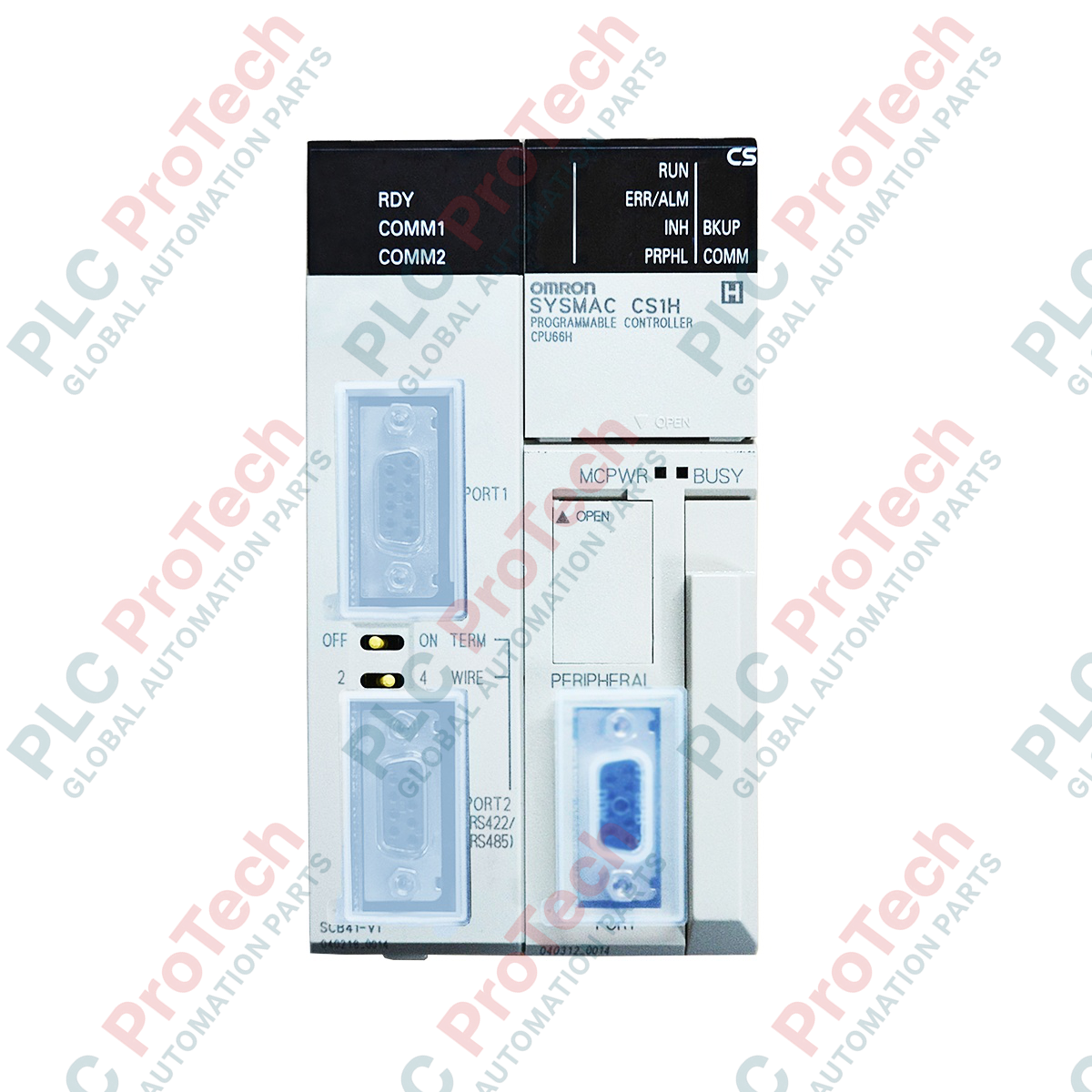
Présentation du produit
La Omron CS1W-SCB41-V1 est une carte de communication série haute performance conçue spécifiquement pour la série de PLC SYSMAC CS1. Contrairement aux modules de communication externes qui occupent un emplacement d’E/S standard, la CS1W-SCB41-V1 est une carte interne qui se monte directement dans un emplacement dédié « inner board » sur l’unité CPU CS1G/H. Cette intégration permet d’économiser un espace précieux dans le rack tout en offrant une interface de communication double port polyvalente : un port RS-232C et un port RS-422A/485. C’est un composant essentiel pour les systèmes industriels nécessitant un échange de données complexe avec des lecteurs de codes-barres, des systèmes de vision, des contrôleurs de température et des PLC tiers. Grâce à sa fonction intégrée Protocol Macro, la carte peut exécuter des séquences de communication personnalisées indépendamment du programme ladder du CPU, réduisant ainsi considérablement le temps de scan et simplifiant la gestion du code.
Configuration technique
L’architecture de la CS1W-SCB41-V1 est conçue pour gérer plusieurs protocoles de communication simultanément sans surcharger le processeur principal.
-
Polyvalence double port : Le port 1 (RS-232C) est idéal pour des connexions point à point à courte distance avec un HMI ou un appareil, tandis que le port 2 (RS-422A/485) supporte des réseaux multi-points jusqu’à 500 mètres.
-
Fonction Protocol Macro : Permet aux ingénieurs de créer des « macros » d’échange de données personnalisées à l’aide du logiciel CX-Protocol. Cela permet au PLC de communiquer avec presque n’importe quel appareil série en utilisant de simples instructions « PMCR » dans le ladder.
-
Modes de fonctionnement multiples : Supporte les modes Host Link (SYSMAC WAY), No-protocol (streaming RS-232C/422A), NT Link (pour connexion HMI 1:N) et Modbus-RTU esclave.
-
Échange de données à haute vitesse : La carte communique avec le CPU via un bus interne dédié, garantissant que les tampons de données série sont rafraîchis avec une efficacité maximale.
-
Amélioration V1 : La désignation « -V1 » signifie une compatibilité matérielle améliorée et une fiabilité accrue par rapport à la version originale non-V1, assurant une stabilité dans les environnements CS1 modernes.
Spécifications techniques
| Attribut |
Spécification |
| Modèle |
CS1W-SCB41-V1 |
| Marque |
Omron |
| Série PLC |
SYSMAC CS1G / CS1H / CS1D |
| Port 1 |
RS-232C (D-Sub 9 broches femelle) |
| Port 2 |
RS-422A / 485 (borne à vis) |
| Distance max. |
Port 1 : 15 m / Port 2 : 500 m |
| Débit en bauds |
1 200 à 115 200 bps |
| Consommation électrique |
280 mA à 5 VDC |
| Poids |
0,15 kg (net) / 1,5 kg (expédition) |
| Normes |
CE, UL, CSA |
FAQ techniques
Comment sélectionner entre RS-422A et RS-485 sur le Port 2 ?
La sélection se fait à l’aide d’un ensemble d’interrupteurs DIP matériels situés sur le côté de la carte et des réglages logiciels dans la configuration du PLC. Pour RS-485 (2 fils), il faut également shunter les bornes appropriées sur le bloc.
Cette carte peut-elle être utilisée dans un PLC des séries CJ1 ou CJ2 ?
Non. La CS1W-SCB41-V1 est une Inner Board conçue spécifiquement pour le facteur de forme physique de la série CS1. Pour les PLC de la série CJ, il faut utiliser les modules de la série CJ1W-SCU qui se montent sur le bus standard.
Quel est l’avantage du Protocol Macro par rapport au mode « No-protocol » ?
En mode « No-protocol », le CPU doit analyser manuellement chaque octet, ce qui est laborieux pour le programme ladder. Le Protocol Macro gère de manière autonome les sommes de contrôle, les tentatives de retransmission et les en-têtes de trame ; le CPU n’a qu’à envoyer ou recevoir les variables de données brutes.
Guide d’ingénierie et d’installation
-
Avertissement décharge électrostatique (ESD) : Comme il s’agit d’une carte interne sans boîtier plastique protecteur, elle est extrêmement sensible aux décharges électrostatiques. Portez toujours un bracelet de mise à la terre et assurez-vous que l’alimentation du PLC est complètement déconnectée avant d’ouvrir le capot du CPU pour insérer la carte.
-
Résistances de terminaison : Lors de l’utilisation du Port 2 dans un réseau multi-points RS-422A/485, assurez-vous que l’interrupteur de résistance de terminaison sur la carte est réglé sur ON uniquement si la carte se trouve à l’une des extrémités physiques du câble de communication. Une terminaison incorrecte est la cause la plus fréquente des erreurs de trame (« Frame Error »).
-
Blindage des câbles : Utilisez toujours des câbles torsadés blindés de haute qualité pour le Port 2. Connectez le blindage à la borne « GR » (masse) sur la carte pour évacuer les interférences électromagnétiques, surtout lorsque le câble passe à proximité de variateurs de fréquence (VFD) ou de contacteurs puissants.