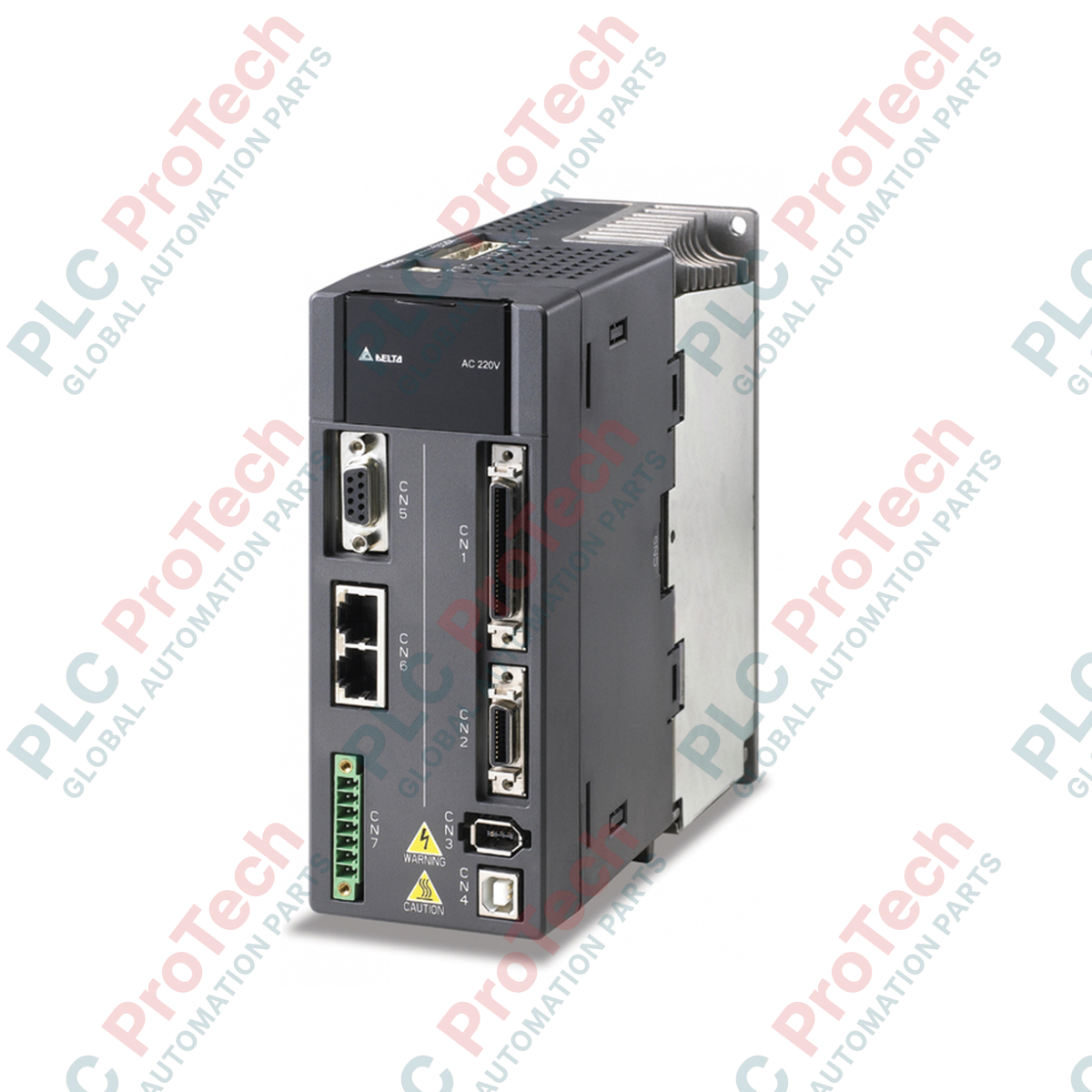
Présentation du contrôleur de mouvement réseau intelligent
Le ASD-A2-1521-F (ASD-A2-1521-F) est un servovariateur CA intelligent et hautes performances, conçu par Delta au sein de l’écosystème de commande phare de la série ASDA-A2. Fournissant une puissance de sortie robuste de 1,5 kW et fonctionnant sur une alimentation secteur monophasée polyvalente de 220 V CA, cet amplificateur numérique à large bande passante est conçu pour les applications industrielles à grande vitesse nécessitant une précision de positionnement déterministe et des capacités de mise en réseau flexibles. Dans des systèmes avancés d’atelier, tels que les machines automatisées de placement de composants électroniques, les portiques robotisés multiaxes, les cellules industrielles de conditionnement pharmaceutique et les lignes d’étiquetage haute précision, le ASD-A2-1521-F maintient une synchronisation optimale des machines et réduit les arrêts imprévus grâce à la came électronique intégrée, aux boucles d’enregistrement haute vitesse et à la suppression automatisée des résonances. Son architecture de bus de communication native permet une synchronisation en temps réel avec les couches d’automatisation de supervision.
Fonctions avancées d’automatisation et architecture matérielle
La conception interne de l’amplificateur ASDA-A2 de 1,5 kW est optimisée pour les boucles de commande de mouvement à faible latence et le traitement de trajectoires complexes :
-
Moteur E-Cam intégré : Intègre une fonction de came électronique (E-Cam) prenant en charge jusqu’à 720 points de positionnement macroscopique avec une interpolation interne fluide, idéale pour les mécanismes de coupe volante, de coupe rotative et de suivi maître-esclave.
-
Interface double en boucle fermée : Équipé d’une interface secondaire de retour de position capable de lire directement des règles linéaires ou des codeurs secondaires, éliminant les erreurs de jeu mécanique sur l’axe entraîné.
-
Noyau d’autoréglage en temps réel : Intègre des réseaux avancés de filtres coupe-bande automatisés qui identifient et neutralisent automatiquement les résonances structurelles à haute fréquence, protégeant ainsi la transmission mécanique contre la fatigue vibratoire.
-
Flexibilité de l'alimentation monophasée : l'optimisation du bus CC interne et l'équilibrage de la capacité permettent à l'amplificateur de fournir une sortie continue de 1,5 kW à partir de sources CA monophasées courantes de 220 V, réduisant ainsi la complexité du déploiement sur le réseau électrique.
Paramètres d'ingénierie critiques
L'aperçu des caractéristiques techniques suivant détaille les paramètres limites mécaniques, électriques et de performance vérifiés pour la configuration du système :
| Paramètre |
Caractéristiques techniques |
| Modèle |
ASD-A2-1521-F |
| Marque |
DELTA |
| Origine |
Taïwan |
| Classification du système d'entraînement |
Plateforme haute performance ASDA-A2 |
| Puissance de sortie nominale |
1,5 kW |
| Configuration de l'alimentation secteur |
220 V CA (monophasé, 50/60 Hz nominal) |
| Plage de tolérance de tension |
170 V CA à 255 V CA |
| Courant de sortie continu |
8,3 A |
| Code de configuration du modèle |
F (agencement intégré d'une interface spécialisée de communication et de commande de mouvement) |
| Suivi de la boucle de rétroaction |
Prend en charge les entrées d'encodeur optique absolu/incrémental 20 bits |
| Architecture du circuit de commande |
Commande SVPWM pilotée par un processeur de signal numérique (DSP) |
| Seuil de température ambiante |
0 à 55 °C (marge pour montage sur châssis standard) |
| Poids net de l'unité |
2,00 kg |
| Poids d'expédition |
4,00 kg |
Base de connaissances techniques et questions fréquentes
Quels avantages spécifiques en matière de commande de mouvement offre la classification du modèle de type F ?
La désignation de version de type « F » identifie une configuration dédiée au sein de la gamme ASDA-A2, dotant le matériel de réseaux de communication spécialisés et de structures de mémoire interne étendues pour le suivi de trajectoires à grande vitesse. Cela permet une synchronisation fluide avec les réseaux de contrôleurs de mouvement tout en conservant la prise en charge complète des mappages macro d'E/S TOR physiques haute densité.
Comment l'interface en boucle fermée à double entraînement empêche-t-elle les erreurs de positionnement de suivi ?
La conception à double boucle capture les données des deux l'encodeur 20 bits du moteur via la borne CN2 et une règle linéaire physique montée directement sur le chariot de la machine via la borne CN5. En calculant l'écart entre la rotation du moteur et le déplacement réel du chariot, le DSP interne ajuste en continu ses boucles de couple afin d'annuler les erreurs de suivi causées par l'usure des engrenages mécaniques, la dilatation thermique de la vis mère ou la déflexion de la courroie.
Des selfs de ligne externes sont-elles recommandées pour les installations monophasées de 1,5 kW ?
Oui. L’utilisation d’un servo-variateur haute capacité de 1,5 kW sur une ligne monophasée entraîne d’importants courants d’impulsion non linéaires, ce qui augmente la distorsion harmonique totale (THD) du réseau électrique de l’installation. L’installation d’une self de ligne CA externe correctement dimensionnée sur la ligne d’arrivée atténue ces courants harmoniques et protège les ponts redresseurs internes contre les surtensions.
Mise en service sur site et consignes de sécurité
-
Installation verticale de l’armoire et espacement thermique : Montez impérativement le servoamplificateur en orientation verticale sur un panneau métallique plat et incombustible afin de maximiser la circulation d’air par effet cheminée. Maintenez un espace structurel libre d’au moins 50 mm au-dessus et au-dessous du boîtier du variateur, et de 20 mm de chaque côté lors de l’agencement de composants en configuration haute densité. Veillez à ce que la température intérieure de l’armoire ne dépasse pas 55 °C.
-
Isolation contre le bruit des codeurs et des communications : Faites passer toutes les lignes de signaux de codeur 20 bits basse tension et les lignes de bus de communication dans des câbles blindés tressés continus. Maintenez ces chemins de signaux sensibles séparés des câbles d’alimentation CA haute tension et des câbles de sortie moteur MLI haute fréquence d’au moins 200 mm dans les chemins de câbles de l’armoire afin d’éviter l’injection de bruit électromagnétique haute fréquence et les pertes de données.
-
Dimensionnement de la dissipation de puissance régénérative : Pour les axes qui exécutent des cycles de décélération répétitifs à grande vitesse ou gèrent d’importantes surcharges gravitationnelles (comme les mécanismes de levage vertical), calculez l’énergie de freinage dissipée en continu. Si la capacité de régénération interne déclenche fréquemment des défauts de surtension, raccordez une résistance de freinage externe de puissance appropriée entre les bornes P et C, puis mettez à jour les paramètres internes du variateur afin de rediriger l’énergie.