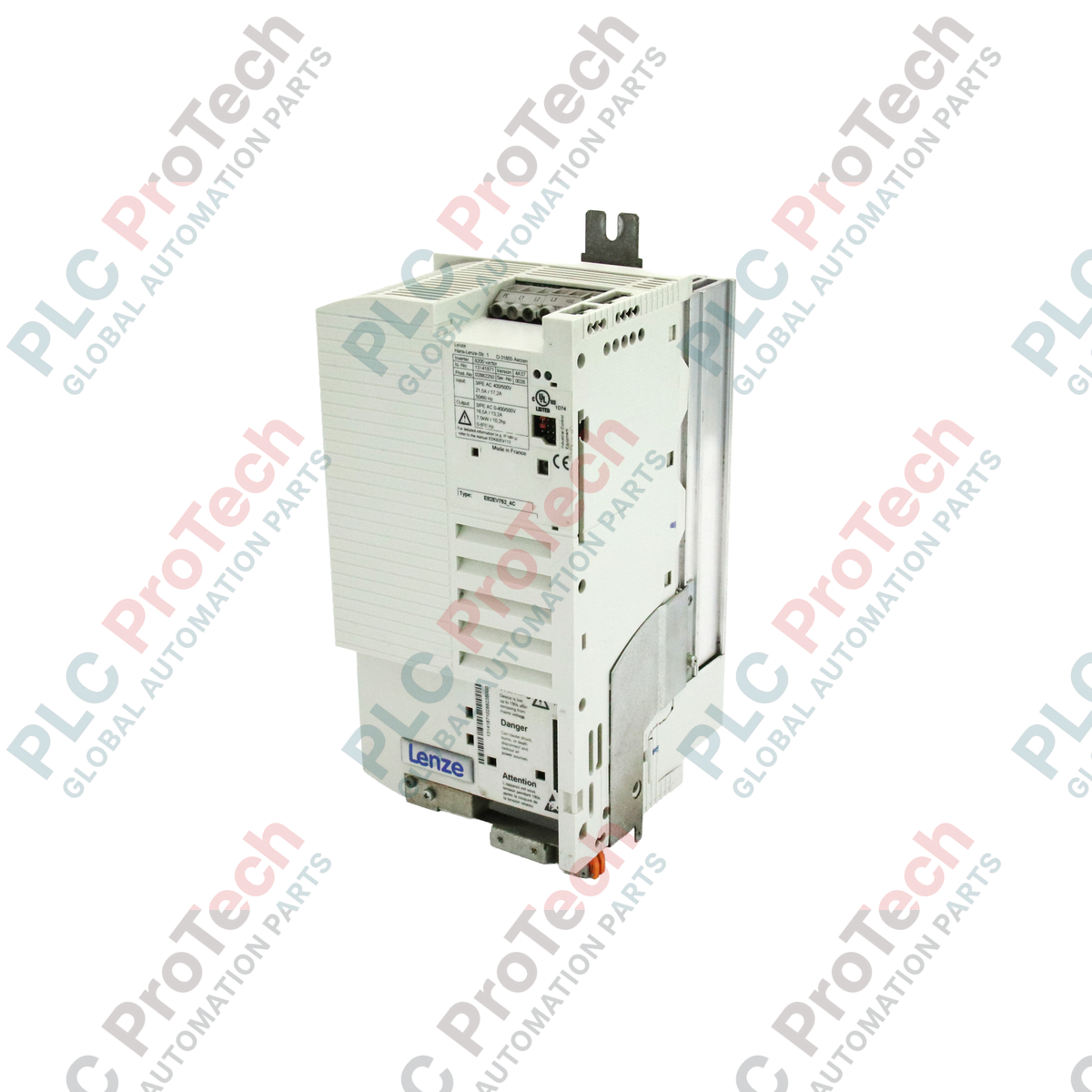
Présentation du produit
Le E82EV752_4C (E82EV752K4C) est un variateur de fréquence vectoriel haute capacité de la série 8200, conçu par Lenze pour les applications exigeantes de commande de moteurs nécessitant jusqu’à 7,5 kW (10 HP) de puissance. Fonctionnant sur une alimentation triphasée de 400 / 500 VAC, ce variateur constitue un élément essentiel des machines industrielles lourdes, notamment des stations de pompage de grande capacité, des mélangeurs industriels à couple élevé et des lignes de convoyage synchronisées dans les usines de production. La désignation « 4C » indique l’intégration de filtres antiparasites intégrés, qui protègent le variateur contre les perturbations électromagnétiques et préservent l’intégrité des signaux de commande voisins. Avec sa structure robuste de 5,00 kg et ses caractéristiques de commande vectorielle optimisées, le E82EV752_4C réduit les contraintes mécaniques et maximise l’efficacité énergétique, même dans les environnements exigeants du secteur B2B mondial. Bien qu’il soit arrivé en phase de retrait, il demeure un composant essentiel pour la maintenance et l’optimisation des infrastructures d’automatisation existantes.
Configuration technique
Le E82EV752_4C utilise une architecture sophistiquée de commande vectorielle qui fournit un couple de démarrage élevé et une régulation précise de la vitesse, même en cas de variations de charge. Cette plateforme « Global Drive » comporte un emplacement modulaire pour la communication par bus de terrain et prend en charge des protocoles tels que PROFIBUS, CANopen et LECOM-B afin de faciliter l’intégration transparente aux systèmes SCADA. Le matériel comprend un ensemble complet de fonctions de protection, notamment la surveillance I2t du moteur, la détection des courts-circuits et la protection contre les surtensions. Son étage de puissance est conçu pour offrir une grande fiabilité et peut gérer d’importantes surcharges transitoires. Le micrologiciel de l’unité permet de paramétrer de manière avancée les rampes en S d’accélération et de décélération ainsi que le freinage par injection de courant continu, assurant la souplesse mécanique requise pour les processus industriels sensibles.
Caractéristiques techniques
| Caractéristique |
Spécification |
| Modèle |
E82EV752_4C / E82EV752K4C |
| Marque |
Lenze |
| Série |
8200-Series Vector |
| Puissance nominale de sortie |
7.5 kW (10 HP) |
| Tension d’entrée |
3 Phase 400 / 500 VAC |
| Courant nominal de sortie |
16.5 A (at 400 V) |
| Antiparasitage |
Integrated / Built-in Filter |
| Dimensions |
25.50 x 30.50 x 12.50 cm |
| Poids |
5.00 kg |
| Indice de protection |
IP20 |
| Température de fonctionnement |
0 to +45 deg C (Up to 55 deg C with derating) |
| État du produit |
Phase-Out |
FAQ techniques
Le E82EV752_4C prend-il en charge le freinage régénératif pour les charges à forte inertie ?
Le variateur comprend un hacheur de freinage interne ; toutefois, pour les applications générant une quantité importante d’énergie régénérative (comme les grands ventilateurs centrifuges), une résistance de freinage externe doit être raccordée aux bornes afin de dissiper l’énergie sous forme de chaleur et d’éviter les déclenchements « OU » (surtension).
Quelle est la principale différence entre les séries 8200 et 9300 ?
La série 8200 est un variateur de fréquence polyvalent principalement conçu pour la commande de vitesse des moteurs asynchrones standard. En revanche, la série 9300 est un système servo dédié au positionnement dynamique et à la commande des moteurs synchrones.
Puis-je utiliser ce variateur de 7,5 kW à une température ambiante plus élevée ?
Oui, il peut fonctionner jusqu’à 55 deg C, mais vous devez appliquer une réduction de courant d’environ 2.5% par degré Celsius au-dessus de 45 deg C afin de protéger les composants électroniques de puissance internes contre les contraintes thermiques.
Guide d’ingénierie et d’installation
-
Refroidissement et circulation de l’air : En raison de sa puissance nominale de 7,5 kW, cette unité génère une quantité importante de chaleur. Elle doit être montée verticalement sur une surface plane et non inflammable. Veillez à laisser un dégagement minimal de 100 mm au-dessus et au-dessous de l’unité afin de permettre une circulation de l’air sans obstruction à travers le dissipateur thermique.
-
Câblage conforme CEM : Pour préserver l’efficacité de l’antiparasitage intégré, utilisez uniquement des câbles moteur blindés. Le blindage doit être raccordé au rail PE à l’aide d’un collier conducteur à 360 degrés. Évitez la mise à la terre en queue de cochon, car elle augmente l’impédance haute fréquence et réduit les performances CEM.
-
Temps de décharge de sécurité : Les condensateurs du bus continu interne emmagasinent une charge potentiellement mortelle. Après avoir déconnecté l’alimentation secteur de 400/500 V, attendez au moins 10 minutes avant de toucher une borne quelconque. Vérifiez toujours que la tension entre +UG et -UG est inférieure à 50 VDC à l’aide d’un multimètre certifié avant de commencer toute intervention.