Présentation du produit
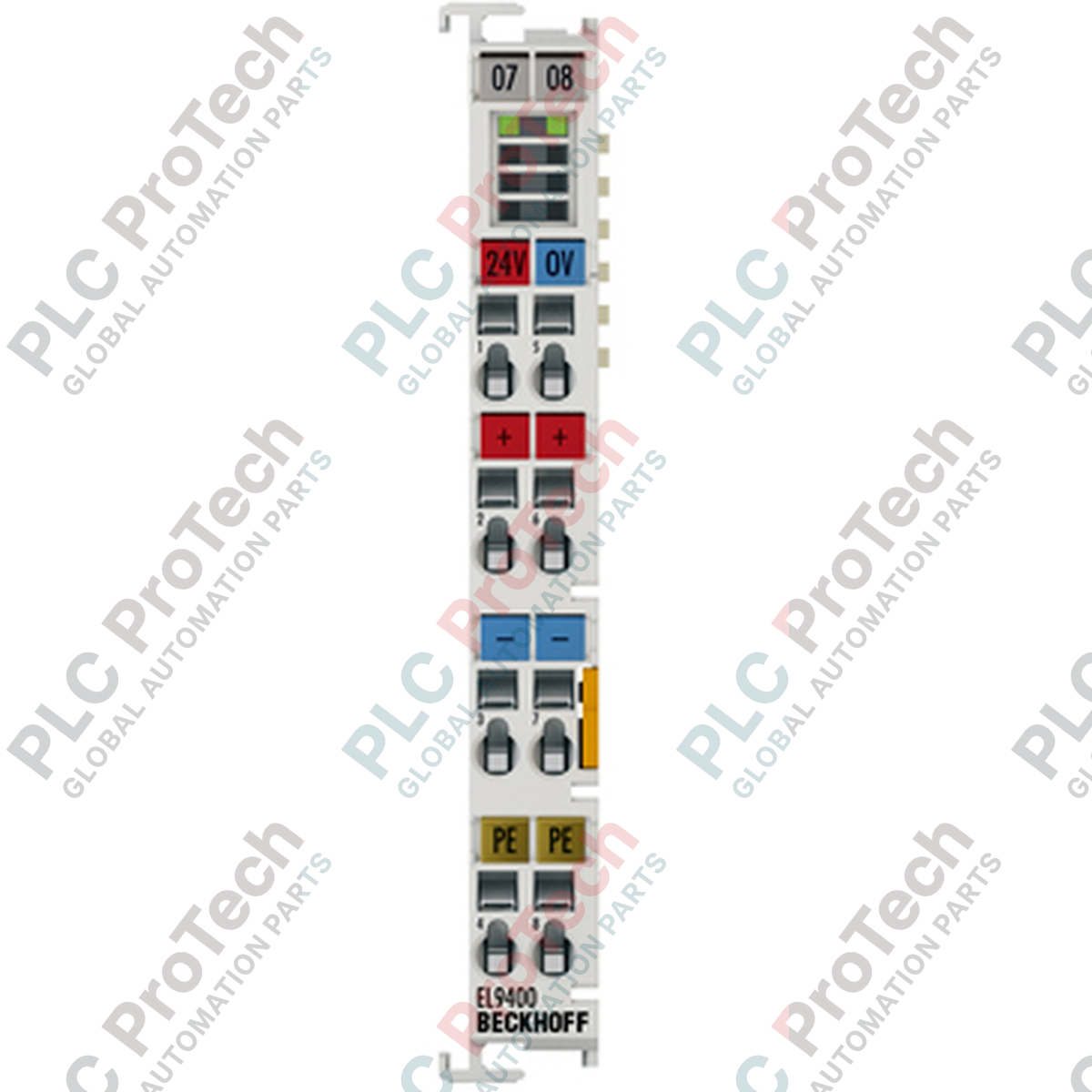
Le EL9400 (EL9400) est un terminal d'alimentation haute efficacité conçu pour rafraîchir le signal et l'alimentation E-bus au sein d’un bloc de terminaux EtherCAT. Dans les systèmes d'automatisation industrielle à grande échelle — tels que les lignes d'assemblage à grande vitesse, les machines d'emballage et les systèmes de commande de mouvement multi-axes — la consommation de courant interne de l’E-bus peut dépasser la capacité du coupleur principal. Le EL9400 comble cette lacune en convertissant une entrée 24 VCC en une alimentation stabilisée de 5 VCC, fournissant jusqu’à 2 A pour l’électronique de communication E-bus en aval. Cela garantit une transmission de données stable et prévient la dégradation du signal sur des stations d’E/S étendues. En isolant le potentiel terrain du potentiel logique avec une isolation électrique de 500 V, le terminal protège également les unités processeur sensibles contre les parasites électriques et les surtensions survenant côté terrain.
Configuration technique
Le EL9400 sert de module de gestion d’alimentation à double fonction. Mécaniquement, il prolonge les contacts d’alimentation 24 VCC (jusqu’à 10 A) vers les terminaux suivants pour l’alimentation des dispositifs terrain. Électroniquement, il termine le segment E-bus précédent et initie un nouveau segment d’alimentation pour la logique de communication interne. Ce module est essentiel lorsque la consommation totale de courant de la logique E-bus des terminaux connectés dépasse la limite d’alimentation du coupleur de bus ou du terminal d’alimentation précédent. L’unité supporte un câblage enfichable pour tous les boîtiers de la série ESxxxx, facilitant la maintenance rapide et le remplacement matériel sans déconnecter le faisceau principal.
Caractéristiques techniques
| Caractéristique |
Spécification |
| Modèle |
EL9400 |
| Marque |
BECKHOFF |
| Tension d'entrée |
24 V CC (-15 % / +20 %) |
| Tension de sortie |
5 V CC (pour alimentation E-bus) |
| Courant de sortie |
2 A |
| Courant d'entrée |
Typ. 70 mA + (E-bus / 4) |
| Contacts d’alimentation |
Max. 24 V CC / Max. 10 A |
| Isolation électrique |
500 V (E-bus / potentiel terrain) |
| Type de connexion |
À ressort (enfichable pour série ES) |
| Température de fonctionnement |
-25 à 60 °C |
| Dimensions |
12 mm x 100 mm x 68 mm |
| Poids |
Environ 65 g |
FAQ techniques
Quand est-il obligatoire d’ajouter un EL9400 à mon segment de terminal EtherCAT ?
Vous devez intégrer un EL9400 lorsque la consommation cumulée de courant de l’E-bus (généralement 5 V) pour tous les terminaux connectés dépasse la capacité de sortie de votre coupleur (souvent 1000 mA ou 2000 mA). Cela est fréquent dans les segments comportant des modules analogiques à haute densité ou des terminaux fonctionnels complexes.
Le EL9400 peut-il alimenter les capteurs et actionneurs terrain ?
Le EL9400 transmet l’alimentation terrain 24 VCC via ses contacts d’alimentation internes (jusqu’à 10 A), mais sa fonction électronique principale est de générer l’alimentation logique 5 V pour l’E-bus. Si vous avez seulement besoin de rafraîchir l’alimentation terrain (24 VCC) sans ajouter de courant E-bus, un terminal d’alimentation EL9100 ou EL9110 peut être plus adapté.
Le EL9400 nécessite-t-il une configuration logicielle dans TwinCAT ?
Le EL9400 est un module matériel passif et transparent vis-à-vis du protocole EtherCAT ; il n’occupe pas d’adresse dans l’image de processus. Cependant, il doit être correctement positionné dans la configuration physique et topologique dans TwinCAT pour calculer précisément le budget d’alimentation du segment E-bus.
Guide d’ingénierie et d’installation
-
Calcul du budget d’alimentation : Avant l’installation, utilisez l’outil « Comparaison de projet » de TwinCAT ou un calcul manuel pour additionner les besoins en courant E-bus de tous les modules en aval. Assurez-vous que le total ne dépasse pas la limite de 2 A du EL9400. Une surcharge de l’alimentation E-bus entraînera des erreurs de communication intermittentes ou des défauts « Invalid V30 State ».
-
Isolation du segment : Le EL9400 fournit une isolation électrique de 500 V entre l’E-bus et les contacts d’alimentation. Pour maintenir cette intégrité, veillez à ce que l’alimentation 24 VCC alimentant le EL9400 soit propre et séparée des circuits à charges inductives à fort bruit autant que possible.
-
Efficacité du câblage : Lors de l’utilisation de la variante ES9400 (enfichable), utilisez les connecteurs codés pour éviter les erreurs de câblage lors du remplacement sur le terrain. Assurez-vous que l’entrée 24 VCC est câblée avec une section minimale de 0,75 mm² pour supporter la charge potentielle de 10 A passant par les contacts d’alimentation vers les terminaux suivants.