Description
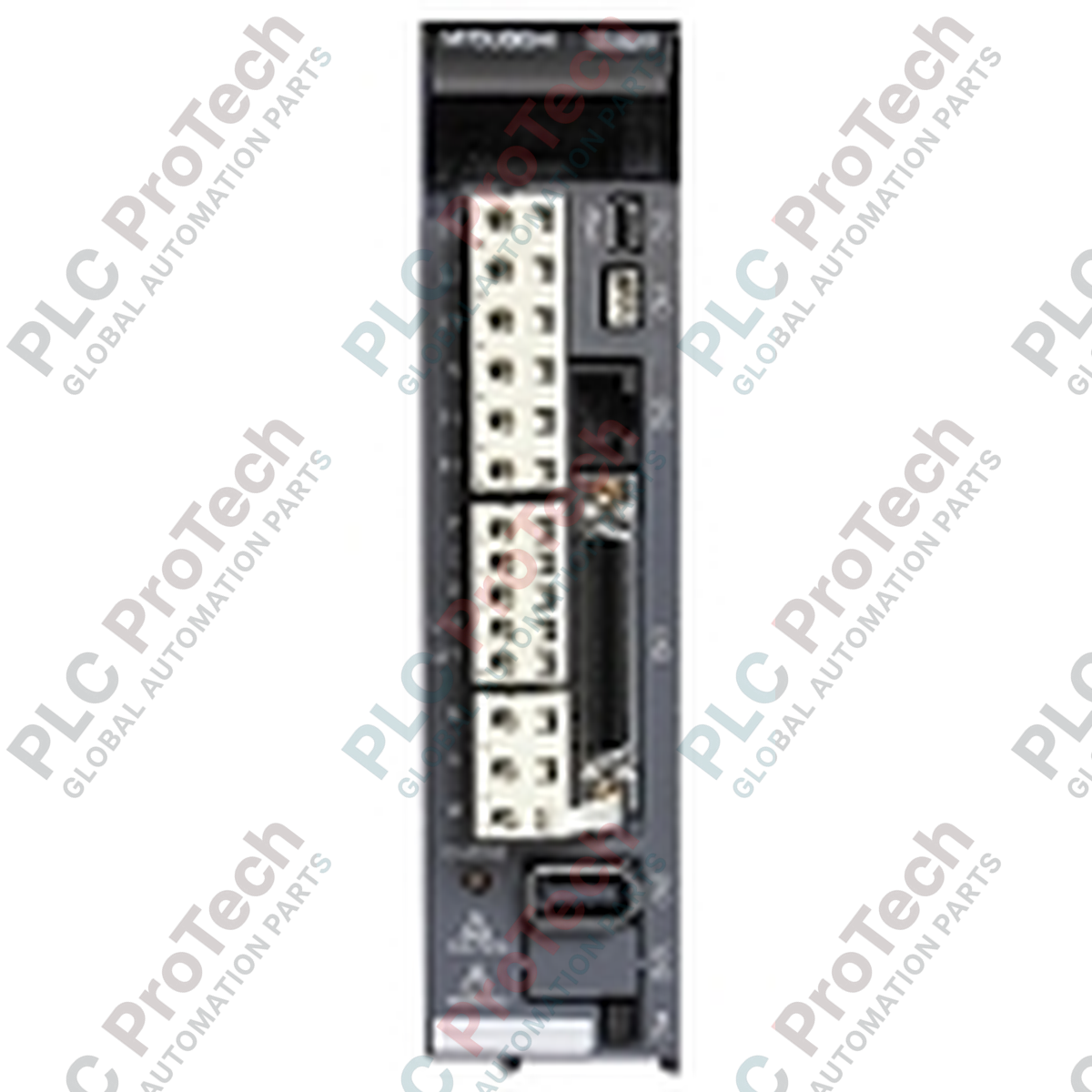
Pour répondre aux exigences complexes du contrôle de mouvement multiaxe, le Mitsubishi Electric MR-J3-500B coordonne la synchronisation de trajectoires continues et le positionnement précis sur un réseau haut débit à fibre optique. Issu de la famille de produits MELSERVO J3, cet amplificateur servo de 5,0 kW s’intègre directement aux contrôleurs de mouvement via le bus de communication SSCNET III, réduisant la sensibilité au bruit électrique grâce à l’isolation optique. L’unité traite les signaux de retour de codeurs absolus/incrémentaux haute résolution de 18 bits, ce qui lui permet de maintenir une vitesse parfaitement constante et d’exécuter des algorithmes de suppression des vibrations sur des profils de charge dynamiques.
Caractéristiques techniques principales
-
Interface SSCNET III : Bus de communication haut débit à fibre optique fonctionnant à 50 Mbit/s avec un temps de cycle de 0,44 ms, empêchant les interférences électromagnétiques externes (EMI).
-
Contrôle avancé de suppression des vibrations : Supprime les oscillations résiduelles en fin de positionnement, réduisant ainsi la fatigue mécanique dans les systèmes à bras long ou à forte inertie.
-
Compatibilité avec le retour haute résolution : Se connecte parfaitement à des codeurs rotatifs 18 bits (262 144 impulsions/tr) pour une résolution de positionnement exceptionnelle et une grande stabilité de la boucle de vitesse.
-
Auto-réglage adaptatif en temps réel : Calcule automatiquement les paramètres de gain optimaux en fonction du calcul continu du rapport d’inertie pendant le fonctionnement actif de la machine.
-
Encombrement thermique compact : Un système de conduits de refroidissement interne hautement efficace et un ensemble ventilateur interne évacuent la chaleur des modules adjacents de l’armoire de commande.
Applications industrielles
- Usinage CNC multiaxe, systèmes à portique et machines de détourage.
- Machines d’emballage à grande vitesse, encartonneuses rotatives et machines verticales de formage-remplissage-scellage.
- Systèmes d’enregistrement de presses d’imprimerie de précision et systèmes d’enroulement avec contrôle de la tension.
- Manutention automatisée des matériaux, robots de prise et de dépose pour charges lourdes et positionneurs de soudage automobile.
Spécifications techniques
| Paramètre |
Valeur de spécification |
| Fabricant |
Mitsubishi Electric |
| Numéro de modèle |
MR-J3-500B |
| Série de produits |
Série MELSERVO-J3 (type réseau SSCNET III) |
| Puissance de sortie nominale |
5,0 kW (5000 W) |
| Alimentation du circuit principal |
Triphasé 200 à 230 V CA, 50/60 Hz |
| Alimentation du circuit de commande |
Monophasé 200 à 230 V CA, 50/60 Hz |
| Système de commande |
Commande PWM à onde sinusoïdale, système de commande du courant |
| Interface de communication |
SSCNET III (bus série optique haut débit) |
| Réponse en fréquence de vitesse |
2100 Hz |
| Température ambiante de fonctionnement |
0 à 55 °C (sans gel) |
| Méthode de refroidissement |
Ventilateur de refroidissement forcé (intégré) |
| Pays d’origine |
Japon |
| Poids d’expédition (calculé) |
6,0 kg (environ 13,2 lb) |
| Dimensions de l’emballage (calculées) |
280 mm x 150 mm x 220 mm |
Connexions et interfaces
| Borne / connecteur |
Fonction / affectation du circuit |
| CN1A |
Connecteur à fibre optique SSCNET III (connexion vers le contrôleur/en amont) |
| CN1B |
Connecteur à fibre optique SSCNET III (connexion vers le variateur suivant/en aval) |
| CN2 |
Interface de retour d’information de l’encodeur du servomoteur (retour absolu/incrémental 18 bits) |
| CN3 |
Interface d’E/S externe (interrupteurs de fin de course, arrêt d’urgence, entrées de détecteur de point proche) |
| L1 / L2 / L3 |
Bornes d’alimentation principale (entrée triphasée 200-230 V CA) |
| L11 / L21 |
Bornes d’alimentation du circuit de commande (entrée monophasée 200-230 V CA) |
| U / V / W |
Bornes de sortie du servomoteur (phases de sortie vers les enroulements du moteur) |
| P / C / D |
Points de raccordement de l’option de freinage régénératif externe |
Observations d’ingénierie empiriques
Modèles alternatifs et compatibilité
Le modèle réseau direct MR-J3-500B fonctionne avec les protocoles SSCNET III et n’est pas directement compatible avec les contrôleurs SSCNET II ni avec les réseaux analogiques ou à train d’impulsions standard (variateurs de type A). Lors de la modernisation d’une machine ancienne équipée d’un variateur MR-J2S-500B, vous devez remplacer les câbles d’encodeur standard et mettre à niveau le contrôleur vers un contrôleur de mouvement Q-Series compatible (tel que Q172HCPU ou QD75MH4) ou vers un module de positionnement L-Series afin de prendre en charge l’interface optique.
Pièges d’application et notes d’ingénierie
Avec une puissance nominale de 5,0 kW, ce variateur génère des pertes thermiques continues pouvant atteindre 300 W lors de profils d’accélération à pleine charge. Lors de l’agencement des armoires, veillez à maintenir un espace libre minimal de 40 mm au-dessus et au-dessous de l’amplificateur. Si vous installez plusieurs amplificateurs sur une même rangée, maintenez un dégagement d’au moins 10 mm entre les variateurs afin d’éviter les effets thermiques mutuels et le déclenchement prématuré des défauts de protection thermique (AL.45 ou AL.46).
Conseils de mise en service et de câblage
Ne dépassez jamais la stricte limite de rayon de courbure de 25 mm des câbles à fibre optique SSCNET III reliant CN1A et CN1B. Le dépassement de cette limite dégrade la transmission optique et provoque des défauts intermittents AL.16 (erreur de communication SSCNET). Utilisez toujours des capuchons de protection en plastique sur les ports optiques inutilisés afin d’empêcher l’infiltration de poussière ou de brouillard d’huile, qui dégrade durablement les optiques du récepteur interne.
Directives d’installation
AVERTISSEMENT DE SÉCURITÉ CRITIQUE
Avant toute opération de câblage, d’installation mécanique ou de maintenance sur les borniers de puissance, isolez le disjoncteur principal. Les condensateurs haute tension conservent une charge potentiellement mortelle. Vérifiez que le voyant rouge CHARGE situé sur la face avant du MR-J3-500B est complètement éteint. Mesurez la tension du bus CC entre les bornes P(+) et N(-) à l’aide d’un multimètre numérique correctement homologué afin de vérifier qu’elle est descendue sous 50 VCC.
1
Montez le servoamplificateur verticalement sur une surface métallique plane et rigide, à l’intérieur d’une armoire de commande exempte de poussière et de brouillard d’huile, présentant un indice de protection IP54 ou supérieur.
2
Raccordez solidement la borne de terre de protection principale (PE) à la plaque principale de mise à la terre en cuivre de l’armoire à l’aide de tresses de terre souples de forte section afin de réduire les bruits haute fréquence.
3
Raccordez l’alimentation CA triphasée à L1, L2 et L3 au moyen d’un disjoncteur de dérivation et d’un contacteur électromagnétique. Raccordez l’alimentation du circuit de commande aux bornes L11 et L21.
4
Connectez le câble de sortie moteur dédié à U, V et W en veillant à respecter exactement la correspondance des phases avec les bornes du servomoteur. Ne raccordez jamais directement l’alimentation secteur CA aux bornes moteur U, V ou W.
5
Branchez le câble de l’encodeur sur CN2, puis branchez les fibres optiques du bus SSCNET III sur CN1A et CN1B en vérifiant qu’elles s’enclenchent correctement. Utilisez le logiciel standard MR-configurator pour la configuration du diagnostic.