Description
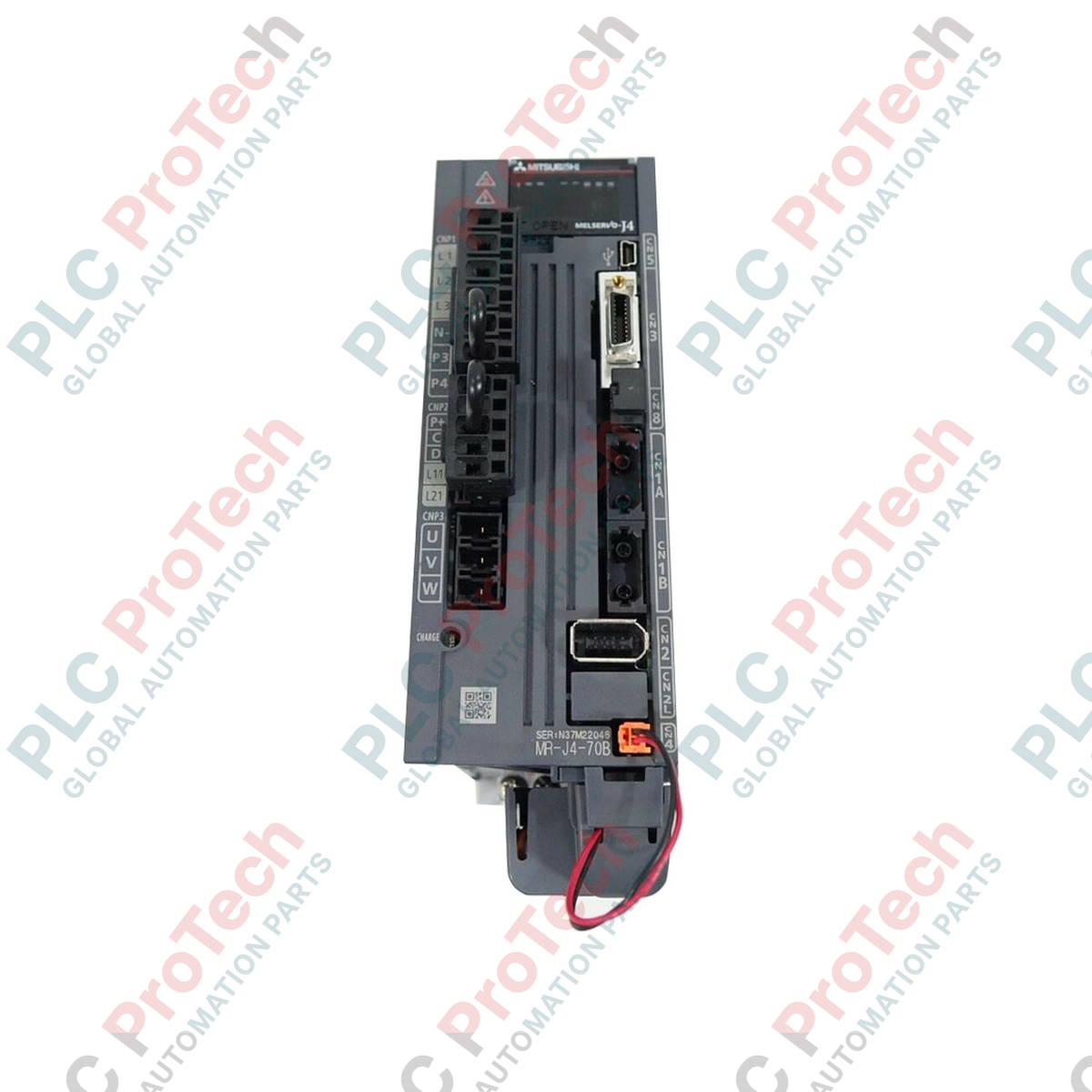
Conçu pour le contrôle de mouvement haute performance, le Mitsubishi Electric MR-J4-70B est un amplificateur servo qui assure un contrôle précis de la position, de la vitesse et du couple au sein de l’écosystème MELSERVO-J4. Avec une puissance de sortie de 0,75 kW, cet amplificateur de classe 200 V s’interface nativement avec les contrôleurs de mouvement via le réseau optique synchrone ultrarapide SSCNET III/H, optimisant les temps de cycle jusqu’à 0,222 ms. Sa fonction de sécurité Safe Torque Off (STO) intégrée et ses filtres dynamiques de suppression des vibrations garantissent la protection des machines et un débit mécanique maximal dans les lignes d’automatisation industrielle exigeantes.
Caractéristiques principales
-
Interface de commande SSCNET III/H : le réseau à fibre optique permet des communications rapides et insensibles au bruit, avec des cycles de synchronisation de 0,222 ms, 0,444 ms ou 0,888 ms.
-
Fonctions de sécurité intégrées : intègre la fonction STO (Safe Torque Off), certifiée selon la catégorie 3 PL e de la norme EN ISO 13849-1 et le niveau SIL 3 de la norme IEC 61508, pour une mise hors tension rapide du moteur.
-
Réglage dynamique et filtres : l’autoréglage en temps réel, associé à une suppression adaptative des vibrations, à des filtres robustes et à une compensation du jeu, réduit les temps de stabilisation et la résonance de la machine.
-
Configurations d’alimentation polyvalentes : prend en charge les configurations d’entrée monophasées ou triphasées de 200 V à 240 V CA.
Applications
- Systèmes de positionnement multiaxes et machines d’emballage pick-and-place à grande vitesse.
- Plateformes de manipulation de semi-conducteurs de précision et tables d’indexage rotatives.
- Lignes d’assemblage automatisées à trajectoire continue nécessitant des réseaux synchronisés à plusieurs variateurs.
Spécifications techniques
| Paramètre |
Spécification |
| Fabricant |
Mitsubishi Electric |
| Numéro de modèle |
MR-J4-70B |
| Série de produits |
Série MELSERVO-J4 |
| Puissance nominale de sortie |
0,75 kW |
| Tension nominale de sortie |
CA triphasé 170 V |
| Courant nominal de sortie |
5,8 A |
| Entrée d’alimentation du circuit principal |
CA triphasé ou monophasé de 200 V à 240 V, 50 Hz / 60 Hz |
| Courant nominal du circuit principal |
3,8 A |
| Entrée d’alimentation du circuit de commande |
CA monophasé de 200 V à 240 V, 50 Hz / 60 Hz |
| Courant et puissance du circuit de commande |
0,2 A / 30 W |
| Interface de commande |
Interface SSCNET III/H |
| Méthode de commande |
Commande PWM à onde sinusoïdale, système de commande du courant |
| Résistance de régénération intégrée |
20 W |
| Sécurité fonctionnelle |
STO (IEC/EN 61800-5-2), EN ISO 13849-1 catégorie 3 PL e, SIL 3 |
| Classe de protection IP |
IP20 (refroidissement naturel / conception ouverte) |
| Température ambiante de fonctionnement |
0 °C à 55 °C (sans gel) |
| Poids |
1,4 kg |
| Poids d’expédition (calculé) |
4,0 kg |
Connexions et interfaces
| Connecteur / Bornier |
Affectation des signaux / circuits |
| L1, L2, L3 |
Entrée d’alimentation CA du circuit principal (triphasée ou monophasée) |
| L11, L21 |
Entrée d’alimentation CA du circuit de commande (monophasée) |
| U, V, W |
Sortie d’alimentation du servomoteur (phases U, V, W) |
| P+, C |
Connexions de la résistance de régénération externe |
| CN1A / CN1B |
Connecteurs de bus à fibre optique SSCNET III/H (entrée / sortie) |
| CN2 |
Interface de retour de l’encodeur du servomoteur |
| CN5 |
Port USB pour la communication avec un PC (MR Configurator 2) |
| CN8 |
Connecteur de sécurité fonctionnelle STO (Safe Torque Off) |
Constats techniques empiriques
Modèles alternatifs et compatibilité
Le MR-J4-70B prend en charge un mode de compatibilité J3 intégré, permettant la mise en service dans d’anciennes architectures de systèmes SSCNET III basées sur le MR-J3. Cela permet de remplacer directement le matériel, tant physiquement que fonctionnellement, sur des configurations de machines existantes, sans nécessiter immédiatement la réécriture du logiciel ou du contrôleur maître. Notez qu’en mode de compatibilité J3, la vitesse de communication par défaut est de 50 Mbps, au lieu de la capacité native de 150 Mbps du SSCNET III/H.
Pièges liés à l’application et remarques techniques
Bien que le MR-J4-70B puisse fonctionner avec une alimentation CA monophasée, l’utilisation du système avec des cycles de charge très dynamiques peut solliciter la banque de condensateurs du bus continu interne. Veillez à ce que l’agencement de votre panneau préserve un espacement minimal de 10 mm de chaque côté de l’amplificateur lorsque plusieurs unités sont montées côte à côte, car le refroidissement par convection naturelle dépend strictement d’un flux d’air vertical dégagé. Pour les fonctionnements cycliques intensifs ou les écarts importants d’inertie, vérifiez si la capacité de régénération interne de 20 W est suffisante ; dans le cas contraire, une résistance de régénération externe doit être ajoutée entre les bornes P+ et C, après déconnexion de la résistance interne.
Conseils de mise en service et de câblage
Ne touchez jamais les faces polies des câbles à fibre optique SSCNET III/H. La poussière, l’humidité ou de légères traces de graisse peuvent atténuer le signal optique, provoquant des dépassements de délai de communication ou des pertes intermittentes de paquets cycliques. Veillez à ce que le rayon de courbure de la fibre ne soit jamais inférieur à 25 mm. De plus, isolez les lignes de commande basse tension et de retour (CN2/CN8) du câblage de puissance (U/V/W et L1/L2/L3) en les faisant passer dans des conduits métalliques dédiés et mis à la terre.
Directives d’installation
AVERTISSEMENT CRITIQUE :
PRÉSENCE D’UNE TENSION DANGEREUSE. Déconnectez et mettez hors tension toutes les alimentations principales et de commande avant toute installation physique ou tout câblage des bornes. Attendez au moins 15 minutes pour permettre la décharge des condensateurs du bus interne. Utilisez un voltmètre numérique fiable pour confirmer que la tension du bus continu est nulle entre les bornes P+ et N- avant de toucher aux bornes.
1
Montez l’amplificateur verticalement sur un panneau arrière plat et ininflammable, à l’aide de matériel de montage standard, afin de garantir une circulation d’air convective correcte dans les canaux de refroidissement.
2
Établissez une liaison de terre de protection fiable via les bornes de terre dédiées afin de réduire les parasites électriques et de prévenir les risques d’électrocution.
3
Câblez l’alimentation de commande (L11/L21) et les bornes d’entrée du circuit principal (L1/L2/L3), en veillant à installer en amont des fusibles ou disjoncteurs de protection de circuit appropriés.
4
Connectez le câble de l’encodeur à CN2 et les fibres optiques SSCNET III/H à CN1A/CN1B, en vérifiant que les protecteurs antipoussière optiques restent propres et soient rangés en lieu sûr.