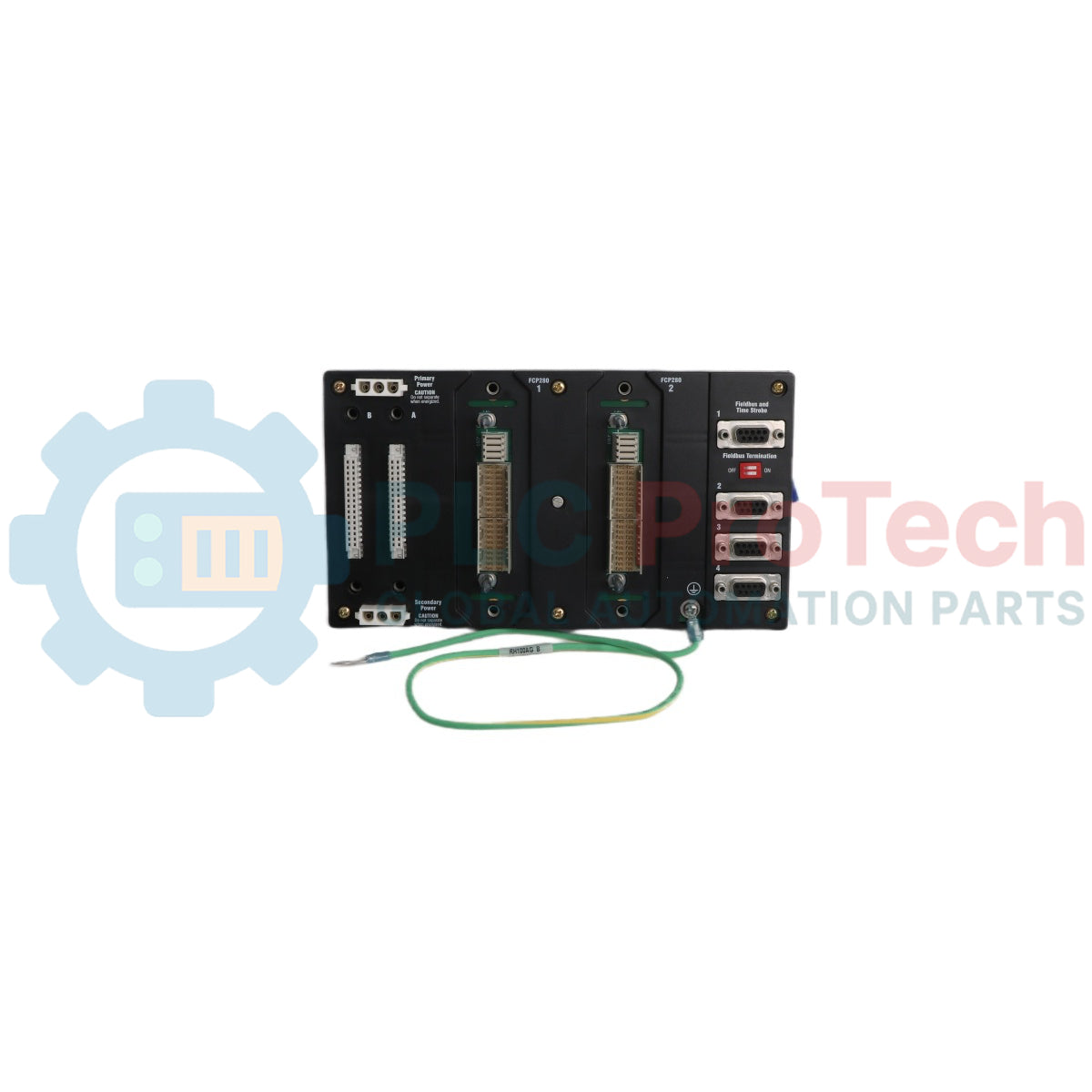
Présentation du produit
Le RH924YF (RH924YF) est une plaque de base modulaire haute performance montée sur rail DIN, spécialement conçue pour la série Foxboro I/A (maintenant EcoStruxure Foxboro DCS). Il sert d'infrastructure fondamentale de montage et d'interconnexion pour le Field Control Processor 280 (FCP280). Dans des environnements de contrôle distribués critiques—tels que les installations pétrolières et gazières mondiales, les usines pharmaceutiques et les réseaux de services publics à grande échelle—le RH924YF offre la stabilité mécanique et le bus arrière électrique nécessaires pour que le FCP280 gère des algorithmes de contrôle complexes et une communication Fieldbus à haute vitesse. Sa conception modulaire permet une expansion flexible du système tout en garantissant que les processeurs de contrôle restent solidement fixés et interconnectés dans l’enceinte industrielle.
Configuration technique (détail approfondi)
Le RH924YF est conçu pour supporter la redondance double processeur et les exigences d’échange de données à haute vitesse du FCP280.
-
Emplacements processeurs : La plaque de base dispose de deux emplacements dédiés pour les modules FCP280, permettant une configuration en paire redondante (tolérante aux pannes). Cela garantit qu’en cas de défaillance du processeur principal, le secondaire prend le relais sans interruption du processus.
-
Bus arrière Fieldbus interne : Elle contient un bus arrière de communication à haute vitesse facilitant le transfert de données entre les FCP280 et les modules Field Bus (FBM) connectés via le Fieldbus à 2 Mbps ou 10 Mbps.
-
Distribution d’alimentation redondante : Le RH924YF intègre deux bornes d’entrée d’alimentation, permettant des alimentations indépendantes (par exemple, alimentations FPS480-24). Cela évite qu’une défaillance d’une seule alimentation mette hors service l’ensemble du nœud de contrôle.
-
Signal de synchronisation et Time Strobe : Comprend un circuit supportant les signaux Time Strobe, garantissant que tous les événements enregistrés par les processeurs sont synchronisés avec une précision à la milliseconde sur l’ensemble du réseau DCS.
Spécifications techniques
| Caractéristique |
Spécification |
| Modèle |
RH924YF |
| Marque |
Foxboro (Schneider Electric) |
| Fonction |
Plaque de base modulaire FCP280 |
| Montage |
Rail DIN horizontal ou vertical |
| Support processeur |
FCP280 (simple ou paire redondante) |
| Entrées d’alimentation |
Double alimentation redondante 24 VDC |
| Température de fonctionnement |
-20 à +70 °C |
| Humidité relative |
5 à 95 % (sans condensation) |
| Certification zone dangereuse |
ATEX Zone 2 / Classe I, Div 2 |
| Revêtement conforme |
ISA-S71.04 Classe G3 (environnement sévère) |
FAQ techniques
Q1 : Le FCP280 peut-il être échangé à chaud sur la plaque de base RH924YF ?
R1 : Oui, le RH924YF supporte la fonctionnalité complète de branchement/débranchement à chaud. Un FCP280 défaillant peut être retiré et remplacé pendant que le partenaire redondant reste opérationnel, assurant ainsi une disponibilité continue de la boucle de contrôle.
Q2 : Quel est l’avantage du montage sur rail DIN pour cette plaque de base ?
R2 : Le design sur rail DIN permet une installation rapide dans des armoires industrielles standard sans besoin de racks de montage spécialisés. Cette modularité facilite la mise à niveau des systèmes FCP270 existants vers la technologie FCP280 en conservant le même encombrement.
Q3 : Le RH924YF fournit-il la connexion pour le Fieldbus ?
R3 : Oui, la plaque de base dispose de connecteurs dédiés (généralement HDLC ou Ethernet selon la version du système) pour relier les processeurs aux câbles d’extension Fieldbus.
Guide d’ingénierie et d’installation
-
Exigences de mise à la terre : Pour garantir l’intégrité du signal et la protection contre les EMI, la plaque de base doit être solidement reliée à la terre de sécurité de l’armoire. Assurez-vous que le rail DIN lui-même est correctement mis à la terre sur le châssis de l’enceinte.
-
Gestion thermique : Lors du montage de plusieurs unités RH924YF, maintenez un dégagement vertical minimum d’au moins 50 mm (2 pouces) entre les plaques de base pour permettre une circulation d’air adéquate et la dissipation de la chaleur des processeurs actifs.
-
Clavettage et alignement : Les modules FCP280 sont précisément clavettés. Ne forcez jamais un module sur le RH924YF ; assurez-vous que les languettes de verrouillage sont complètement désengagées avant l’insertion, puis verrouillez-les fermement une fois le module en place pour éviter l’usure des contacts due aux vibrations.
Avantages techniques
Le RH924YF est un élément clé de la performance de pointe du FCP280. En fournissant un bus arrière classé G3 (résistant à la corrosion), il permet le déploiement du système de contrôle dans des environnements sévères—comme à proximité de tours de refroidissement ou de réacteurs chimiques—où l’électronique standard échouerait. L’intégration de la logique de synchronisation temporelle directement dans le matériel de la plaque de base permet un enregistrement de la séquence des événements (SOE) essentiel pour l’analyse post-incident. De plus, sa compatibilité descendante avec les E/S de la série 200 existante garantit que les exploitants d’usine peuvent moderniser leur logique de contrôle tout en préservant leur investissement dans le câblage terrain et les modules d’E/S.