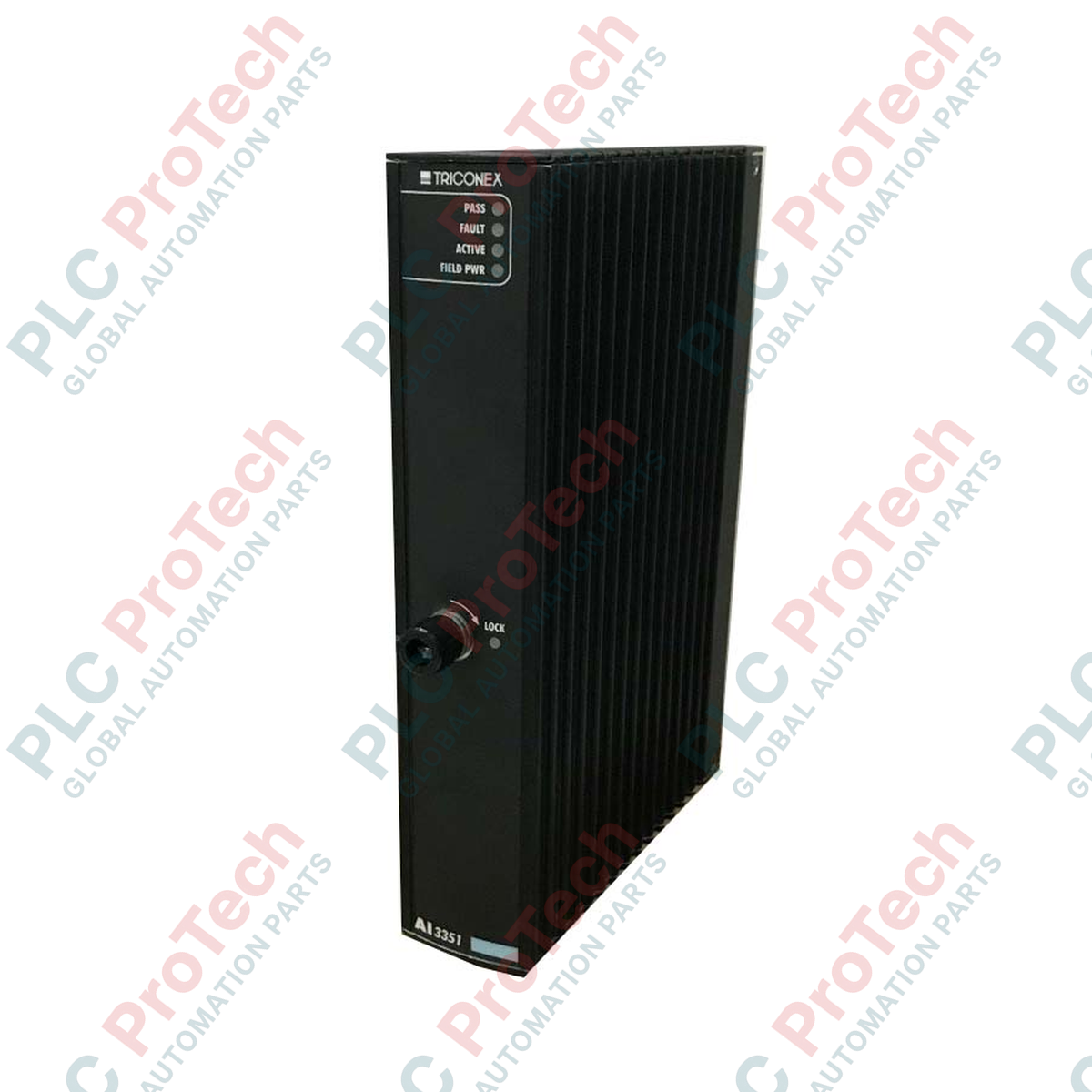
Product Overview
The 3351 (3351) is a high-performance, 32-point Analog Input Module designed for the Triconex Triple Modular Redundant (TMR) safety system. Operating within a standard 4–20 mA range, the Triconex 3351 provides high-density monitoring for critical process variables in demanding environments such as oil and gas refineries, petrochemical plants, and power generation facilities. By utilizing three isolated input paths and sophisticated voting logic, this module ensures that a single hardware failure never compromises the Safety Instrumented System (SIS). The integration of the 3351 module is vital for operators seeking to maximize plant availability and minimize costly unscheduled shutdowns caused by sensor signal discrepancies or module faults.
Advanced TMR Hardware Architecture
The 3351 module leverages the patented Triconex TMR architecture to deliver unparalleled reliability. Each of the 32 input points is commoned and processed through three independent legs.
-
Triple Redundancy: Every analog signal is branched to three separate input legs (Leg A, B, and C). Each leg performs independent signal conditioning and analog-to-digital conversion.
-
Internal Voting Logic: The converted digital values are compared and voted upon by the Main Processors. This process transparently filters out transient noise and hardware intermittent faults.
-
Diagnostic Precision: The module executes continuous self-diagnostics to detect "stuck-on" conditions or calibration drifts. If one leg deviates beyond a programmed threshold, the system flags a fault while continuing to operate safely in a dual-redundant mode.
-
Input Filtering: With a 16 Hz (3dB) input bandwidth, the module is optimized to reject high-frequency process noise while maintaining the responsiveness required for safety-critical loops.
Technical Specifications
| Parameter |
Specification Details |
| Model |
3351 |
| Brand |
Triconex (Schneider Electric) |
| Input Type |
Analog Input (TMR) |
| Nominal Input Current |
4–20 mA |
| Number of Points |
32, Commoned |
| Operational Range |
2–22 mA DC |
| Input Bandwidth |
16 Hz (3dB) |
| Source Impedance |
180 ohms |
| Operating Temperature |
0 to 60 deg C |
| Weight |
1.5 kg |
| Shipping Weight |
3.0 kg |
| Relative Humidity |
5 to 95 percent (Non-condensing) |
Technical FAQs
How does the 3351 handle "Out of Range" signals?
The 3351 recognizes signals between 2 mA and 22 mA. Any signal falling below 2 mA is typically treated as a "Bad Sensor" or open circuit, while signals above 22 mA indicate a short circuit or transducer failure, triggering an immediate system alarm.
Can the 3351 be replaced while the system is online?
Yes, the Triconex 3351 supports Hot-Swap functionality. When inserted into a spare slot or replacing a faulted unit, the module automatically undergoes a self-test and synchronizes its data with the active Main Processors without interrupting the process.
What is the significance of the "Commoned" architecture in this module?
The 32 points are commoned to simplify wiring in high-density applications. It is essential to ensure that the field loop power supply is compatible with this common-return configuration to prevent ground loops.
Field Engineering & Installation Guide
-
Shielding and Grounding: For 4–20 mA loops, use high-quality twisted-pair shielded cabling. Connect the shield at the Triconex termination panel ground bar only. Do not ground the shield at the field transmitter end to avoid circulating ground currents that can introduce errors into the 16 Hz bandwidth.
-
Impedance Matching: The 3351 has an internal source impedance of 180 ohms. Ensure that your field transmitters have sufficient driving voltage (typically 24 VDC) to overcome the combined loop resistance of the module and the field wiring.
-
Heat Dissipation: In cabinets with multiple high-density 3351 modules, ensure a minimum of 5 cm of clear air space between the chassis and cabinet doors. Maintain an ambient environment below 60 deg C to prevent accelerated aging of the electrolytic capacitors.
Industrial Endurance Advantages
-
Environmental Resilience: The 3351 is engineered to operate in harsh industrial atmospheres. The internal circuitry is treated to resist the effects of chemical corrosion and high humidity, typical of near-shore or tropical processing sites.
-
Vibration Tolerance: Built to meet stringent seismic and industrial vibration standards, the module's mechanical housing ensures that the connection to the backplane remains gas-tight even in the presence of heavy rotating machinery.
-
Legacy Integration: The 3351 maintains full compatibility with various versions of the Tricon chassis, allowing for seamless safety system expansions or the replacement of aging infrastructure without requiring a complete system overhaul.