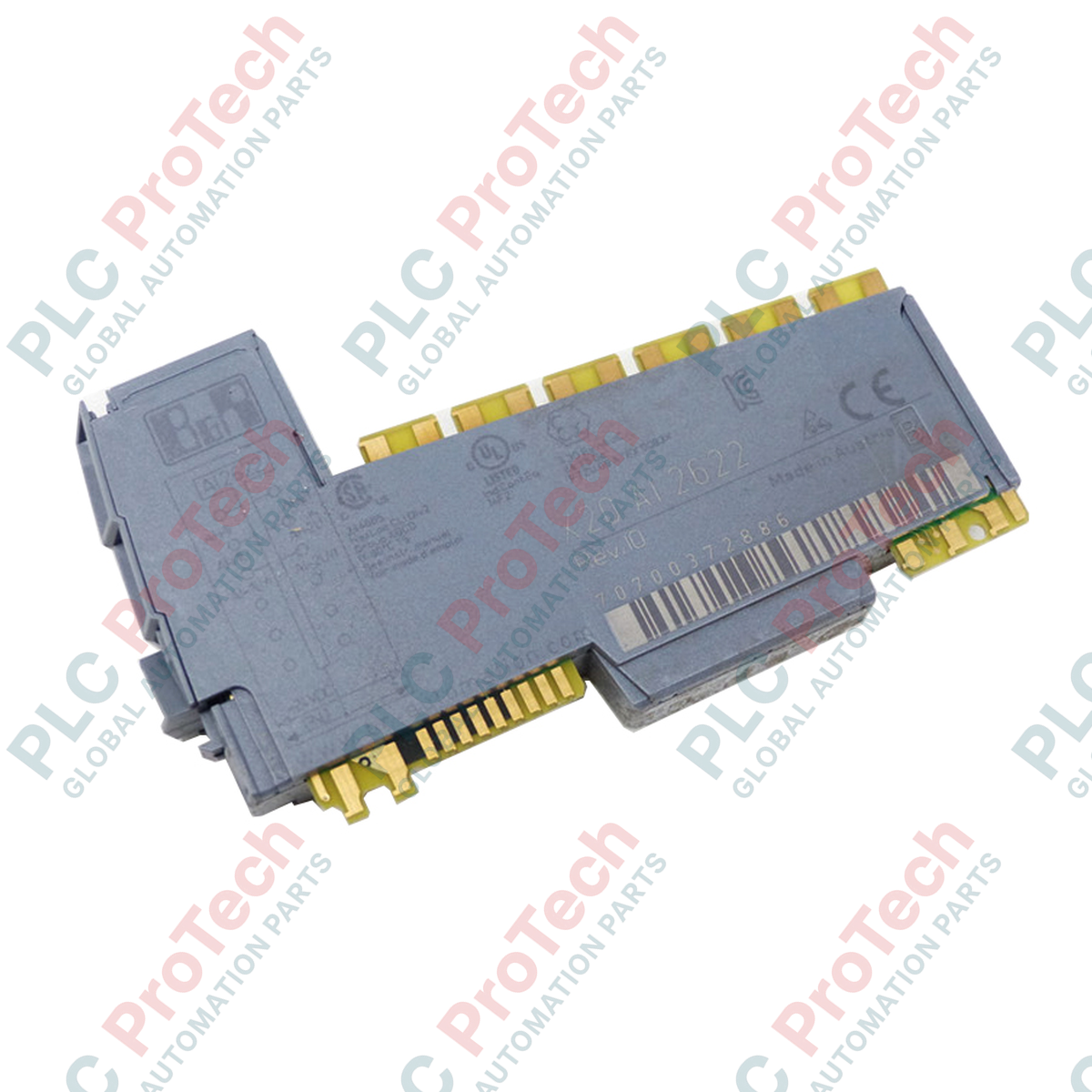
Présentation du produit
Le X20AI2622 (X20AI2622) est un module d’entrée analogique haute performance de la gamme B&R X20 System , conçu pour l’acquisition précise de signaux dans les environnements d’automatisation avancés. Équipé de deux entrées configurables individuellement, ce module offre la flexibilité nécessaire pour interfacer des signaux industriels standard, notamment une tension de ±10 V ou des boucles de courant de 0 à 20 mA / 4 à 20 mA . Qu’il s’agisse de surveiller la pression dans des systèmes hydrauliques, la température dans des réacteurs chimiques ou les débits dans des stations de traitement de l’eau, le X20AI2622 établit une nouvelle référence en matière de précision et de fiabilité, garantissant la numérisation des données critiques du procédé avec un bruit minimal et une fidélité maximale.
Traitement des signaux et intelligence diagnostique
L’architecture matérielle du X20AI2622 est optimisée pour une faible consommation d’énergie et une grande stabilité thermique. Elle ne consomme que 0.01 W sur le bus et 0.8 W pour les opérations d’E/S internes. Cette efficacité empêche l’accumulation de chaleur dans les armoires de commande à forte densité, prolongeant ainsi la durée de vie de l’ensemble de la station d’E/S.
Le module dispose d’un ensemble complet de voyants d’état fournissant un retour en temps réel sur l’état de fonctionnement, l’état du module et la fonction d’E/S individuelle de chaque canal. Cette capacité de diagnostic localisée permet aux techniciens de terrain d’identifier d’un coup d’œil une perte de signal ou une défaillance matérielle, réduisant ainsi considérablement les opérations de maintenance. Les entrées sont conçues pour une conversion haute résolution, permettant de détecter les infimes variations des signaux de terrain, ce qui est essentiel pour les boucles de régulation PID avancées et l’analyse prédictive.
Caractéristiques techniques
| Attribut |
Spécification |
| Modèle |
X20AI2622 |
| Marque |
B&R (Bernecker + Rainer) |
| Type de produit |
Module d’entrée analogique |
| Nombre d’entrées |
2 |
| Plage d’entrée (tension) |
±10 V |
| Plage d’entrée (courant) |
0 à 20 mA / 4 à 20 mA |
| Consommation électrique (bus) |
0.01 W |
| Consommation électrique (interne) |
0.8 W |
| Diagnostics |
Voyants LED pour l’état et la fonction d’E/S |
| Poids d’expédition |
2.0 kg |
FAQ techniques
Comment basculer entre les modes tension et courant sur le X20AI2622 ?
Le mode d’entrée est défini par une configuration logicielle dans B&R Automation Studio. Le module ne comporte aucun cavalier physique, ce qui élimine le risque d’erreurs de configuration matérielle lors de l’installation.
Ce module prend-il en charge la détection de rupture de fil ?
Oui, lorsqu’il est configuré pour la plage 4 à 20 mA , le module peut détecter une rupture de fil si le signal passe sous le seuil standard, ce qui déclenche un bit de diagnostic dans le CPU.
Quelle est l’importance du voyant « fonction d’E/S par canal » ?
Chaque canal d’entrée dispose d’un voyant LED dédié indiquant la validité du signal entrant. Cela permet de vérifier rapidement et physiquement le câblage de terrain sans avoir à connecter un ordinateur portable au contrôleur.
Guide d’ingénierie et d’installation
-
Adaptation d’impédance : Lors de l’utilisation de l’entrée de courant (0-20 mA), assurez-vous que la résistance totale de la boucle du capteur connecté ne dépasse pas l’impédance d’entrée maximale du module. Cela préserve la linéarité du signal et évite l’écrêtage à l’extrémité supérieure de la plage.
-
Protocole de blindage : Les signaux analogiques sont très sensibles aux parasites haute fréquence. Utilisez toujours des câbles blindés à paires torsadées. Le blindage doit être mis à la terre à l’aide de la plaque de mise à la terre du système X20 afin de fournir un chemin à faible résistance aux interférences électromagnétiques (EMI).
-
Considérations thermiques : Bien que le X20AI2622 présente un très faible niveau de consommation (0.8 W), il est recommandé de regrouper les modules analogiques à distance des modules de sortie numériques générant beaucoup de chaleur (comme les relais), afin de garantir la stabilité de la tension de référence à long terme.
Avantages techniques
Le X20AI2622 offre un avantage technique majeur grâce à sa polyvalence à double mode. En prenant en charge les entrées de tension et de courant sur un seul module, il réduit la variété des pièces de rechange qu’une installation doit stocker. Le boîtier X20 sans ventilateur et renforcé garantit des performances durables dans les environnements soumis aux vibrations mécaniques et aux variations de température. En outre, l’intégration au X2X Link assure une transmission déterministe des données, ce qui en fait une solution idéale pour les applications industrielles à grande vitesse où la synchronisation et la précision sont essentielles.