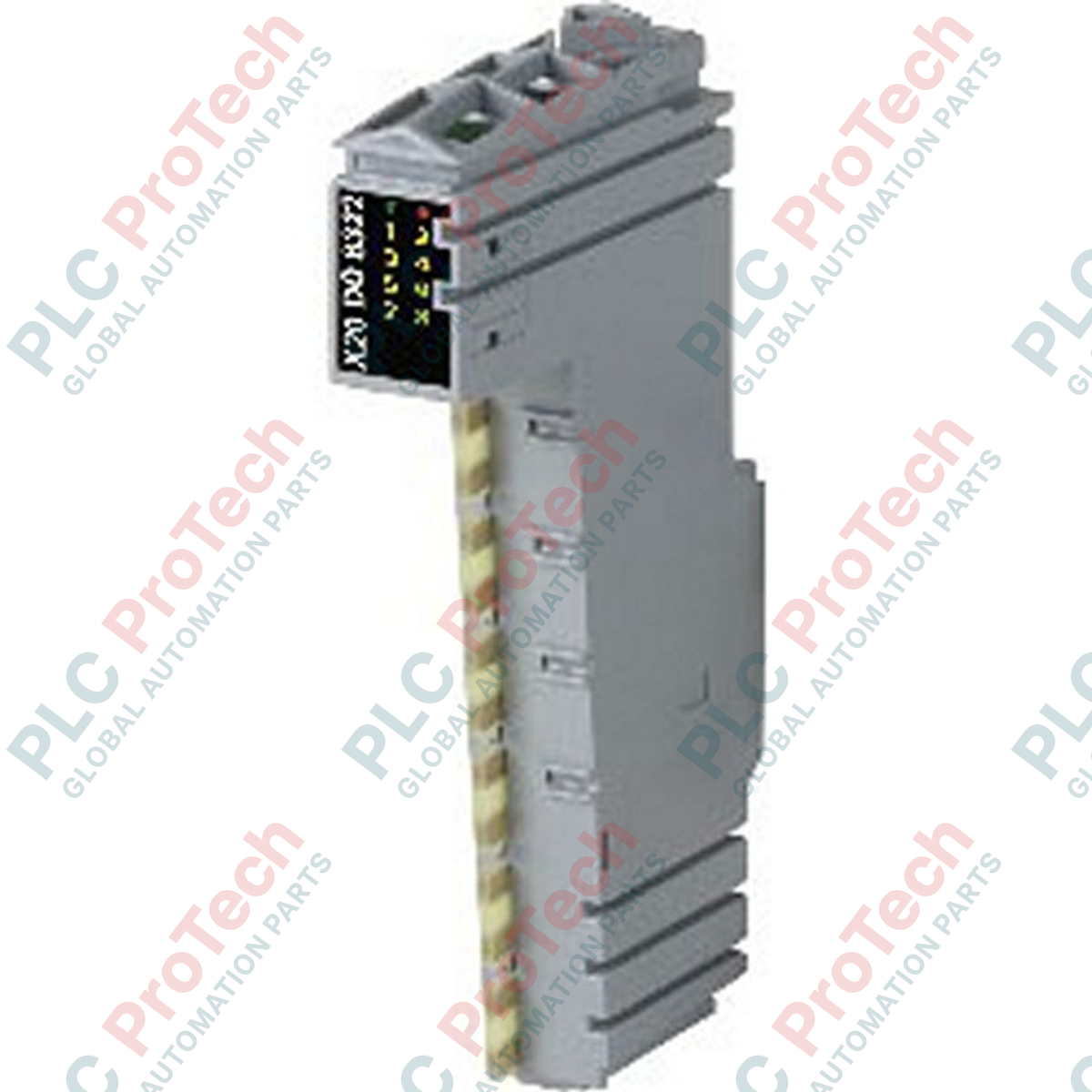
Présentation du produit
Le X20DO8322 (X20DO8322) est un module de sortie numérique haute densité conçu pour le système B&R X20, offrant 8 sorties source fiables en 24 VCC dans un format compact à emplacement unique. Conçu pour l'automatisation industrielle à haute efficacité, ce module est optimisé pour la technologie de connexion 1-fil, ce qui en fait un choix idéal pour le contrôle de solénoïdes, petits actionneurs et dispositifs de signalisation lorsque l'espace dans l'armoire et la simplicité du câblage sont essentiels. Le X20DO8322 fournit un courant constant de 0,5 A par canal, garantissant un fonctionnement stable dans diverses applications B2B telles que les lignes d'assemblage automatisées, les systèmes de manutention de matériaux et les panneaux de contrôle CVC. Son intégration transparente avec le backplane X20 permet un débit de données rapide et une latence minimale dans les boucles de contrôle critiques en temps réel.
Configuration technique
L'architecture du X20DO8322 est basée sur une logique de sortie "source" (PNP), où le module commute le potentiel positif de 24 VCC vers la charge. Chacun des 8 canaux est protégé électroniquement, garantissant que le module peut supporter les défauts de câblage courants sur le terrain sans dommage interne. La conception de connexion 1-fil est spécifiquement destinée à simplifier le processus de câblage ; les sorties sont connectées directement à l'appareil de terrain, tandis que la masse commune est généralement gérée via un rail de distribution centralisé. Cette configuration, combinée à la largeur d'un seul emplacement du module, permet une densité d'E/S exceptionnellement élevée dans le rack X20, permettant aux ingénieurs de faire évoluer les systèmes de contrôle sans agrandir les dimensions de l'armoire.
Caractéristiques techniques
| Caractéristique |
Détails de la spécification |
| Modèle |
X20DO8322 |
| Marque |
B&R Industrial Automation |
| Type de module |
Module de sortie numérique (Source/PNP) |
| Nombre de sorties |
8 |
| Tension de sortie |
24 VCC |
| Courant de sortie |
0,5 A par canal |
| Type de connexion |
Technologie 1-fil |
| Emplacements du module |
1 (Numérique) |
| Version du firmware requise |
V1.00 ou supérieure |
| Indice de protection |
IP20 |
| Température de fonctionnement |
0 à +55 degrés Celsius |
| Dimensions |
Largeur standard X20 1 emplacement |
| Poids à l'expédition |
2,0 kg |
FAQ techniques
Quel est l'avantage de la technologie de connexion 1-fil dans le X20DO8322 ?
La technologie 1-fil permet de ne connecter que le fil de signal du module à la charge. Cela réduit considérablement la quantité de câblage nécessaire au niveau des E/S, car toutes les lignes de retour (0 V) sont regroupées à l'extérieur, simplifiant la gestion des câbles et réduisant le risque d'erreurs de câblage.
Ce module supporte-t-il la modulation de largeur d'impulsion (PWM) ?
Le X20DO8322 est un module de sortie numérique standard conçu pour un commutateur simple ON/OFF. Pour les applications nécessitant une PWM à haute vitesse ou un contrôle précis de la vitesse des moteurs, il convient d'utiliser des modules fonctionnels spécialisés B&R (comme les séries X20DS ou X20MM).
Comment le module réagit-il à une surcharge de sortie ?
Le module intègre une protection électronique. En cas de courant dépassant 0,5 A (par exemple un court-circuit dans le câblage sur le terrain), le module limite le courant ou coupe le canal affecté pour protéger le circuit interne, signalant généralement une erreur de diagnostic dans la cartographie des E/S du PLC.
Guide d'ingénierie et d'installation
-
Gestion du courant total : Bien que chaque canal soit évalué à 0,5 A, calculez toujours la charge simultanée totale sur les 8 canaux. Assurez-vous que l'alimentation alimentant le contrôleur de bus X20 ou le module d'alimentation peut gérer les pics de courant lorsque toutes les sorties sont activées afin d'éviter les chutes de tension.
-
Suppression des charges inductives : Lors de la commande de charges inductives telles que les bobines de relais CC ou les électrovannes, il est fortement recommandé d'installer une diode de roue libre (diode de clamp) en parallèle avec la charge. Cela empêche les pics de tension de contre-EMF de solliciter les transistors de sortie du X20DO8322, prolongeant ainsi la durée de vie opérationnelle du module.
-
Stratégie de mise à la terre 1-fil : Étant donné qu'il s'agit d'un module 1-fil, le chemin de retour du courant doit être robuste. Utilisez un rail de masse commun (0 V) de haute qualité dans l'armoire et assurez-vous que tous les appareils de terrain sont solidement reliés à ce rail. Une masse flottante ou un chemin de retour à haute résistance peut provoquer un comportement de commutation incohérent ou des défauts de diagnostic "fantômes".