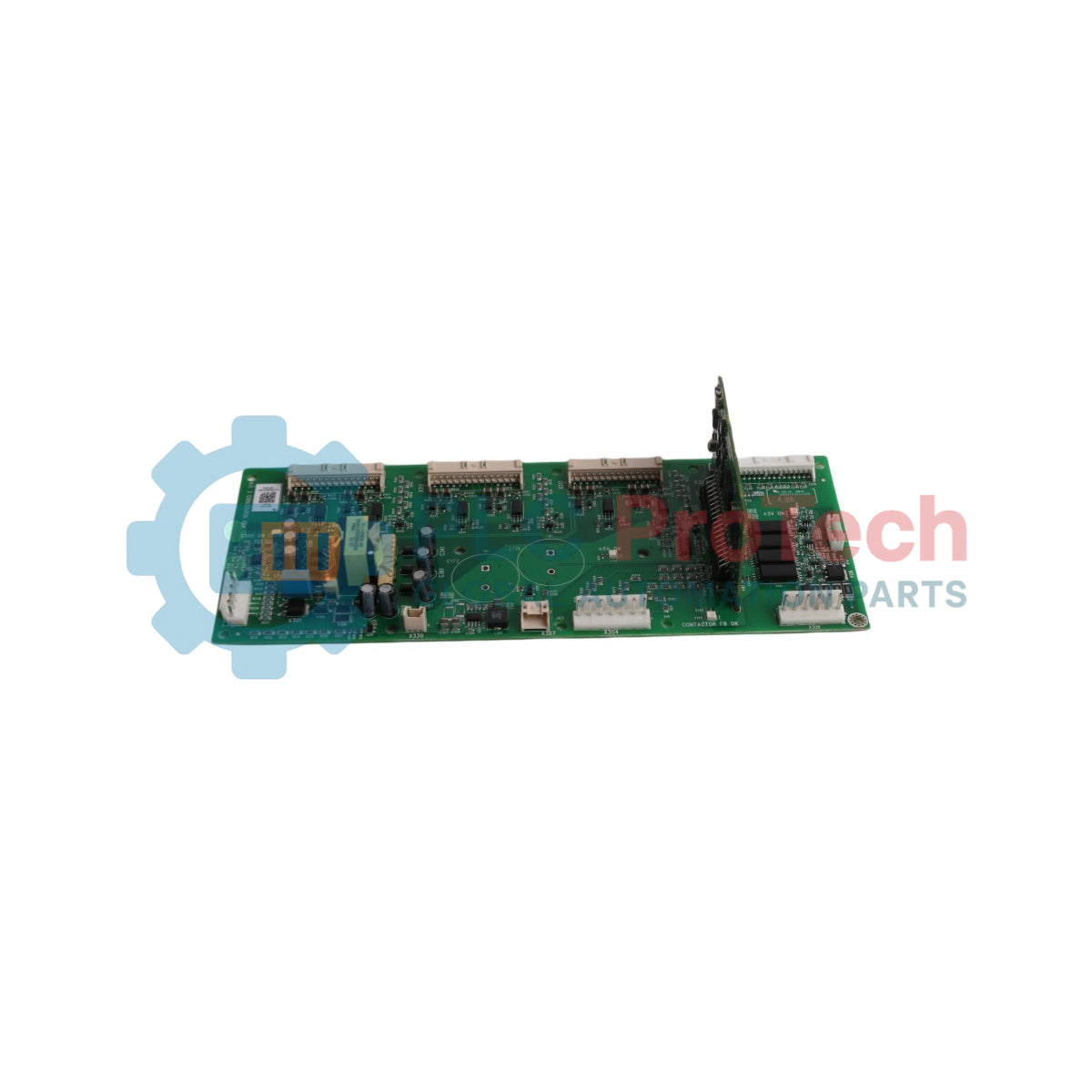
Product Overview
The QINT-781 (3AXD50000019758) is a high-precision Main Circuit (MC) Interface Board engineered for the ABB ACS880 series of industrial drives. Acting as a critical communication and control bridge between the drive's power stage and the control unit, the QINT-781 facilitates high-speed signal processing necessary for managing high-current DC outputs ranging from 500 VDC to 800 VDC. In demanding environments such as offshore drilling rigs, metals processing plants, and deep-pit mining operations, the reliability of this interface board is paramount. It ensures stable switching frequencies up to 20 kHz, directly impacting the drive's efficiency and motor control accuracy. Deploying genuine ABB interface boards is essential for minimizing harmonics and preventing catastrophic semiconductor failure, thereby reducing unplanned downtime in mission-critical infrastructure.
Technical Configuration
The QINT-781 architecture is designed to handle significant power throughput while maintaining signal integrity. It serves as the primary gateway for gate driver signals and DC bus feedback.
-
Power Handling: Optimized for high-capacity drives with continuous current ratings up to 150 A and peak capabilities reaching 200 A.
-
High-Frequency Precision: Supports a dynamic switching frequency range of 10-20 kHz, allowing for fine-tuned motor torque response and reduced acoustic noise in the motor windings.
-
Thermal Management: Built with industrial-grade components rated for operation up to 55 deg C, ensuring performance stability in poorly ventilated control cabinets or high-ambient regions.
-
Galvanic Isolation: Incorporates robust isolation layers to protect low-voltage control circuits from the high-voltage DC bus transients common in regenerative braking or heavy load fluctuations.
Technical Specifications
| Attribute |
Specification |
| Model |
QINT-781 |
| Part Number |
3AXD50000019758 |
| Brand |
ABB |
| Drive Compatibility |
ACS880 Series |
| DC Output Voltage |
500 - 800 VDC |
| Continuous Current |
150 A |
| Maximum Current Rating |
200 A |
| Switching Frequency |
10 - 20 kHz |
| Operating Temperature |
-10 to +55 deg C |
| Storage Temperature |
-20 to +70 deg C |
| Origin |
Estonia / Finland (Varies by Batch) |
| Weight |
Approx. 0.85 kg |
Industrial Field FAQs
Is the QINT-781 board interchangeable across all ACS880 frames?
No. The QINT-781 is specific to high-power frames that match its 150 A continuous current rating. Always verify the frame size (e.g., R8i or similar) and the specific drive firmware version before installation to ensure full compatibility.
What are the symptoms of a failing MC Interface Board?
Common indicators include intermittent DC bus overvoltage faults, irregular motor vibration caused by inconsistent switching, or failure of the drive to initialize the power stage during startup.
Does this board require firmware flashing upon replacement?
While the hardware provides the interface, the drive's control unit (BCU/ZCU) manages the logic. However, after replacing a 3AXD50000019758, a parameter identification run (ID Run) is highly recommended to calibrate the interface with the specific motor and power stack characteristics.
Engineering Installation and Safety Guidelines
-
Residual Voltage Warning: Before attempting to access or replace the QINT-781, ensure the drive has been disconnected from the AC input for at least 20 minutes. Use a certified voltmeter to verify that the DC bus voltage has discharged to below 50 VDC. Failure to do so poses a lethal flashover risk.
-
Fiber Optic and Ribbon Cable Handling: This board utilizes high-sensitivity connectors for gate driving. Ensure that all ribbon cables are seated squarely and locked. Avoid sharp bends in any fiber optic links connected to the interface, as micro-fractures can lead to signal loss and drive tripping under load.
-
ESD Protection: The 3AXD50000019758 contains sensitive CMOS components. Installation must be performed in an ESD-safe environment using a grounded wrist strap to prevent latent damage that could lead to premature board failure in the field.
-
Mounting Torque: When securing the board to the standoffs, use a torque-limiting screwdriver set to 0.8 Nm. Overtightening can cause micro-cracks in the multi-layer PCB, resulting in intermittent faults during thermal expansion.