


First TwinCAT PLC Project on a Beckhoff IPC
Build and verify a first TwinCAT PLC project on a Beckhoff IPC. This checklist covers target selection, EtherCAT discovery, I/O mapping, safe activation, restart tests, and commissioning records.
Manufacturer: BECKHOFF
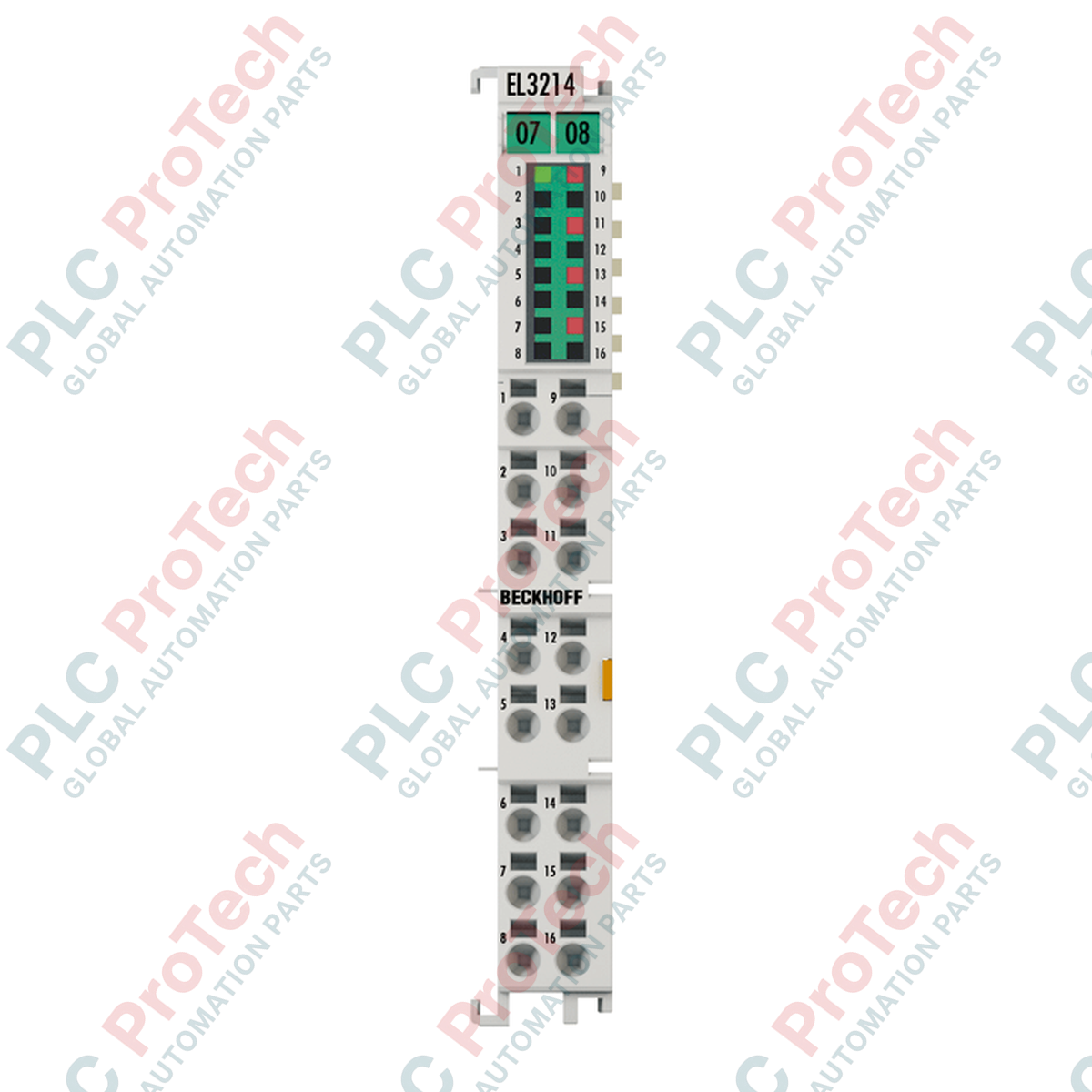
Product No.: EL3214
Country of origin:Germany
Product Type: EtherCAT Terminals
Payment: T/T, Western Union
Weight: 2000g
Dimensions: 12 mm x 100 mm x 68 mm
Shipping port: Xiamen
Warranty: 12 months
Designed for high-precision temperature acquisition within EtherCAT networks, the Beckhoff EL3214 analog input terminal provides direct connection for up to four resistance sensors. This 16-bit resolution module features a highly compact, 12 mm High Density (HD) housing with integrated signal LEDs, saving critical space inside the control cabinet. The terminal dynamically supports both 2-wire and 3-wire connection technologies, ensuring flexible integration with standard RTD sensors including Pt100, Ni100, and various resistance transmitters. Powered directly via the E-bus, it delivers stable, linear measurement results with low noise levels and built-in limit value monitoring.
| Parameter | Specification Value |
|---|---|
| Manufacturer | Beckhoff Automation |
| Model Reference | EL3214 |
| Product Type | EtherCAT Terminal (High Density Enclosure) |
| Number of Inputs | 4 channels |
| Nominal Resolution | 16 bit (0.1 degC per digit) |
| Supported Sensors | Pt100, Pt200, Pt500, Pt1000, Ni100, Ni120, Ni1000, KTY, and Resistance (10 Ohm to 4 kOhm) |
| Measuring Range | -200 to +850 degC (Pt sensors) / -60 to +250 degC (Ni sensors) |
| Measurement Error | < +/-0.5 degC (Pt sensors in 4x 3-wire operation) |
| Measuring Current | < 0.5 mA (dependent on load/sensor resistance) |
| Conversion Time | approx. 170 ms (default settings) |
| Input Filter Limit Frequency | typ. 1 kHz |
| Electrical Isolation | 500 V (E-bus / signal voltage) |
| E-Bus Current Consumption | typ. 140 mA |
| Operating Temperature Range | -25 to +60 degC |
| Storage Temperature Range | -40 to +85 degC |
| Relative Humidity | 95%, non-condensing |
| Vibration / Shock Resistance | Conforms to EN 60068-2-6 / EN 60068-2-27 |
| Protection Rating / Installation | IP20 / variable positions supported |
| Dimensions (W x H x D) | 12 mm x 100 mm x 68 mm |
| Product Weight | approx. 60 g |
| Shipping Weight (Calculated) | 0.25 kg (including packaging material) |
| Approvals and Markings | CE, UL, DNV GL |
| Conductor Type | Cross-Section Range | AWG Size Range |
|---|---|---|
| Solid Conductor (s) | 0.08 to 1.5 mm² | AWG 28 to 16 |
| Stranded Conductor (st) | 0.25 to 1.5 mm² | AWG 22 to 16 |
| Flexible Conductor with Ferrule (f) | 0.14 to 0.75 mm² | AWG 26 to 19 |
| Stripping Length | 8 to 9 mm | |
The EL3214 represents a High Density (HD) upgrade path for installations previously utilizing 2-channel temperature modules like the EL3202. While it significantly increases terminal density (4 channels within a 12 mm width), note that the EtherCAT process image mapping differs. Ensure that the corresponding TwinCAT System Manager configurations are refreshed and PLC variables are remapped when migrating older layouts to the EL3214 structure.
RTD measurements are highly sensitive to self-heating effects. The EL3214 limits its active measuring current to less than 0.5 mA to keep this error margin negligible. However, when placing sensors in stagnant or poorly conductive fluids, small temperature offsets may occur. If electrical grid interference (50 Hz or 60 Hz) affects signal stability, configure the integrated digital filter via CoE (CANopen over EtherCAT) settings to align with your local AC line frequency to achieve optimal noise rejection.
To ensure the rated accuracy of under +/-0.5 degC in 3-wire configurations, all three connection leads must have the identical length, material, and cross-section. Differences in wire resistance between the signal and compensation lines directly introduce systematic offsets. Always use shielded, twisted-pair cabling for long-distance runs and ground the shield immediately at the entry point of the control panel on dedicated grounding rails, ensuring the DIN rail itself has a low-impedance connection to earth ground.
Align the EL3214 terminal with the adjacent EtherCAT module on the standard 35 mm DIN rail (conforming to EN 60715).
Press the module firmly down onto the rail until the side double-slot lock and the bottom DIN rail locking mechanism click into place.
Prepare conductors to a stripping length of 8 to 9 mm. Insert a flathead screwdriver into the spring actuator slot to open the terminal clamp, push the conductor in, and release the tension to secure.

Global Express Shipping
Returns & Warranty
| Product Image | Model Number / Title | Condition | Availability | Action |
|---|---|---|---|---|

|
Allen-Bradley 1769-IF8 Compact I/O Analog Input Module | Original New | In Stock | View Details |
Global Express Shipping
Returns & Warranty
Orders are processed and delivered Monday-Friday (excluding public holidays).
For full eligibility, restocking fees, and international return details, please view our official Refund & Return Policy .
| Country of origin |
Germany
|

Build and verify a first TwinCAT PLC project on a Beckhoff IPC. This checklist covers target selection, EtherCAT discovery, I/O mapping, safe activation, restart tests, and commissioning records.

A practical commissioning sequence for KEPServerEX OPC UA connections: define data ownership, test tags locally, configure endpoint and certificate trust, limit access, then verify failure recovery...

Commissioning an Ethernet-connected PLC often starts with the laptop, not the controller. Learn how to record existing settings, choose a temporary address, test connectivity, and restore the plant...

Combustible dust controls require more than alarms. Learn how to map dust generation, select instrumentation, design interlocks, handle failed feedback, test safe states, and maintain the full...

Hairpin windings raise slot fill and support compact traction motors, but conductor geometry, AC losses, insulation damage, weld quality, and cooling determine whether the design meets its targets.

Use Ansible to standardize SCADA server changes without expanding OT risk. This guide covers inventories, idempotent playbooks, staged testing, credentials, logging, and practical rollback controls.