


Replacing a Beckhoff EL4032: Wiring and Output Checks
A field checklist for replacing a Beckhoff EL4032, covering the ±10 V load, terminal map, power contacts, EtherCAT state, and watchdog behavior.
Manufacturer: BECKHOFF
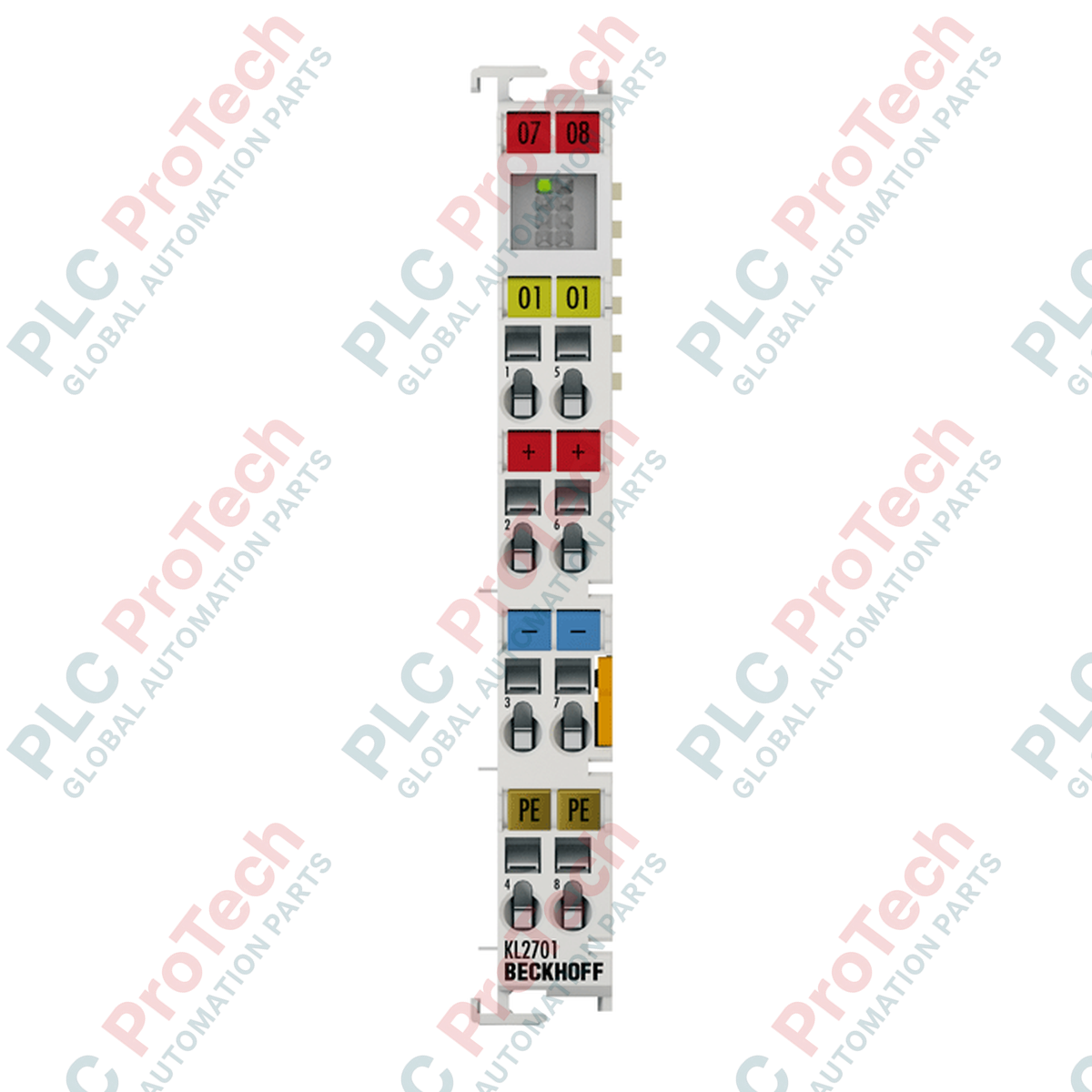
Product No.: KS2701
Country of origin:Germany
Product Type: Bus Terminal
Payment: T/T, Western Union
Weight: 2000g
Dimensions: 6.8 cm x 1.2 cm x 10.0 cm
Shipping port: Xiamen
Warranty: 12 months
The Beckhoff KS2701 (KS2701) is a high-performance Bus Terminal designed for industrial switching applications. Featuring a single-channel relay output (make contact), it provides seamless integration for controlling ohmic and inductive loads up to 230 V AC/DC. Its flexible connection technology supports 2-, 3-, and 4-wire configurations, making it a versatile choice for a wide range of automation tasks. By offering 2500 V AC electrical isolation between the field side and the internal K-bus, the KS2701 ensures robust protection of your PLC and communication infrastructure against voltage transients.
Designed for the modular Beckhoff Bus Terminal system, the KS2701 is housed in a compact, pluggable polycarbonate enclosure. It is engineered to handle substantial switching demands, featuring a steady-state current rating of 3 A and the capacity to handle peak currents of up to 50 A for short durations (100 ms). The terminal requires no manual address or configuration settings, allowing for "plug-and-play" deployment. With its integrated surge voltage protection (starting at 400 V AC), this terminal is exceptionally well-suited for switching inductive loads, such as contactor coils or small solenoid valves, while maintaining precise 2–4 ms switch-off times.
| Feature | Specification |
|---|---|
| Model | KS2701 |
| Output Type | 1 x Relay (Make contact) |
| Nominal Voltage | 0 to 230 V AC/DC |
| Max Steady Current | 3 A |
| Peak Current | 50 A (100 ms) |
| Switch-off Time | 2 to 4 ms |
| Electrical Isolation | 2500 V AC |
| Bit Width | 2 outputs |
| Protection Rating | IP 20 |
| Weight | 0.055 kg |
Why is surge voltage protection important for this terminal?
When switching inductive loads (like solenoids or large contactors), the collapsing magnetic field generates a high-voltage transient (back EMF) that can damage electronic components. The integrated surge protection (starting at 400 V) suppresses these spikes, significantly extending the relay's service life.
Can I use this terminal for low-voltage signal switching?
While the KS2701 is robust enough for 3 A loads, the gold-free contacts are optimized for general-purpose switching. For extremely low-current, low-voltage signal applications (e.g., < 10 mA, < 5 V), consider using a terminal with gold-plated contacts to ensure reliable signal continuity.
Does this terminal require configuration in TwinCAT?
No, the KS2701 is a self-configuring device. Once connected to the K-bus, the system detects it automatically, occupying 2 bits in the process image. No manual addressing is required.
What is the recommended fuse for this terminal?
To protect the relay contacts from welding during a short circuit, you should install a fast-acting fuse rated at ≤ 10 A in series with the load.

Global Express Shipping
Returns & Warranty
Global Express Shipping
Returns & Warranty
Orders are processed and delivered Monday-Friday (excluding public holidays).
For full eligibility, restocking fees, and international return details, please view our official Refund & Return Policy .
| Color pattern |
Greyish White
|
| Country of origin |
Germany
|

A field checklist for replacing a Beckhoff EL4032, covering the ±10 V load, terminal map, power contacts, EtherCAT state, and watchdog behavior.

Before replacing a Yokogawa AAI835, verify the 4-in/4-out channel map, power-loss loop behavior, barrier type, output load, cable, and redundancy.

ABB PM891K01 article 3BSE053241R1 is the non-redundant AC 800M processor kit. Use this field checklist before replacement.

Replacement checks for ABB TP853 3BSE018126R1: identify the installed CI853, CI855, CI857, or CI861 interface, record wiring, and verify communication after installation.

Engineering checks for the Allen-Bradley 5069-L330ERMS2: controller capacity, separate RTB kits, local I/O limits, network-node limits, and motion-axis count.

Checks to record before replacing ABB 3HNE 00006-1 DSQC 351: controller generation, X3/X5/X20/X21 wiring, DeviceNet settings, INTERBUS mapping, and LED states.