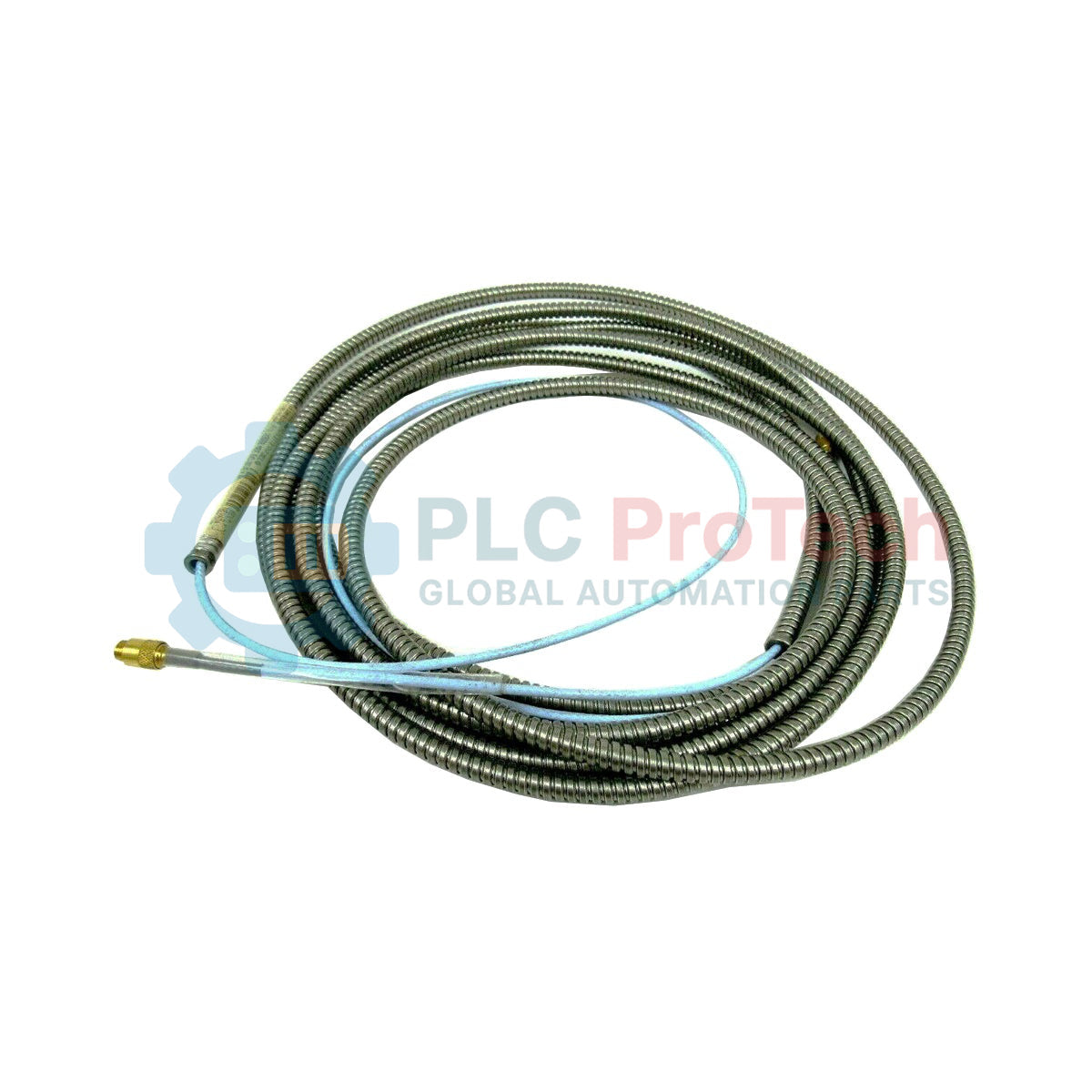
Description
Engineered for industrial machinery protection systems, the Bently Nevada 1X35668 serves as a critical link in proximity probe transducer circuits, ensuring the accurate transmission of high-frequency vibration and position signals. This rugged extension cable connects non-contacting displacement sensors to their designated proximitor sensors, maintaining the precise electrical characteristics necessary for system calibration.
Designed to withstand harsh operating conditions, the cable minimizes signal attenuation and phase shift across extended distances. This ensures that critical diagnostic data from steam turbines, gas turbines, compressors, and pumps is delivered to the monitoring system without degradation. The robust outer jacket provides excellent resistance against mechanical wear, moisture, and industrial chemical exposure.
Features
- Optimized electrical impedance to maintain complete calibration accuracy of the proximity transducer loop.
- High-density shielding to protect signals from electromagnetic interference (EMI) and radio frequency noise.
- Durable outer sheathing engineered to resist industrial solvents, oils, and moisture.
- Robust coaxial connectors ensuring secure mechanical coupling and reliable electrical contact.
Applications
- Turbomachinery shaft vibration and axial position monitoring.
- Compressor, pump, and gearbox predictive maintenance systems.
- Power generation facilities, oil and gas refineries, and chemical processing plants.
Technical Specifications
| Manufacturer |
Bently Nevada |
| Part Number / SKU |
1X35668 |
| Alternate Part Number |
68135045 |
| Product Type |
Extension Cable |
| Application |
Proximity Transducer Systems |
| Country of Origin |
USA |
| Approximate Shipping Weight |
2.0 kg |
Installation Guidelines
- Maintain the recommended minimum bend radius during installation to prevent damage to the inner conductor and shielding.
- Ensure all connection points are clean, dry, and free of contaminants before securing connectors.
- Utilize connector protectors or appropriate sealing tape when routing cables through environments with high oil or moisture exposure.
- Keep sensor cabling isolated from high-voltage power lines and transient electrical sources to minimize signal noise interference.