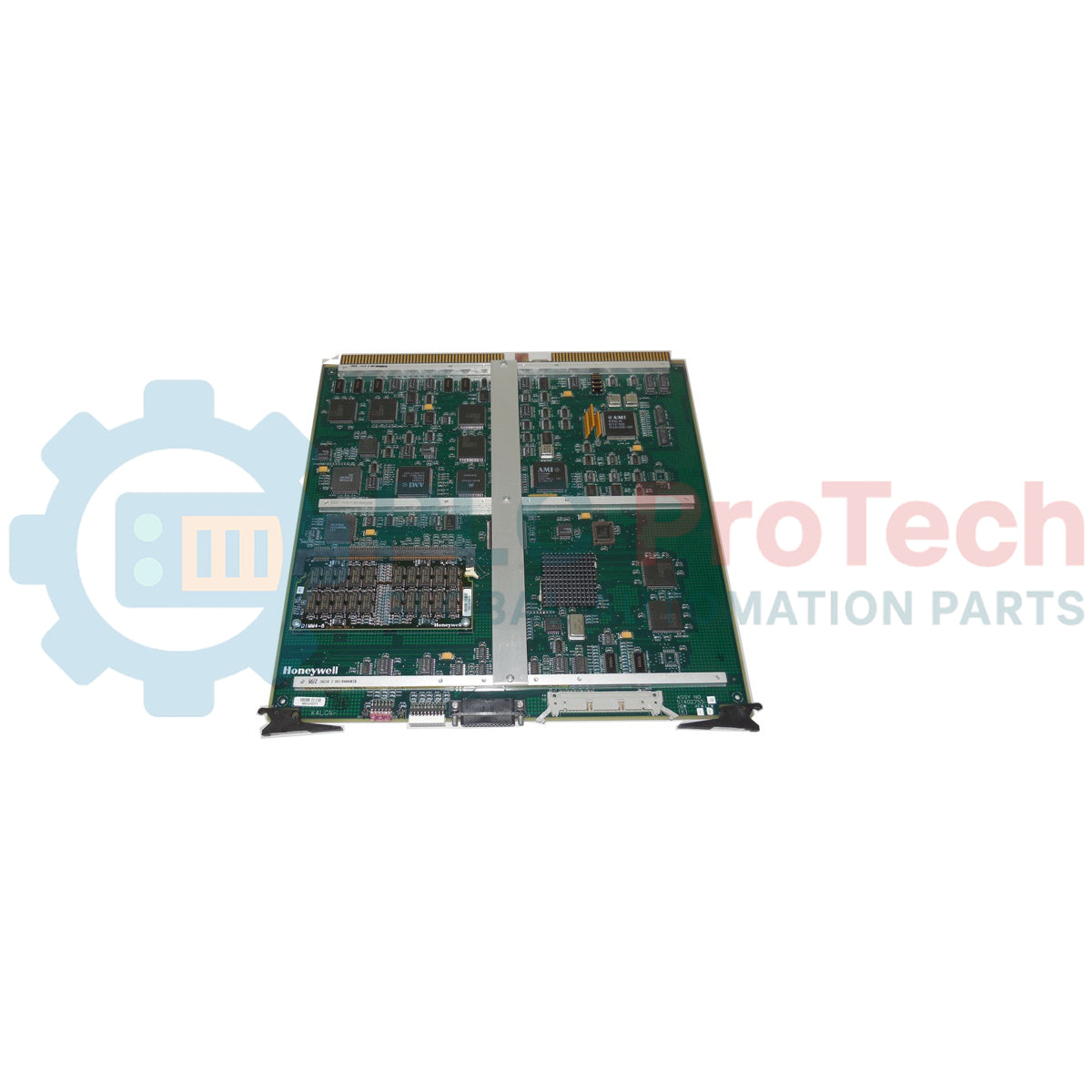
Description
Executing central command and control operations within legacy distributed control architectures, the Honeywell 51402755-100 manages complex logic processing and interface bus timing for the K4LCN-4 Local Control Network assemblies. This processing module is engineered specifically to maintain high-throughput communication across the TDC 3000 and TPS control backplanes, ensuring reliable, low-latency execution of process control loops and database transactions in demanding environments.
Features
- High-density microprocessing board architecture optimized for real-time Honeywell Local Control Network (LCN) operations.
- Direct integration with TDC 3000 / TPS card files without requiring chassis modifications.
- Onboard diagnostic indicators for rapid hardware and communication status verification.
- Robust thermal construction designed to withstand industrial-grade cabinet operating temperatures.
- Low-power CMOS components integrated to reduce internal thermal load and extend component lifespan.
Applications
- Honeywell TDC 3000 Distributed Control Systems (DCS) maintenance and expansion.
- Legacy Local Control Network (LCN) infrastructure support in continuous process plants.
- Refinery, petrochemical, and power generation control room operations.
Technical Specifications
| Manufacturer |
Honeywell |
| Part Number / SKU |
51402755-100 |
| Processor Designation |
K4LCN-4 |
| System Compatibility |
Honeywell TDC 3000 / TPS |
| Module Type |
Processor Card |
| Shipping Weight (Calculated) |
5.0 kg (11.02 lbs) |
| Country of Origin |
United States |
Empirical Engineering Insights
Alternative Models & Compatibility
The K4LCN-4 model serves as a direct functional replacement for older K4LCN hardware revisions (such as K4LCN-2 or K4LCN-3), providing improved thermal profiles and reliable memory execution. Ensure that your LCN software and system release level support the K4LCN-4 revision prior to physical board swap-out.
Application Pitfalls & Engineering Notes
Operating legacy Honeywell card files in enclosed cabinets requires consistent forced-air cooling. Degradation of cabinet cooling fans is the primary contributor to processor board overheating, which can manifest as intermittent LCN connection drops or unexpected processor halt codes. Maintain clear airflow pathways around the chassis.
Commissioning & Wiring Tips
Always verify the integrity of the gold-plated edge connectors on the back of the card before insertion. Dust and atmospheric contaminants in industrial settings can prevent secure contact with the card file backplane, leading to intermittent power delivery or data loss on the LCN.
Installation Guidelines
CRITICAL WARNING
Do not insert or remove this card while the card file backplane is energized. Live insertion (hot-swapping) can cause destructive high-voltage transients on the backplane data bus, leading to permanent damage to this processor card and adjacent communication modules. Ensure complete subsystem de-energization before executing replacement procedures.
1
Isolate and verify the target card file chassis is completely powered down.
2
Equip a calibrated electrostatic discharge (ESD) wrist strap connected to a verified earth ground point.
3
Align the processor card with the card file guide rails, sliding the card smoothly into the slot until the backplane connectors seat firmly.
4
Secure the card using the integrated chassis retaining screws to prevent structural shifting due to ambient industrial vibration.