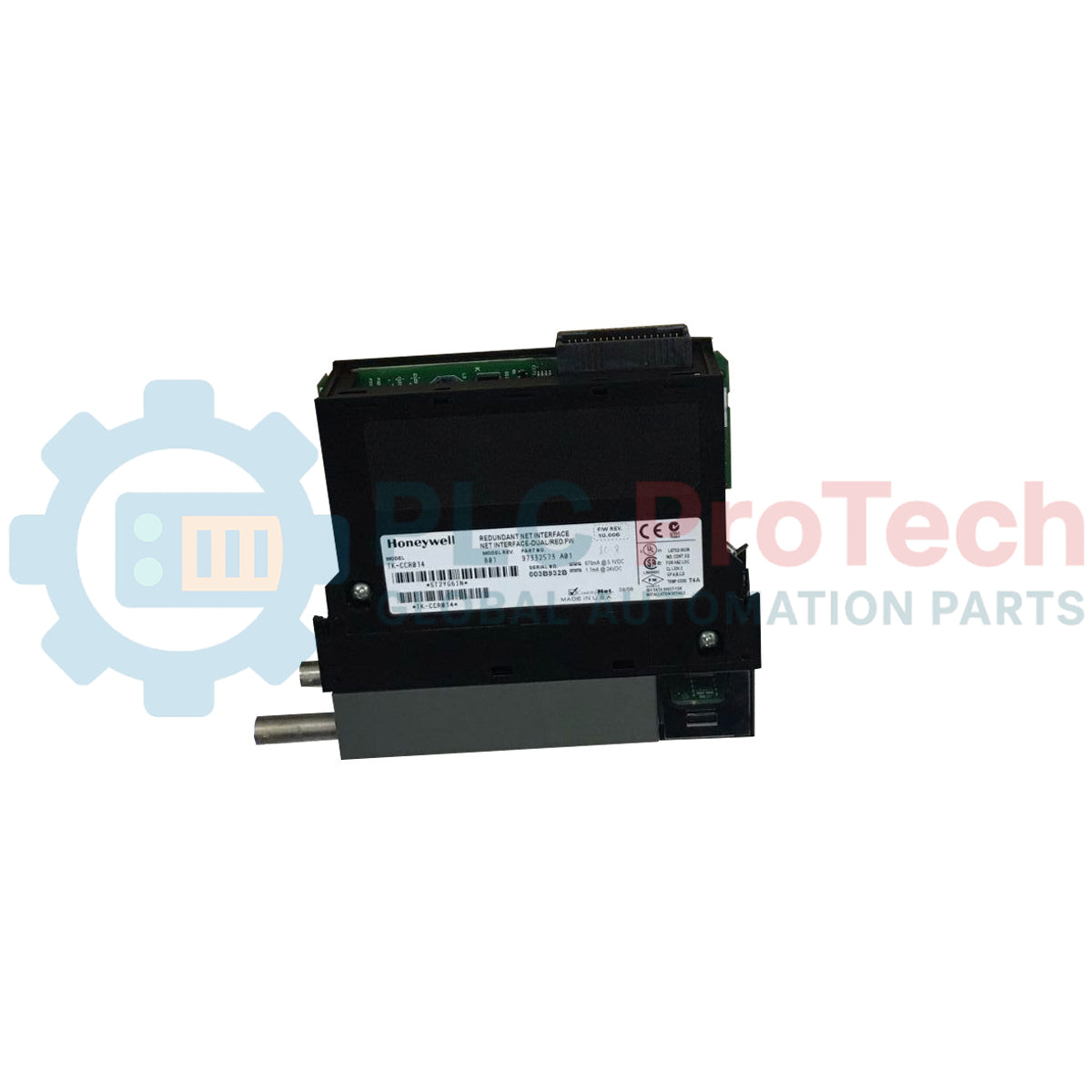
The TK-CCR014 is a high-reliability communication routing component operating as a Redundant Net Interface Module within the Honeywell C200 and Experion distributed control system (DCS) architectures. This interface module provides critical dual-channel ControlNet network linking capabilities, acting as the deterministic communication bridge between primary processing chassis networks and remote I/O chassis blocks. Built with a redundant network transceiver layout, the unit monitors connection path health in real time and automatically executes sub-millisecond switchovers to the backup channel if a media interruption occurs. This fault-tolerant structure guarantees steady parameters, safety logic execution, and uninterrupted diagnostic telemetry across centralized process networks.
Features
Redundant dual-channel interface supporting seamless network media switchovers.
Highly deterministic ControlNet protocol management for real-time tracking.
Standardized form factor for direct rack integration into standard C200 slots.
Integrated front-panel status lights for instant diagnostic and link health reporting.
Applications
Redundant network tracking between master C200 processors and remote I/O racks.
High-availability communication bridging in distributed control systems (DCS).
Supervisory network isolation in chemical manufacturing and petroleum refineries.
Real-time network infrastructure coordination inside critical power generation utility loops.
Technical Specifications
Parameter
Specification
Manufacturer
Honeywell
Model
TK-CCR014
Product Type
Redundant Net Interface Module (ControlNet FIM)
Product Series
C200 / Experion System Chassis I/O (CIOM-A)
Weight
0.45 Kg
Shipping Weight
2 Kg
Country of Origin
United States / Global Operations
Network Protocol
ControlNet (Redundant Media Support)
Installation Guidelines
Grounding and Shielding
Verify that the hosting C200 equipment rack is bonded cleanly to the main facility instrument grounding network using a low-impedance copper wire. Communication trunk coax and tap cables must follow standardized network installation procedures, ensuring that the shield integrity is maintained across the segments to suppress high-frequency radio interference.
Handling and ESD Protection
The internal communication processors are highly sensitive to electrostatic discharge (ESD). Field engineers must wear an approved, snug-fitting static-dissipative wrist strap connected to a verified ground prior to unboxing the module, shifting node addresses, or sliding the card into the chassis backplane.
Alignment and Insertion
Align the edges of the module's circuit board with the molded plastic track guides of the local slot. Slide the unit inward firmly until the rear pins match and fully engage the backplane connector. Secure the mechanical faceplate screws to protect the communication interface from continuous industrial panel vibration.
Network Cable Routing
Maintain a safe physical clearance between the network coax cables and high-voltage AC mains lines or heavy motor starters. Keeping the network lines inside dedicated, isolated conduit trays minimizes magnetic fields from introducing data errors or transmission delays on the control link.
FAQ
What is the core purpose of this interface module?
It provides a redundant, deterministic ControlNet link to connect process controllers with distributed remote I/O chassis assemblies.
How does the module react if one of the network cables is broken?
The internal redundant interface immediately switches data traffic to the secondary channel without dropping communication frames or resetting the rack status.
Is this device compatible with standard Honeywell C200 systems?
Yes, it utilizes the precise physical form factor required to fit into standard CIOM-A rack slots.
What is the net unboxed weight of this communication hardware?
The standalone unboxed module has an exact physical weight of 0.45 Kg.
What do the front-panel indicator lights signify?
The LEDs provide real-time status diagnostics regarding module health, backplane synchronization, and the operational link state of both channels.
Does this hardware require distinct configuration settings?
Yes, hardware node switches or software configuration tools must be set to assign the module its correct address on the network.
What type of cabling is used to hook up this network module?
It connects to standard industrial ControlNet network layouts using coaxial media taps and BNC-style locking terminators.
Can this component run as an independent loop controller?
No, it is a dedicated network communications interface designed to route data packages between controllers and peripheral racks.
What precautions should be followed concerning static discharge during card replacement?
Always practice correct ESD guidelines, utilizing grounded bags and active wrist straps whenever handling the module out of the chassis.
What is the total package mass when packed for standard freight delivery?
The gross shipping weight of the module and its protective industrial box is specified at 2 Kg.
Shipping & Returns
Global Express Shipping
Standard Delivery: 4–6 business days via DHL, FedEx, and UPS.
Express Dispatch: Same-day dispatch for in-stock orders placed before 2:00 PM (GMT+8).
Worldwide Coverage: Serving over 150 countries.
Returns & Warranty
30-Day Guarantee: Returns accepted for in-stock products in original, factory-sealed packaging.
12-Month Warranty: Every industrial component is backed by our technical warranty.
The TK-CCR014 is a high-reliability communication routing component operating as a Redundant Net Interface Module within the Honeywell C200 and Experion distributed control system (DCS) architectures. This interface module provides critical dual-channel ControlNet network linking capabilities, acting as the deterministic communication bridge between primary processing chassis networks and remote I/O chassis blocks. Built with a redundant network transceiver layout, the unit monitors connection path health in real time and automatically executes sub-millisecond switchovers to the backup channel if a media interruption occurs. This fault-tolerant structure guarantees steady parameters, safety logic execution, and uninterrupted diagnostic telemetry across centralized process networks.
Features
Redundant dual-channel interface supporting seamless network media switchovers.
Highly deterministic ControlNet protocol management for real-time tracking.
Standardized form factor for direct rack integration into standard C200 slots.
Integrated front-panel status lights for instant diagnostic and link health reporting.
Applications
Redundant network tracking between master C200 processors and remote I/O racks.
High-availability communication bridging in distributed control systems (DCS).
Supervisory network isolation in chemical manufacturing and petroleum refineries.
Real-time network infrastructure coordination inside critical power generation utility loops.
Technical Specifications
Parameter
Specification
Manufacturer
Honeywell
Model
TK-CCR014
Product Type
Redundant Net Interface Module (ControlNet FIM)
Product Series
C200 / Experion System Chassis I/O (CIOM-A)
Weight
0.45 Kg
Shipping Weight
2 Kg
Country of Origin
United States / Global Operations
Network Protocol
ControlNet (Redundant Media Support)
Installation Guidelines
Grounding and Shielding
Verify that the hosting C200 equipment rack is bonded cleanly to the main facility instrument grounding network using a low-impedance copper wire. Communication trunk coax and tap cables must follow standardized network installation procedures, ensuring that the shield integrity is maintained across the segments to suppress high-frequency radio interference.
Handling and ESD Protection
The internal communication processors are highly sensitive to electrostatic discharge (ESD). Field engineers must wear an approved, snug-fitting static-dissipative wrist strap connected to a verified ground prior to unboxing the module, shifting node addresses, or sliding the card into the chassis backplane.
Alignment and Insertion
Align the edges of the module's circuit board with the molded plastic track guides of the local slot. Slide the unit inward firmly until the rear pins match and fully engage the backplane connector. Secure the mechanical faceplate screws to protect the communication interface from continuous industrial panel vibration.
Network Cable Routing
Maintain a safe physical clearance between the network coax cables and high-voltage AC mains lines or heavy motor starters. Keeping the network lines inside dedicated, isolated conduit trays minimizes magnetic fields from introducing data errors or transmission delays on the control link.
FAQ
What is the core purpose of this interface module?
It provides a redundant, deterministic ControlNet link to connect process controllers with distributed remote I/O chassis assemblies.
How does the module react if one of the network cables is broken?
The internal redundant interface immediately switches data traffic to the secondary channel without dropping communication frames or resetting the rack status.
Is this device compatible with standard Honeywell C200 systems?
Yes, it utilizes the precise physical form factor required to fit into standard CIOM-A rack slots.
What is the net unboxed weight of this communication hardware?
The standalone unboxed module has an exact physical weight of 0.45 Kg.
What do the front-panel indicator lights signify?
The LEDs provide real-time status diagnostics regarding module health, backplane synchronization, and the operational link state of both channels.
Does this hardware require distinct configuration settings?
Yes, hardware node switches or software configuration tools must be set to assign the module its correct address on the network.
What type of cabling is used to hook up this network module?
It connects to standard industrial ControlNet network layouts using coaxial media taps and BNC-style locking terminators.
Can this component run as an independent loop controller?
No, it is a dedicated network communications interface designed to route data packages between controllers and peripheral racks.
What precautions should be followed concerning static discharge during card replacement?
Always practice correct ESD guidelines, utilizing grounded bags and active wrist straps whenever handling the module out of the chassis.
What is the total package mass when packed for standard freight delivery?
The gross shipping weight of the module and its protective industrial box is specified at 2 Kg.
A dead control cabinet does not automatically mean a failed power supply. This field guide uses input, no-load, loaded, ripple, wiring, and protection checks to separate source faults from downstream...
Reliable control begins before the PLC executes a loop. This engineering guide follows the signal chain from sensing and conditioning to transmission, control action, final elements, calibration, and...
Modbus remains widely deployed because its data model is simple, not because every implementation is simple. This guide explains frames, register mapping, timing, diagnostics, and the design limits...
A practical engineering guide to PLC CPU operation, from deterministic scan cycles and I/O image tables to memory, communications, diagnostics, redundancy, processor sizing, and reliable system...
Replacing a 1756-L73 does not automatically mean upgrading its firmware. This guide compares v19.013, v21.011 and v31.011, focusing on project compatibility, HMI communications, legacy networks and...
Implement a 3-SPST switch XOR light circuit in LogixPro or RSLogix 500 using an internal relay bit. Includes truth tables, boolean equations, and verified.
Choosing a selection results in a full page refresh.