1 of 2

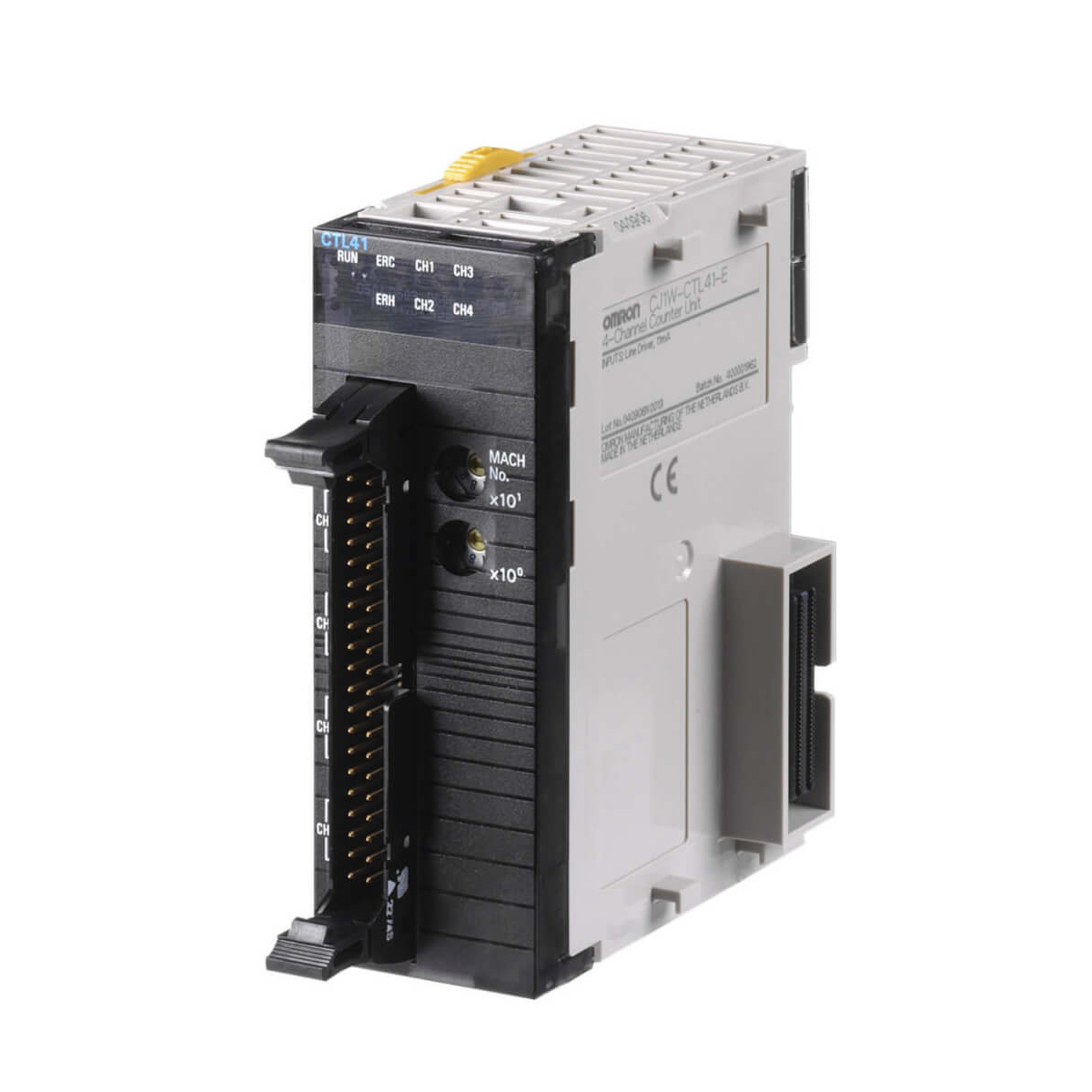
Omron CJ1W-CTL41-E CJ-series 4-Channel Counter Unit

Omron CJ1W-CTL41-E CJ-series 4-Channel Counter Unit

Only 7 item(s) left in stock
  • Manufacturer: Omron

  • Product No.: CJ1W-CTL41-E

  • Country of origin:Japan

  • Product Type: High Speed Counter Special IO Module

  • Payment: T/T, Western Union

  • Weight: 2000g

  • Dimensions: 31 x 90 x 65 mm (W x H x D)

  • Shipping port: Xiamen

  • Warranty: 12 months

Quantity
View full details

Description

The Omron CJ1W-CTL41-E is a high-speed, freely configurable 4-Channel Counter Unit belonging to the CJ-series Special I/O Unit classification. Engineered for use within high-performance industrial networks, it can be deployed with both CJ-series CPU Units and NJ-series Machine Automation Controllers to handle high-frequency signaling. The unit independently processes bi-directional pulse sequences up to 100 kHz, offloading the central processor from rapid motion tracking and position monitoring overhead. System integration allows the mapping of 32 separate internal software outputs linked to pre-allocated comparison zones or exact digital variables. This makes the module optimal for executing real-time triggering commands in dynamic machinery setups without incurring standard PLC program loop delays.

Features

  • Four independent bi-directional counting channels processing up to a maximum binary range of 32-bits.
  • High-frequency signal tracking capable of accepting input pulse rates up to 100 kHz.
  • Flexible encoder signal handling supporting Phase Differential, Up/Down Pulse, and Pulse & Direction inputs.
  • Selectable counter profiles enabling either Circular Counter or Linear Counter behaviors per channel.
  • Configurable output control configurations operating via Range Mode (up to 4 ranges per channel) or Comparison Mode (up to 8 comparison values per channel).
  • Integrated 32-point Software Output array mapping counter status changes directly to CPU device variables.
  • Built-in error reporting and physical operational status validation via dedicated front-panel LED diagnostics.

Applications

  • High-speed packaging, automated sorting plants, and dynamic bottling systems.
  • Accurate multi-axis positioning monitoring, linear length measurement, and electronic CAM operations.
  • Proportioning, dosing, and fluid flow regulation loops within the process industry.
  • Continuous web handling, tension tracking, and rotary encoder winding configurations.
  • Energy monitoring, batch synchronization, and discrete high-frequency pulse logging.

Technical Specifications

Performance

Parameter Specification
Unit Type CJ-series Special I/O Unit
Number of Counter Channels 4 Channels
Maximum Input Frequency 100 kHz
Counting Range 32-bit Binary
Counter Types Circular Counter, Linear Counter
Supported Input Signal Types Phase Differential (x1, x2, x4), Up/Down Pulse, Pulse & Direction
Internal Software Outputs 32 Outputs
Output Control Modes Range Mode, Comparison Mode
Configurable Hysteresis Range 1 to 255 Pulses

Electrical & Memory

Parameter Specification
Internal Current Consumption 320 mA at 5 VDC
Initial Counter Value Range 2,147,483,648 to 2,147,483,647 Pulses
Hardware Connection Interface Front-facing 40-pin connector layout
Data Refresh Allocation (CIO-words) CIO-words 2000 to 2959
Special I/O DM Memory Allocation D-words 20000 to 29599

Environmental

Parameter Specification
Operating Temperature 0 to 55 deg C
Storage Temperature -20 to 70 deg C
Ambient Relative Humidity 10% to 90% (without condensation)

Mechanical

Parameter Specification
Dimensions (W x H x D) 31 x 90 x 65 mm
Weight 2 kg

Connections / Interfaces

The front of the module features a split 40-pin connector configuration distributed into two parallel vertical rows (Pins 1-20 and Pins 21-40). The physical external encoder inputs are assigned according to the following layout matrix:

Pin No. Signal Function Pin No. Signal Function
40 Not Connected 39 Not Connected
38 Channel 4 Z- Input 37 Channel 4 Z+ Input
36 Channel 4 B- Input 35 Channel 4 B+ Input
34 Channel 4 A- Input 33 Channel 4 A+ Input
32 Channel 3 Z- Input 31 Channel 3 Z+ Input
30 Channel 3 B- Input 29 Channel 3 B+ Input
28 Channel 3 A- Input 27 Channel 3 A+ Input
26 Not Connected 25 Not Connected
24 Channel 2 Z- Input 23 Channel 2 Z+ Input
22 Channel 2 B- Input 21 Channel 2 B+ Input
20 Channel 2 A- Input 19 Channel 2 A+ Input
18 Channel 1 Z- Input 17 Channel 1 Z+ Input
16 Channel 1 B- Input 15 Channel 1 B+ Input
14 Channel 1 A- Input 13 Channel 1 A+ Input
12 Not Connected 11 Not Connected
10 Not Connected 9 Not Connected
8 Not Connected 7 Not Connected
6 Not Connected 5 Not Connected
4 Not Connected 3 Not Connected
2 Not Connected 1 Not Connected


Note: Interface signals from RS-422 Line Drivers can wire directly to the 40-pin MIL connector, or route via an intermediate terminal block assembly (e.g., Omron XW2B-40Gx, XW2D-40G6, or screwless XW2G-40G7-E) using a standard pre-assembled XW2Z I/O interface cable.

Installation Guidelines

  • DIN Rail Interlocking: Align the back plane connection pins of the unit precisely with the main rack bus guide. Firmly slide the module horizontally onto the 35 mm rail tracking next to the processor or expansion modules, then lock the upper and lower yellow slider mechanisms securely into position until an audible click occurs.
  • Debris Protection Label: Leave the protective factory cover label adhered to the upper ventilation slots until all panel structural layout and wiring actions are complete. This prevents wire clippings, insulation shards, or metal particles from entering the enclosure and causing immediate internal circuit shorting or component fire. Remove the label once field wiring is finalized to allow passive convection airflow and prevent heat radiation traps.
  • Signal Line Shielding: Utilize shielded twisted-pair cables exclusively for the high-frequency encoder input links. Ground the cable shield braiding cleanly at the control panel ground bar to mitigate industrial EMI/RFI issues.
  • Cable Separation: Route the signal input lines completely clear of high-voltage supply leads, alternating current power conductors, and variable frequency drive (VFD) output cables to preserve logic pulse integrity.
  • Chassis Isolation: Always verify that the master system rack power source is entirely disconnected before sliding, unlatching, or swapping the interface card assembly on the active backplane bus.

Compliance and Certifications

  • EMS (Electromagnetic Susceptibility): EN 61131-2, EN 61000-6-2
  • EMI (Electromagnetic Interference): EN 61131-2, EN 61000-6-4

FAQ

  • What is the default tracking type assigned to the counting channels?By default, each of the four discrete high-speed counting tracks is pre-configured to behave as a Circular Counter.
  • What type of signal interfaces can be wired to the counter inputs?The terminals accept direct signal lines from an RS-422 Line Driver or through standard 24 VDC NPN/PNP field configurations via a designated Omron external terminal converter unit.
  • What is the maximum operational pulse frequency this module can accept?The hardware inputs are designed to reliably capture and process input pulse frequencies up to 100 kHz.
  • How are the 32 software outputs driven by counter transitions?In Range Mode, outputs turn ON when the count resides inside designated parameters. In Comparison Mode, outputs toggle dynamically based on directional matching of exact pulse targets.
  • Can a physical hardware trigger reset the tracking register value?Yes, a reset can be initiated by a dedicated software bit through the main system program loop or executed externally via the channel’s physical Z-input signal.
  • What is the purpose of the hysteresis setting on this unit?For channels configured in Range Mode, a software hysteresis of 1 to 255 pulses can be assigned to eliminate output chattering near the threshold values.
  • Does this unit draw its operational power from an external 24V supply?
  • No, it draws its primary operational logic power directly from the system backplane bus, demanding 320 mA at 5 VDC.
  • What software utility is used to set up the counter data parameters?Initial channel attributes, counter ranges, and comparison target matrices are mapped using the Special Unit Setup editing interface inside Sysmac Studio.
  • How does the unit retain its parameter variables when the control panel drops power?Configuration structures and initial variables are stored within the CPU Unit’s system memory and are written back to the counter hardware at every system boot or unit restart.
  • What do the front-panel ERH and ERC LED indicators represent?
  • The ERH LED alerts the operator to a host CPU or backplane bus configuration error, whereas the ERC indicator flags an internal hardware system or parameter out-of-bounds fault.
  • Can the field sensor connections be wired directly into screw terminals on the module?No, the unit uses a high-density 40-pin MIL connector layout. Screw terminal wiring requires an external terminal module such as the XW2B-40Gx connected via an XW2Z I/O interface cable.

Product Documentation

Technical Datasheet (PDF) Complete specifications and technical drawings.
Download Now

Global Express Shipping

  • Standard Delivery: 4-6 Business Days via DHL, FedEx, and UPS.
  • Express Dispatch: Same-day dispatch for in-stock orders placed before 2:00 PM (GMT+8).
  • Worldwide Coverage: Serving over 150 countries, including rapid delivery to Saudi Arabia and UAE.

Returns & Warranty

  • 30-Day Guarantee: Returns accepted for in-stock products in original, factory-sealed packaging.
  • 12-Month Warranty: Every industrial component is backed by our professional technical warranty.

Orders are processed and delivered Monday-Friday (excluding public holidays).


For full eligibility, restocking fees, and international return details, please view our official Refund & Return Policy .

TECHNICAL SPECIFICATIONS

Color pattern
Greyish White
Country of origin
Japan
Power source
DC Power

Recently Viewed Products

Technical knowledge

Guide to Robotic Grippers: From Delicate Handling to Heavy-Duty Automation

Modern robotic grippers are evolving beyond traditional mechanical jaws. From gecko-inspired adhesive systems and soft food-grade grippers to AI-powered warehouse tools, advanced gripping...

Throwback: How Early Electric Motors Changed Underground Mining

From rope-driven DC compressors to battery-powered mine carts, early mining operations marked a turning point in industrial electrification. This article explores how electric motors transformed...

Factory I/O: A Modern PLC Simulation Tool for Industrial Automation Training

Factory I/O is transforming PLC education by delivering immersive 3D industrial simulations for students, engineers, and maintenance teams. The platform bridges the gap between theory and real-world...

Programming Single-Axis Motion Cycles on a CMZ Servo Drive

This tutorial examines how onboard PLC functionality inside a CMZ SBD servo drive can execute standalone motion programs, including homing logic, position control, and cyclic axis movement without an...

Single-Axis Motion Control Setup with CMZ Servo Drives

This tutorial explores the commissioning of a single-axis servo motion system using a CMZ SBD drive, covering hardware setup, axis scaling, homing configuration, and safe motion verification for...

Mitsubishi FX PLC Integration With FR-D700 VFD and HMI Control

This tutorial explains how Mitsubishi FX PLCs integrate with FR-D700 VFDs and HMI panels for forward/reverse motor control. It covers wiring logic, parameter configuration, ladder programming, and...