Product Overview
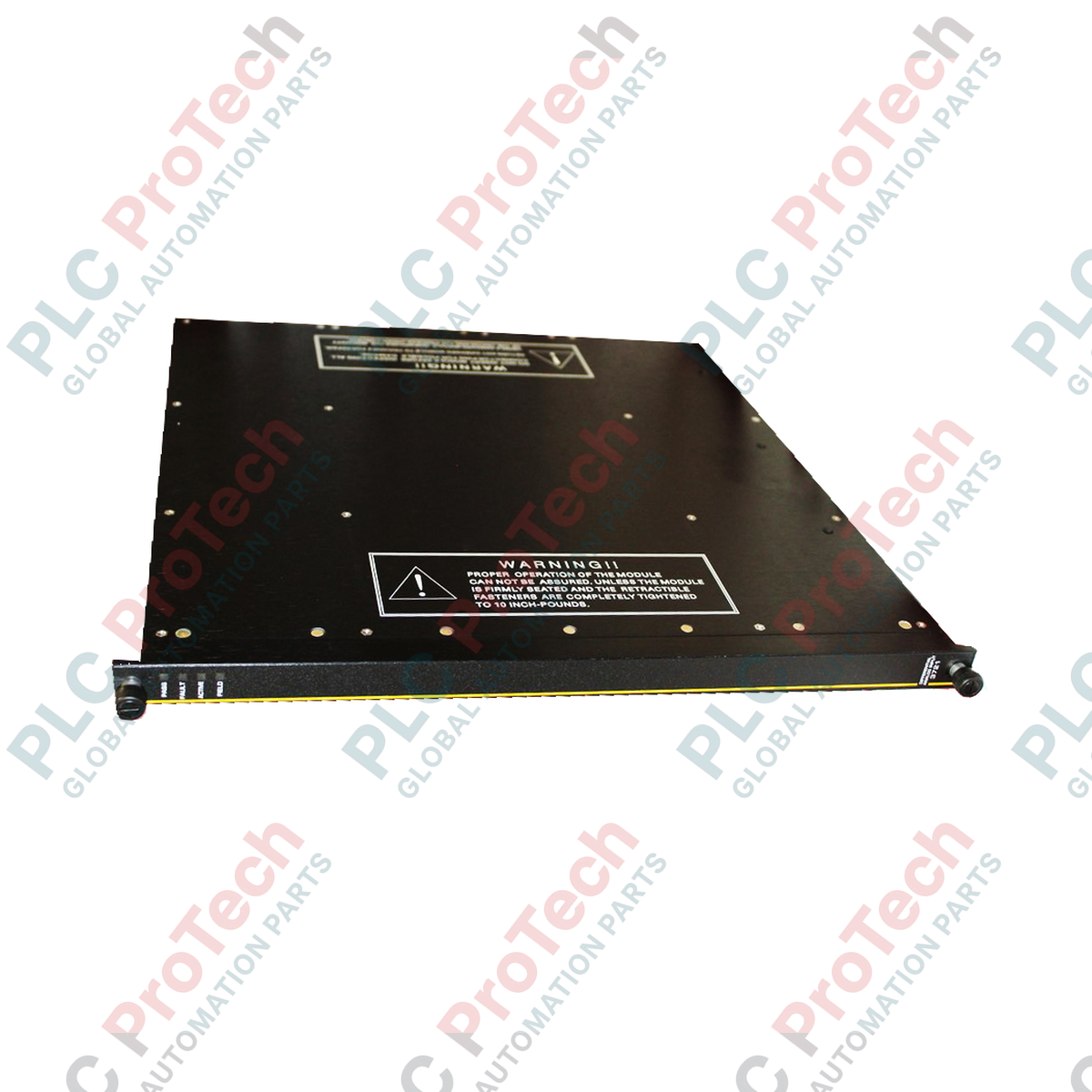
The 3721 (3721) is a high-density, Triple Modular Redundancy (TMR) Analog Input Module engineered for the Triconex safety system to ensure maximum process uptime and safety integrity. Featuring 32 differential, DC-coupled input points, this module is specifically designed to interface with critical sensors in demanding environments such as oil and gas refineries, chemical processing plants, and power generation facilities. By utilizing a triplicated architecture, the 3721 independently processes each input signal across three channels, performing hardware-based voting to eliminate single points of failure. Its rapid 10 ms update rate and programmable resolution make it indispensable for high-speed safety instrumented functions (SIF) where precise monitoring of pressure, flow, or temperature is vital to preventing catastrophic system failures.
System Architecture & Signal Processing
The 3721 module employs a sophisticated triplicated hardware design to maintain signal gold-standard accuracy even in electrically noisy industrial settings.
-
Triplicated Input Path: Each of the 32 differential inputs is isolated and routed to three independent primary communication paths. This ensures that a failure in one sensing circuit does not compromise the overall safety loop.
-
High-Resolution Accuracy: The module supports 12-bit or 14-bit programmable resolution, allowing engineers to balance data granularity with processing speed. With an accuracy of less than 0.15% of FSR, it provides reliable data for tight control limits.
-
Robust Signal Protection: To defend against field wiring errors and surges, the module features Input Overrange Protection up to 150 VDC or 115 VAC continuous, significantly reducing the risk of board-level damage during electrical faults.
Triconex 3721 Analog Input Module – Technical Specifications
| Parameter |
Specification |
| Model |
3721 |
| Brand |
Triconex (Schneider Electric) |
| Module Type |
Analog Input Module |
| Color Code |
Yellow |
| Number of Input Signals |
32 differential, DC-coupled |
| Input Voltage Range |
0 to 5 VDC or -5 to +5 VDC |
| Input Current Range |
0 to 20 mA with 250 Ω shunt resistor |
| Resolution |
12 bits or 14 bits programmable |
| Input Update Rate |
10 ms |
| Accuracy |
< 0.15% of FSR from 32° to 140° F (0° to 60° C) |
| Input Resistance (Load) |
10 MΩ (DC), minimum |
| Input Resistance at Power Off |
140 kΩ (DC), typical |
| Common Mode Rejection (typical) |
-85 dB (DC – 100 Hz) |
| Common Mode Voltage Range |
-12V to +12V peak |
| Channel-to-Channel Isolation |
420 kΩ, typical |
| Normal Mode Rejection |
-3 dB @ 23 Hz; -8 dB @ 60 Hz; -14 dB @ 120 Hz |
| Input Over-range Measurement |
+6%, -5.3 to +5.3 VDC |
| Input Over-range Protection |
150 VDC continuous, 115 VAC continuous |
| Logic Power |
< 12 watts |
| Field to System Isolation |
800 VDC minimum |
| Module Status Indicators |
Pass, Fault, Active, Field |
| Input Diagnostic Fault Coverage |
Minimum input change: 2% of full scale |
| Input Change Sample Period |
20 ms |
| Minimum Period of Mis-compares |
25 samples |
| System Compatibility |
Tricon v10.2 and later systems |
| Net Weight |
1.36 kg |
| Shipping Weight |
4.0 kg |
Technical Maintenance & FAQ
How do I switch between 12-bit and 14-bit resolution on the 3721?
The resolution is software-programmable via the TriStation 1131 configuration environment. Changing this setting allows you to optimize the module for specific sensor requirements without needing to modify physical hardware or jumpers.
What happens if a field signal exceeds 5 VDC?
The 3721 includes robust protection circuitry. It can withstand continuous exposure up to 150 VDC without sustaining permanent hardware damage, though the signal will be flagged as "Overrange" in the system diagnostics until it returns to the normal operating window.
Is the 3721 compatible with 4-20 mA signals?
Directly, the 3721 is a voltage-input module (0-5 VDC). To monitor 4-20 mA loops, you must use an external precision shunt resistor (typically 250 ohms) at the terminal assembly to convert the current signal into a 1-5 VDC signal compatible with the module.
Field Engineering & Installation Strategy
-
Differential Wiring Best Practices: For the 32 differential points, always use high-quality shielded twisted-pair (STP) cabling. Ensure the shield is grounded only at one end (typically the chassis side) to prevent ground loops that could degrade the -85 dB Common Mode Rejection performance.
-
Thermal Management: While the module is rated for 0 to 60 deg C, high-density configurations (32 points active) generate internal heat. Ensure the Tricon chassis fans are clean and provide unobstructed vertical airflow to maintain the specified 0.15% accuracy over the long term.
-
Terminal Assembly Torque: When securing field wires to the associated External Termination Assembly (ETA), apply a torque of 0.5 to 0.6 Nm. Under-tightening can cause signal drift or "Open Input" alarms due to vibration in heavy industrial environments.
Industrial Advantages & Resilience
The Triconex 3721 stands out for its superior electrical isolation and fault tolerance. Its non-commoned, differential input structure provides exceptional immunity to electromagnetic interference (EMI), which is critical when sensors are located near large motors or variable speed drives. The module supports Hot-Swap replacement, allowing maintenance teams to replace a faulty unit while the controller remains online, thereby maintaining the "Always Available" status of the safety system. With its USA-based manufacturing standards and rigorous environmental testing, the 3721 ensures a multi-decade service life in the harshest global industrial applications.