Descrição
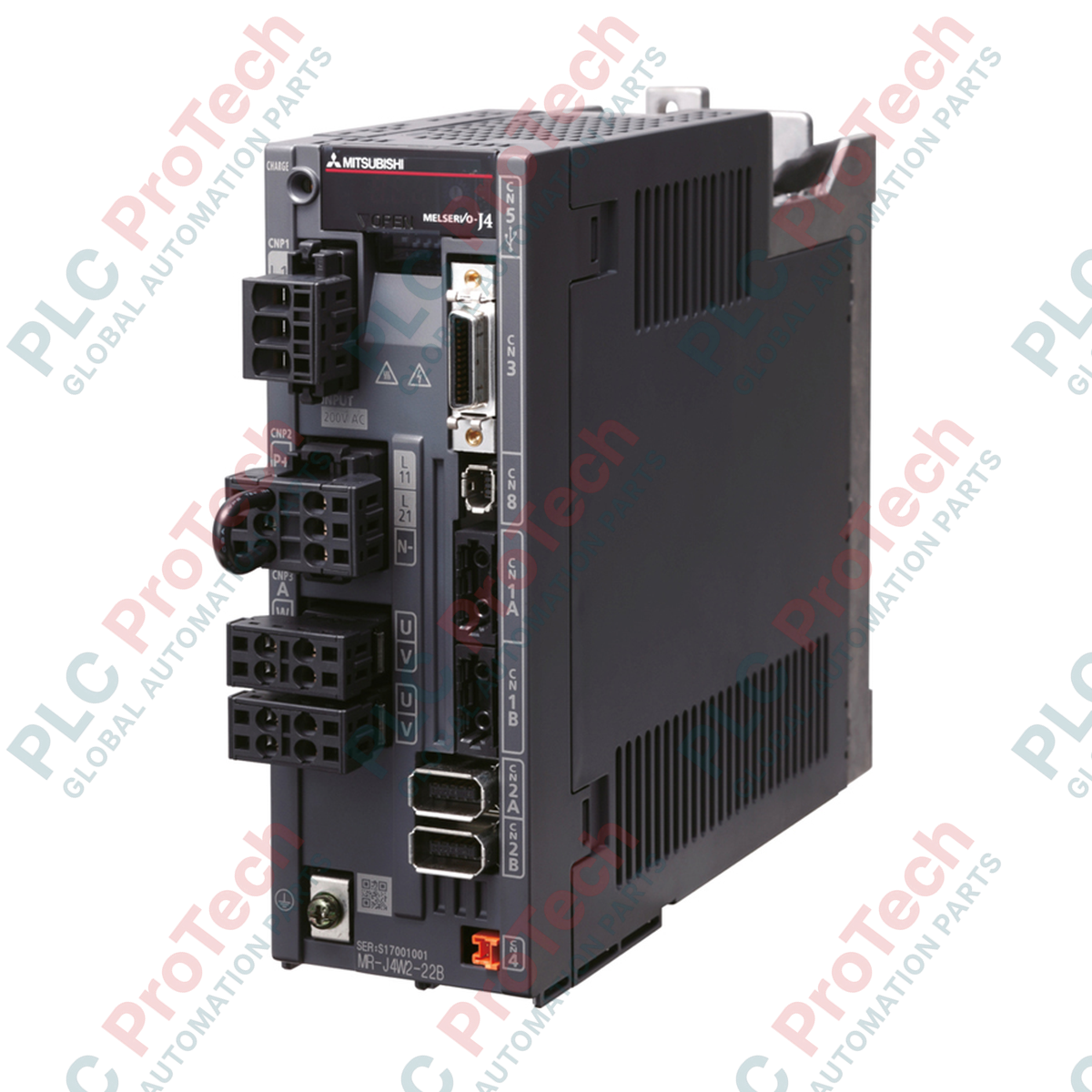
Projetado para executar o controle multieixos sincronizado em um único gabinete compacto, o Mitsubishi Electric MR-J4W2-44B é um amplificador servo CA digital de eixo duplo que opera na plataforma MELSERVO-J4. Ao consolidar a eletrônica de controle de dois eixos independentes de 0,4 kW, esta unidade reduz significativamente a área ocupada pelo painel de controle, otimiza a distribuição de energia e simplifica o roteamento da rede. A integração das comunicações de fibra óptica de alta velocidade SSCNET III/H permite uma sincronização de movimento de alta resolução com interferência eletromagnética insignificante, tornando-a uma escolha ideal para montagens automatizadas multieixos de alta velocidade.
Recursos
-
Integração de eixo duplo: aciona dois servomotores rotativos ou lineares independentes de até 0,4 kW cada, reduzindo em até 30% o espaço necessário no painel.
-
Protocolo SSCNET III/H: barramento óptico de alta velocidade operando a 150 Mbps para controle sincronizado preciso e determinístico, com imunidade total a ruídos.
-
Controle avançado de supressão de vibração II: compensa dinamicamente a ressonância mecânica tanto em elementos estruturais de alta frequência quanto na oscilação de carga de baixa frequência.
-
Ajuste com um toque: a estimativa em tempo real da razão de inércia mecânica permite o ajuste automático instantâneo dos ganhos do servomotor.
-
Suporte à segurança funcional: funções integradas de Desligamento Seguro do Torque (STO), em conformidade com padrões internacionais de segurança.
Aplicações
- Máquinas de embalagem multieixos sincronizadas e linhas de encaixotamento.
- Robôs cartesianos de alta velocidade para operações de coleta e colocação e sistemas de montagem de semicondutores.
- Mesas de posicionamento X-Y precisas e transportadores para movimentação de materiais.
- Máquinas automatizadas de bobinagem, indexação e etiquetagem.
Tabela de especificações técnicas
| Fabricante |
Mitsubishi Electric |
| Número do modelo |
MR-J4W2-44B |
| Nome da série |
MELSERVO-J4 (MR-J4) |
| Eixos controlados |
2 eixos (eixo A e eixo B) |
| Potência de saída nominal |
0,4 kW por eixo (total de 0,8 kW) |
| Interface de comunicação |
SSCNET III/H (conexão óptica) |
| Fonte de alimentação do circuito principal |
CA trifásica de 200 a 240 V, 50/60 Hz |
| Fonte de alimentação do circuito de controle |
CA monofásica de 200 a 240 V, 50/60 Hz |
| Compatibilidade do encoder |
Sistemas absolutos/incrementais de 22 bits |
| Método de resfriamento |
Resfriamento natural |
| Temperatura ambiente de operação |
0 a 55 °C (sem congelamento) |
| Dimensões (A x L x P) |
195 mm x 60 mm x 168 mm |
| Peso líquido |
1,4 kg |
| Peso de envio (calculado) |
3,5 kg |
Conexões e interfaces
| Código do terminal / conector |
Atribuição funcional |
| L1 / L2 / L3 |
Entrada da fonte de alimentação do circuito principal (200–240 V CA) |
| L11 / L21 |
Entrada da fonte de alimentação do circuito de controle |
| U / V / W (Eixo A) |
Terminais de saída do servomotor para o eixo A |
| U / V / W (Eixo B) |
Terminais de saída do servomotor para o Eixo B |
| CN1A / CN1B |
Conectores de entrada/saída do circuito de fibra óptica SSCNET III/H |
| CN2A / CN2B |
Interfaces de conexão do encoder para o Eixo A / Eixo B |
| CN8 |
Conector de sinal de segurança funcional (STO) |
Modelos alternativos e compatibilidade
A série MR-J4W2 foi projetada como a plataforma principal para configurações de múltiplos eixos no ecossistema MR-J4. Observe que, ao migrar unidades MR-J3W legadas para a configuração MR-J4W2, é necessária a tradução dos parâmetros no pacote de programação, como o GX Works2 ou o GX Works3. Embora as dimensões físicas de montagem sejam ligeiramente diferentes das unidades de eixo único, o ganho de espaço obtido com a eliminação do cabeamento independente da alimentação de controle justifica facilmente a transição.
Armadilhas de aplicação e observações de engenharia
Como o Eixo A e o Eixo B compartilham um barramento CC interno comum, a energia regenerativa de um eixo em desaceleração é naturalmente utilizada pelo segundo eixo em motorização. No entanto, se ambos os eixos passarem simultaneamente por uma desaceleração com alta inércia, a capacidade regenerativa poderá saturar rapidamente o capacitor interno, acionando uma falha de sobretensão (AL.33). Para operações com ciclos regenerativos contínuos ou alta inércia de carga, sempre calcule os requisitos totais de regeneração do sistema e conecte um resistor de regeneração externo de tamanho adequado entre os terminais L+ e L-.
Dicas de comissionamento e fiação
Ao instalar os cabos de fibra óptica SSCNET III/H (MR-J3BUS_M), não viole o raio mínimo de curvatura de 25 mm. Curvas acentuadas ou tensão excessiva das abraçadeiras no roteamento da fibra óptica atenuarão o sinal luminoso, causando falhas aleatórias na linha (AL.37) ou erros de comunicação (AL.E6). Sempre tampe as portas ópticas não utilizadas do amplificador para evitar contaminação da lente do transceptor óptico por poeira e umidade.
Diretrizes de instalação
AVISO CRÍTICO:
Risco de choque elétrico e descarga de carga residual. Sempre desconecte as fontes de alimentação do circuito principal e do circuito de controle antes de iniciar a instalação física ou a fiação. Aguarde pelo menos 15 minutos após desligar a alimentação para que as lâmpadas de carga interna na face frontal do amplificador se apaguem completamente antes de manusear as conexões dos cabos.
1
Monte o amplificador servo verticalmente em uma superfície metálica plana e sem pintura para garantir um aterramento de baixa impedância e maximizar a transferência térmica.
2
Garanta um espaçamento livre de pelo menos 40 mm acima e abaixo do invólucro e de pelo menos 10 mm em cada lado do chassi para permitir um fluxo de ar desobstruído.
3
Conecte o terminal de aterramento de proteção (PE) ao painel de aterramento do gabinete antes de conectar quaisquer fases de alimentação de entrada ou cabos do encoder.