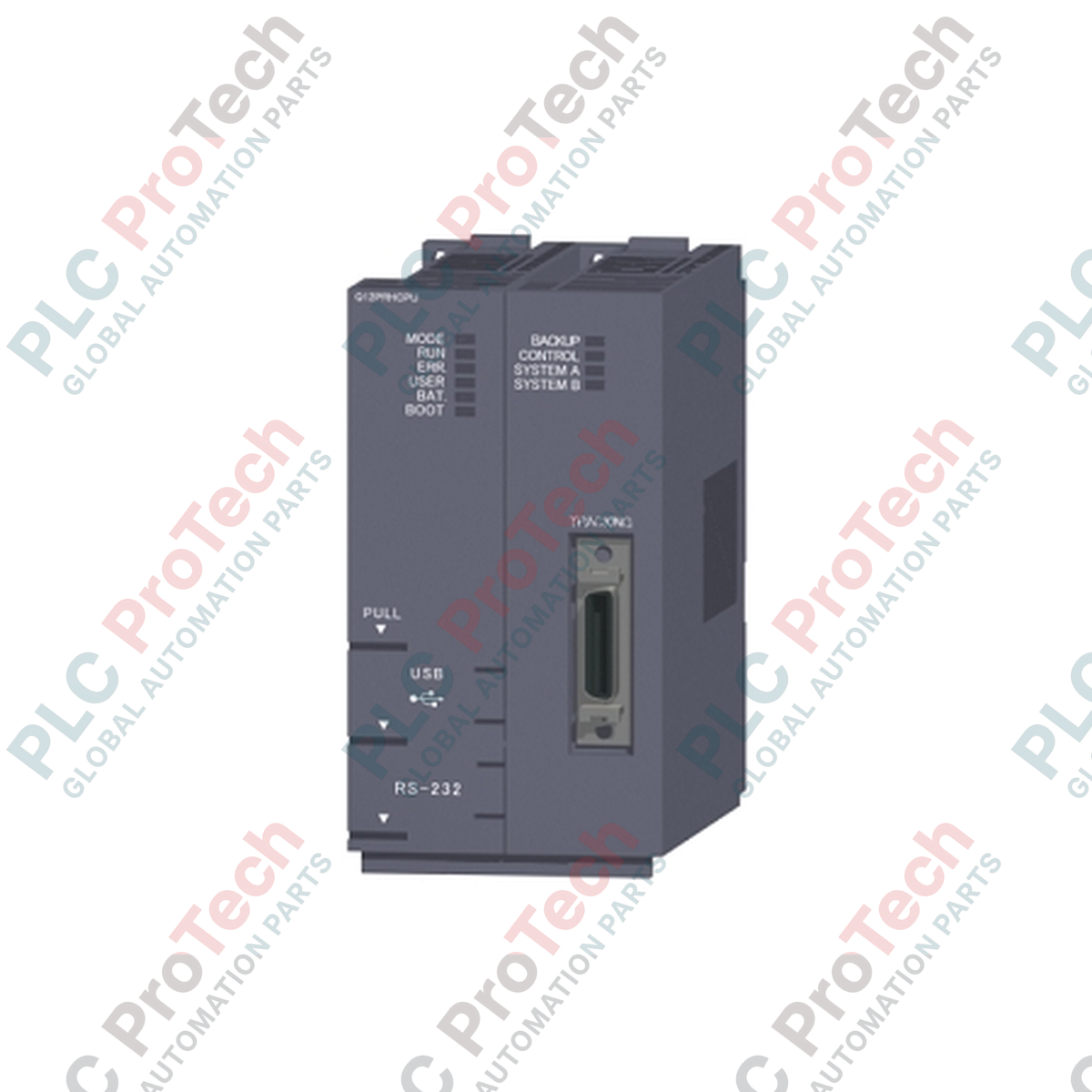
Projetado para garantir controle de alta disponibilidade em ambientes críticos de automação, o Mitsubishi Electric Q12PRHCPU opera como um módulo CPU redundante de alto desempenho dentro da plataforma MELSEC Q Series. Este módulo é projetado para evitar tempo de inatividade do sistema utilizando uma arquitetura de dupla redundância onde uma CPU reserva assume o controle instantaneamente em caso de falha da CPU principal. Possui capacidade de programa de 120k passos e suporta até 4096 pontos físicos de E/S, tornando-o adequado para operações industriais de grande escala e tolerantes a falhas.
Principais Características
-
Arquitetura de Sistema Redundante: Suporta redundância hot-standby com troca automática e sem interrupções para evitar paradas no processo.
-
Processamento de Alta Velocidade: Executa instruções LD em 34 nanossegundos (0,034 microssegundos) para rápida execução de tarefas.
-
Capacidade Hot-Swappable: Permite substituição online dos módulos CPU de reserva, fonte de alimentação e rede sem interromper o processo de controle ativo.
-
Interfaces de Programação Duplas: Equipado com portas USB (Mini-B) e RS-232 (Mini-DIN) para programação flexível, diagnóstico e monitoramento.
-
Capacidade Extensa de Memória: Oferece 120k passos de memória de programa junto com memória dedicada para rastreamento, garantindo sincronização perfeita de dados entre unidades ativas e de reserva.
Aplicações
- Tratamento de água e estações municipais de tratamento de esgoto.
- Linhas contínuas de processamento químico, petroquímico e farmacêutico.
- Geração de energia, automação de subestações e redes de distribuição de utilidades.
- Ventilação de túneis, sistemas de energia para transporte público e infraestrutura crítica.
Especificações Técnicas
| Parâmetro |
Valor da Especificação |
| Fabricante |
Mitsubishi Electric |
| Número do Modelo |
Q12PRHCPU |
| Série |
Série MELSEC Q |
| Tipo de Módulo |
Módulo CPU PLC Redundante |
| Capacidade do Programa |
120k passos (480 KB) |
| Pontos de E/S (Físicos) |
4096 pontos |
| Pontos de E/S (Dispositivo) |
8192 pontos |
| Velocidade da Instrução LD |
0,034 microssegundos (34 ns) |
| Consumo de Corrente (5 VDC) |
0,89 A |
| Temperatura de Operação |
0 a 55 °C |
| Temperatura de Armazenamento |
-25 a 75 °C |
| Umidade Relativa |
5 a 95% UR (sem condensação) |
| Peso Líquido |
0,30 kg |
| Peso para Envio (Calculado) |
2,00 kg |
| Dimensões (L x A x P) |
27,4 mm x 98 mm x 115 mm |
| País de Origem |
Japão |
Conexões e Interfaces
| Porta de Interface |
Tipo de Conector |
Atribuição Funcional |
| Porta RS-232 |
Mini-DIN 6 pinos |
Programação serial, conexão periférica e diagnóstico do sistema. |
| Porta USB |
Mini-B |
Programação, monitoramento e configuração de parâmetros em alta velocidade via GX Works2. |
| Porta de Rastreamento |
Conector Redundante Dedicado |
Conexão de cabo de rastreamento de alta velocidade para sincronizar a memória com a CPU reserva. |
Insights Empíricos de Engenharia
Modelos Alternativos e Compatibilidade
O Q12PRHCPU deve ser usado em conjunto com unidades base redundantes (como Q38RB ou Q68RB) e módulos de fonte de alimentação redundantes (Q61P-D). Ele não pode ser misturado com CPUs padrão da série Q em uma unidade base padrão para operações redundantes. Ao substituir módulos Q12HCPU mais antigos, observe que unidades base padrão não redundantes são incompatíveis com a interface física de rastreamento e o roteamento de barramento duplo da série redundante.
Armadilhas de Aplicação e Notas de Engenharia
O comprimento do cabo de rastreamento é uma restrição crítica. Cabos de rastreamento padrão (QC10TR ou QC30TR) são limitados a 3 metros. Ultrapassar essa distância ou usar cabos personalizados sem blindagem pode introduzir interferência eletromagnética, levando a falhas na sincronização do rastreamento (como "SP.UNIT LAY. ERR" ou "CONTROL CPU ERROR"). Além disso, otimize as configurações de tamanho dos dados de rastreamento no GX Works2 para evitar extensões excessivas do tempo de varredura durante os ciclos de sincronização.
Dicas de Comissionamento e Cabeamento
Antes de ligar o sistema redundante, verifique se ambos os módulos CPU primário (Sistema A) e reserva (Sistema B) possuem versões de firmware idênticas. Discrepâncias no firmware podem impedir que a CPU reserva entre no estado "BACKUP", deixando o sistema em modo de operação não redundante com uma única CPU. Sempre faça o download de arquivos de parâmetros e blocos de programa idênticos para ambas as unidades antes de executar a sincronização inicial do sistema.
Diretrizes de Instalação
AVISO CRÍTICO:
Certifique-se de que todas as fontes de alimentação externas que alimentam a unidade base e os racks de E/S associados estejam completamente desenergizadas antes de montar ou remover os módulos CPU. A falha em isolar a energia pode resultar em arco elétrico, danos ao barramento interno da placa traseira ou mudanças inesperadas no estado do sistema de controle.
1
Monte o módulo CPU com segurança na unidade base redundante (Q38RB ou Q68RB), garantindo que a aba de travamento inferior encaixe firmemente no lugar.
2
Conecte o cabo de rastreamento dedicado entre as portas de rastreamento dos dois módulos Q12PRHCPU para estabelecer o link de sincronização.
3
Fixe os conectores do cabo de rastreamento usando os parafusos de retenção integrados para evitar desconexões acidentais devido à vibração do painel.
4
Estabeleça uma conexão funcional sólida de aterramento a partir dos terminais LG e FG da unidade base até o barramento de aterramento do gabinete principal de controle.