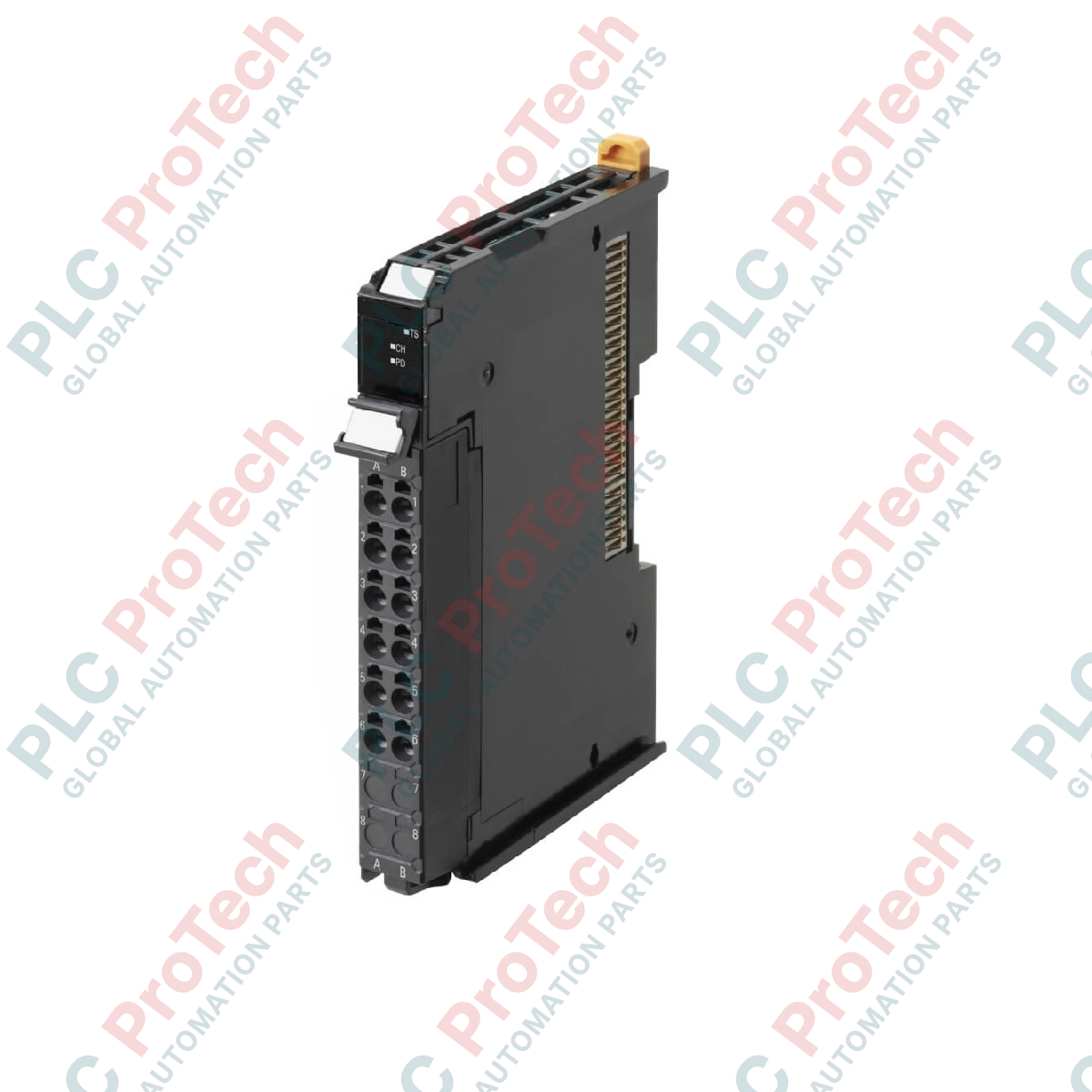
Descrição
Integrando o rastreamento térmico de alta resolução diretamente aos sistemas de automação Sysmac, o Omron NX-TS2204 oferece monitoramento de detectores de temperatura por resistência de canal duplo para processos industriais de alta precisão. Operando na arquitetura de barramento NX de alta velocidade, este módulo é compatível com sensores Pt100 e Pt1000 de três fios, com velocidade de conversão rápida de 60 ms por unidade e uma excepcional resolução de medição de 0,001 °C. Projetado para manter a integridade do sinal em ambientes com ruído elétrico, ele incorpora isolamento galvânico entre canais e entre canal e barramento por meio de transformadores de alimentação integrados e isoladores digitais de sinal.
Recursos
- Configuração de entrada dupla compatível com sensores RTD Pt100 e Pt1000 padrão de três fios.
- Resolução de processamento ultrafina de no máximo 0,001 °C para aplicações de controle de processos sensíveis.
- O método de atualização em execução livre garante atualizações assíncronas e contínuas da temperatura, independentemente dos ciclos de tarefa.
- Formato de alta densidade com 12 mm de largura, que economiza espaço valioso no painel em montagem padrão em trilho DIN.
- Bloco de terminais de fixação sem parafusos com 16 pontos, para uma fiação de campo rápida, segura e estanque a gases.
- Barreiras de isolamento avançadas entre os canais de entrada e os circuitos internos do barramento NX para evitar interferências causadas por loops de terra.
Aplicações
- Controle térmico multizona em equipamentos de extrusão, moldagem por injeção e termoformagem de plásticos.
- Monitoramento de câmaras ambientais e processos industriais de secagem de alta precisão.
- Sistemas de pasteurização e cozimento em linhas de alimentos, bebidas e embalagens.
- Registro das condições ambientais de salas limpas e monitoramento de HVAC em instalações de fabricação de semicondutores.
Especificações técnicas
| Parâmetro de especificação |
Valor técnico |
| Fabricante |
Omron |
| Número do modelo |
NX-TS2204 |
| Tipo de produto |
Unidade de entrada de temperatura (termômetro de resistência) |
| Número de entradas |
2 pontos |
| Sensores de temperatura compatíveis |
Pt100 (três fios), Pt1000 (três fios) |
| Tempo de conversão |
60 ms por unidade |
| Resolução |
Máximo de 0,001 °C |
| Método de atualização de E/S |
Atualização em execução livre |
| Terminais de conexão externa |
Bloco de terminais de fixação sem parafusos (16 terminais) |
| Faixa de conversão de entrada |
±20 °C da faixa de entrada |
| Corrente de detecção de entrada |
Aproximadamente 0,25 mA |
| Efeito da resistência do condutor |
Máximo de 0,06 °C/Ohm (até no máximo 20 Ohms) |
| Requisito do período de aquecimento |
30 minutos |
| Método de isolamento |
Alimentação: transformador; Sinal: isolador digital (entrada para barramento e canal para canal) |
| Resistência de isolamento |
Mínimo de 20 MOhms entre circuitos isolados (a 100 VCC) |
| Rigidez dielétrica |
510 VCA entre circuitos isolados por 1 minuto (corrente de fuga de no máximo 5 mA) |
| Consumo de energia da unidade NX |
0,90 W máx. (na unidade da CPU); 0,75 W máx. (no acoplador de comunicação) |
| Método de alimentação da E/S |
Não é necessária fonte de alimentação externa para E/S |
| Dimensões (L x A x P) |
12 x 100 x 71 mm |
| Peso da unidade |
0,07 kg |
| Peso de envio |
1,00 kg |
Insights de engenharia empíricos
Modelos alternativos e compatibilidade
O NX-TS2204 é uma unidade de entrada RTD altamente especializada. Se o seu sistema depender de entradas de termopar em vez de termômetros de resistência, o NX-TS2101 ou NX-TS2102 deverá ser selecionado. Certifique-se de que o software Sysmac Studio esteja atualizado de acordo com a revisão do firmware da CPU da série NX ou do acoplador de comunicação, para garantir todos os recursos de configuração de parâmetros.
Armadilhas de aplicação e observações de engenharia
É estritamente necessário um período de aquecimento de 30 minutos após ligar a fonte de alimentação, para garantir que os componentes internos atinjam um equilíbrio térmico estável. O monitoramento preciso da temperatura depende de resistências equilibradas nos condutores; um desequilíbrio entre os três fios do sensor RTD causará diretamente um desvio na medição da temperatura, adicionando no máximo 0,06 °C por Ohm de discrepância de resistência.
Dicas de comissionamento e cabeamento
Sempre passe os cabos dos sensores por canaletas dedicadas para instrumentação de baixa tensão, separadas das linhas de CA de alta potência. Recomendamos aterrar a blindagem dos cabos RTD em um único ponto próximo ao módulo para evitar correntes circulantes e o acoplamento de ruído na blindagem. Verifique novamente se os pinos dos terminais estão inseridos com uma ponteira corretamente crimpada, para garantir o melhor contato a longo prazo em painéis sujeitos a alta vibração.
Diretrizes de instalação
AVISO CRÍTICO: CHOQUE ELÉTRICO E DANOS AO SISTEMA
Isole todas as fontes de alimentação elétrica que fornecem energia ao rack do PLC e aos dispositivos de entrada antes de inserir, remover ou conectar qualquer módulo NX. A falha em desenergizar todo o sistema de controle pode causar movimentos inesperados da máquina, choque elétrico ou danos permanentes ao circuito de comunicação do backplane do NX.
1
Monte o módulo no trilho DIN alinhando o gancho superior da unidade ao trilho e pressionando-o para baixo até que a trava se encaixe firmemente.
2
Conecte os sensores Pt100/Pt1000 de três fios ao bloco de terminais de fixação sem parafusos inserindo uma ferramenta de ponta chata no orifício de liberação, inserindo o fio e removendo a ferramenta para travá-lo.
3
Ligue o sistema e monitore o indicador "TS" no painel frontal: uma luz verde fixa indica o status normal de operação, enquanto indicadores vermelhos piscam para sinalizar erros de diagnóstico, como fios rompidos ou curtos-circuitos nos sensores.