1 of 1

EPP7342-0002 | BECKHOFF | Boîtier EtherCAT P

EPP7342-0002 | BECKHOFF | Boîtier EtherCAT P

Il ne reste que 10 article(s) en stock
  • Fabricant : BECKHOFF

  • N° de produit : EPP7342-0002

  • Pays d'origine :Allemagne

  • Type de produit : Boîte EtherCAT P

  • Paiement : Virement bancaire, Western Union

  • Poids : 500g

  • Dimensions : 30 mm x 126 mm x 26.5 mm

  • Port d'expédition : Xiamen

  • Garantie : 12 mois

Quantité
Voir les détails complets

Description

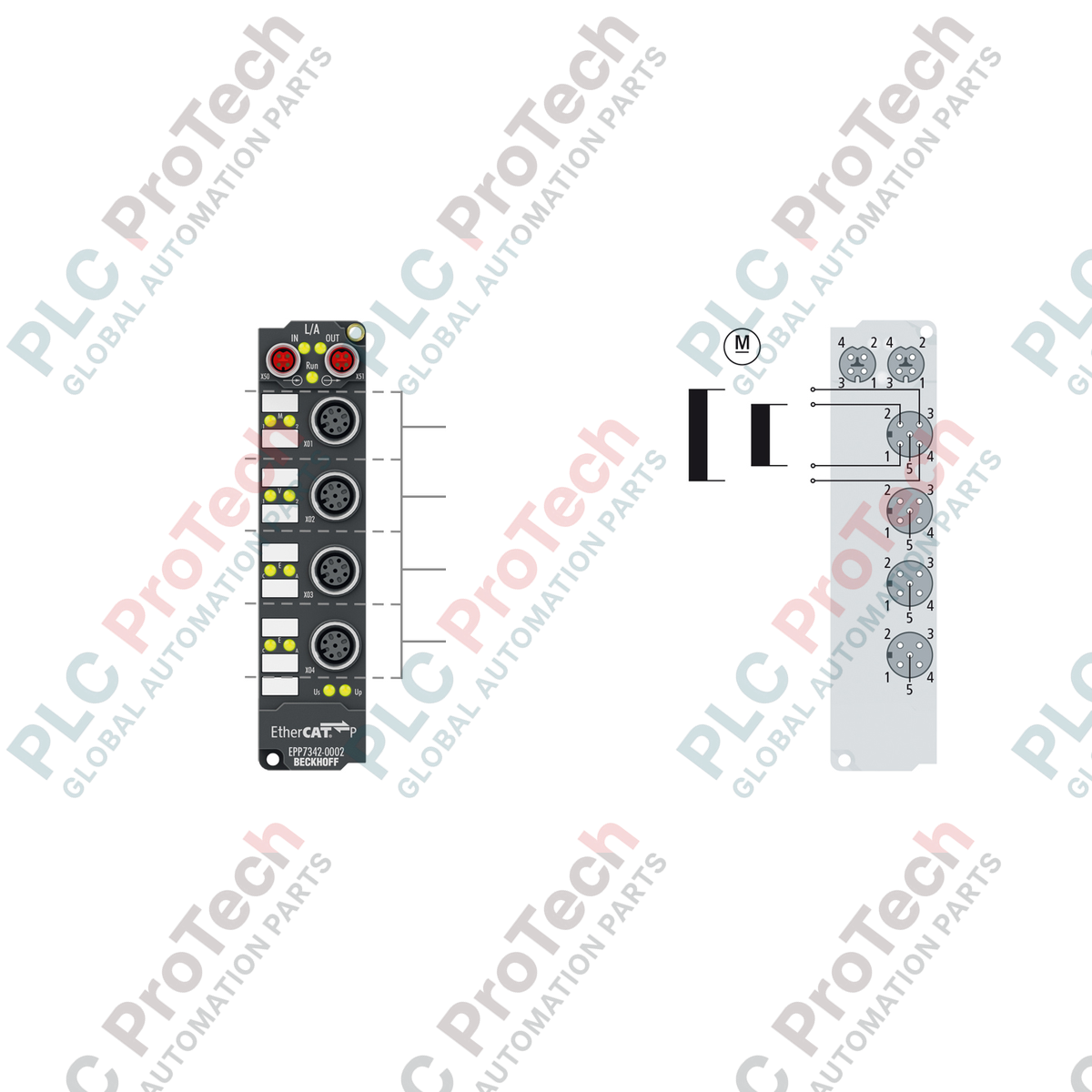
Decentralized motion control in demanding environments is efficiently handled by the BECKHOFF EPP7342-0002, a rugged, dual-channel DC motor output stage designed directly for field installation. This high-performance EtherCAT P Box integrates dual-channel drive control for small DC brush motors with built-in incremental encoder inputs, facilitating closed-loop positioning directly on the machine frame. By utilizing EtherCAT P technology, the device combines ultra-fast communication and power supply (both system/sensor voltage US and peripheral power for actuators UP) into a single, standardized M8 connection, drastically reducing cabling complexity, weight, and installation footprints in modular machine designs.

Features

  • Dual-channel DC brush motor control with integrated travel distance control functionality.
  • Dynamic 32 kHz PWM clock frequency utilizing a 180-degree phase shift to minimize peak currents and reduce electromagnetic emissions.
  • Built-in incremental encoder feedback interface for precise speed, velocity, and positioning feedback loops.
  • Fully short-circuit-proof output stages with a common thermal overload warning system mapped directly to the controller.
  • Integrated Distributed Clocks (DC) support, allowing synchronization with microsecond precision across the EtherCAT network.
  • High environmental protection rating (IP65/66/67) for direct machine mounting without requiring protective electrical enclosures.

Applications

  • Decentralized conveyor drive systems, sorting mechanisms, and divert gates in high-throughput logistics.
  • Format adjustments, motorized guide positioning, and automated tooling alignment in packaging machinery.
  • Intralogistics drive units, automated guided vehicles (AGVs), and compact transfer shuttles.
  • Distributed auxiliary motion axes in packaging, printing, and automated assembly cells.

Technical Specifications

Parameter Specification Value
Manufacturer BECKHOFF
Model Number EPP7342-0002
Product Series EtherCAT P Box (EPP)
Protocol EtherCAT
Number of Channels 2 Outputs
Rated Load Voltage 8 to 48 V DC
Load Type DC brush motor, inductive loads
Output Current Max. 3.5 A per channel (short-circuit proof)
Duty Factor 0 to 100% (voltage-controlled)
Internal Resolution Max. 10-bit current, 16-bit speed
Electrical Isolation 500 V
Current Consumption (from US) Typ. 100 mA
Housing Material PA6 Polyamide
IP Rating IP65, IP66, IP67 (conforms to EN 60529)
Operating Temperature -25 to +60 degC
Storage Temperature -40 to +85 degC
Dimensions (W x H x D) 30 mm x 126 mm x 26.5 mm
Weight Approx. 165 g
Shipping Weight (Calculated) 2.0 kg (packaged)

Connections and Interfaces

Connector Type Connection Assignment
Bus Interface (2 x M8) Screw type, shielded, P-coded (EtherCAT P input and output loop)
Motor Connection (M12) M12 x 1, 5-pin, A-coded (DC output and feedback signals)
Housing Sockets Integrated 8 x M8 and 4 x M12 interfaces

Empirical Engineering Insights

Alternative Models & Compatibility

The EPP7342-0002 utilizes EtherCAT P, meaning it cannot be used directly in traditional standard EtherCAT (EP series) chains without a dedicated junction or feed-in box (such as the EP9224-0037). Ensure that your TwinCAT configuration files (ESI) are updated to match the EtherCAT P device profile to ensure hassle-free integration and scanning in the TwinCAT system manager.

Application Pitfalls & Engineering Notes

When sizing DC motors, pay close attention to the 3.5 A limit per channel. If both output stages trigger thermal overload concurrently, the module reports a common thermal overload warning. When running inductive loads or motors with high regenerative energy on deceleration, external transient voltage suppression must be planned if the returned energy exceeds the absorption capabilities of the system power supply line.

Commissioning & Wiring Tips

Proper grounding of the fieldbus shielding is imperative. Always use pre-assembled, fully shielded M8 P-coded cabling for the EtherCAT P line to prevent noise injection from adjacent high-voltage motor cables. The encoder lines must also be shielded and routed away from high-noise AC lines to maintain continuous signal integrity during operation.

Installation Guidelines

CRITICAL WARNING

Before starting any mounting, connection, or service procedures on the module, ensure that the power supply of the entire EtherCAT P segment is completely de-energized. Verify the system has bled residual electrical charges. Failure to isolate power can result in transient arcs, damage to the internal output stages, or permanent controller disruption.

1

Securely mount the EtherCAT P Box to a flat, stable surface using the two integrated 3.5 mm mounting holes designed for M3 screws.

2

Connect the incoming EtherCAT P cable to the M8 input socket (P-coded) and connect the outgoing cable to the subsequent downstream box.

3

Ensure unused M8 and M12 sockets are sealed with official IP67 protective caps to prevent moisture, dust, and contaminant ingress.

4

Connect the motor outputs and incremental encoder lines, verifying the pin alignment against your machine schematic before energizing.

Loading product navigation…

Can this module run with standard EtherCAT cables?

No, it requires standard EtherCAT P cables which utilize P-coded M8 connectors. Standard EtherCAT lines use different coding and are physically incompatible with EtherCAT P boxes.

What is the consequence of a thermal overload on one of the channels?

This box features a common thermal overload warning system for both stages. If one channel experiences an overload, a common error bit is set in the process image for control-level diagnostics.

How do you configure motor parameters like current limit and deceleration?

Motor and controller parameters are directly configured through the CoE (CanOverEtherCAT) directory of the device within the TwinCAT system manager.

Does this box require a protective enclosure?

No, the device features an IP65/66/67 rated enclosure (PA6 polyamide), allowing direct field mounting directly on machines without additional protective housing.

Expédition express mondiale

  • Livraison standard : 4 à 6 jours ouvrables via DHL, FedEx et UPS.
  • Expédition express : Expédition le jour même pour les commandes en stock passées avant 14h00 (GMT+8).
  • Couverture mondiale : Service dans plus de 150 pays, avec livraison rapide en Arabie Saoudite et aux Émirats arabes unis.

Retours et garantie

  • Garantie de 30 jours : Retours acceptés pour les produits en stock dans leur emballage d'origine scellé en usine.
  • Garantie de 12 mois : Chaque composant industriel est couvert par notre garantie technique professionnelle.

Les commandes sont traitées et livrées du lundi au vendredi (hors jours fériés).


Pour connaître l'éligibilité complète, les frais de restockage et les détails des retours internationaux, veuillez consulter notre site officiel Politique de remboursement et de retour .

TECHNICAL SPECIFICATIONS

Country of origin
Allemagne

Produits récemment consultés

Connaissances techniques

Actionneurs électriques conçus pour remplacer les systèmes à fluide : un guide pratique d'automatisation industrielle

Cet article explique comment les actionneurs électriques intégrés, tels que la série e-Actuator de SMC, transforment le contrôle du mouvement industriel en remplaçant les systèmes pneumatiques et...

Opérations mathématiques avec OpenPLC pour les applications d'automatisation industrielle

Cet article explique comment les systèmes PLC réalisent des opérations mathématiques de base telles que l'addition, la soustraction, la multiplication, la division, le modulo et l'exponentiation dans...

Logique booléenne avancée avec la programmation FBD PLC : applications industrielles pratiques au-delà de la logique de base

L'article explique plusieurs fonctions avancées de la logique booléenne utilisées en programmation d'automates programmables industriels (API) au-delà des opérations de base ET, OU et NON. Il aborde...

Logique booléenne en programmation PLC : comprendre les portes logiques FBD

La logique booléenne est la base de tout programme PLC. Des commandes machines simples aux systèmes d'automatisation industrielle complexes, les portes logiques déterminent comment les contrôleurs...

Guide approfondi sur les pare-feux industriels et la segmentation des réseaux OT

Les pare-feux industriels jouent un rôle crucial dans la cybersécurité OT, protégeant les réseaux PLC, DCS et SCADA grâce à la segmentation, au contrôle des entrées/sorties et à l’intégration IDS/IPS...

Guide des pinces robotiques : de la manipulation délicate à l'automatisation lourde

Les pinces robotiques modernes évoluent au-delà des mâchoires mécaniques traditionnelles. Des systèmes adhésifs inspirés des geckos aux pinces souples de qualité alimentaire, en passant par des...