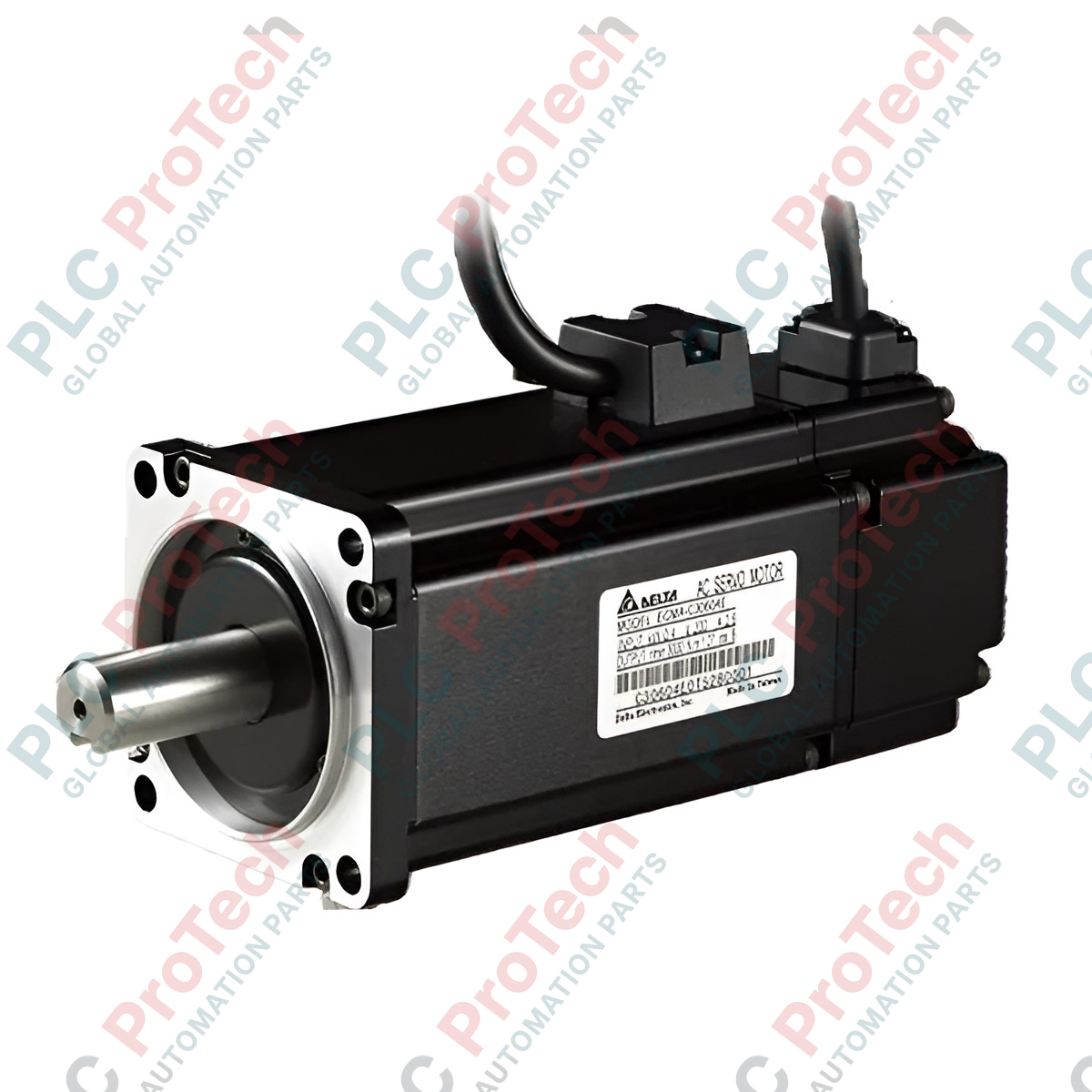
Présentation du mouvement industriel à couple élevé
Le ECMA-E21310SS (ECMA-E21310SS) est un moteur servo synchrone AC robuste conçu par Delta pour des applications industrielles de contrôle de mouvement à haute précision et inertie moyenne. Fonctionnant à une puissance nominale solide de 1 kW, ce moteur à commutation électrique offre un équilibre optimisé entre vitesse et couple moteur important. Dans des opérations lourdes exigeantes telles que les centres d'usinage CNC multi-axes, les presses d'impression industrielles automatisées et les lignes d'alimentation continue de matériaux, le ECMA-E21310SS maintient une intégrité absolue de positionnement et réduit les arrêts de production imprévus grâce à sa construction robuste de cadre 130 mm et son encodeur optique intégré. Équipé d'un frein électromagnétique interne robuste, ce moteur assure une sécurité immédiate de maintien de charge et un verrouillage de position lors de coupures de courant soudaines ou d'arrêts d'urgence à l'échelle de l'usine.
Décomposition du suffixe du numéro de pièce
Delta utilise une matrice alphanumérique standard pour présenter le profil physique et électrique de la série de moteurs ECMA :
-
ECM : Moteur à commutation électrique (type de produit)
-
A : Moteur servo AC (classification de conduite)
-
E2 : Plateforme de conception série E2
-
E : Tension d'entrée 220 V AC / vitesse nominale standard 2000 tr/min
-
2: Configuration d'encodeur optique incrémental 17 bits
-
13: Taille de bride de cadre moteur de 130 mm
-
10: Capacité de puissance de sortie nominale de 1 kW
-
S : Configuré avec un frein de maintien intégré, un joint d'huile robuste et une clavette avec trou de vis
-
S : Diamètre d'arbre standard selon spécification
Paramètres mécaniques & électriques critiques
Le tableau de spécifications suivant définit les conditions limites électriques, mécaniques et environnementales principales pour l'intégration technique :
| Paramètre |
Spécifications |
| Modèle |
ECMA-E21310SS |
| Marque |
DELTA |
| Origine |
Taïwan |
| Taille de la bride |
130 mm |
| Puissance de sortie nominale |
1 kW |
| Tension d'alimentation nominale |
220 V AC |
| Vitesse de rotation nominale |
2000 tr/min |
| Vitesse de rotation maximale |
3000 tr/min |
| Mécanisme de retour d'information |
Encodeur incrémental 17 bits (131 072 impulsions/tour) |
| Configuration de l'arbre |
Clavette avec trou de vis (diamètre standard) |
| Frein de maintien |
Frein électromagnétique intégré inclus |
| Protection environnementale |
Joint d'huile intégré |
| Température de fonctionnement |
0 à 40 °C (non congelant) |
| Poids net |
2,00 kg |
| Poids d'expédition |
3,00 kg |
Base de connaissances techniques & questions fréquentes
Quels sont les avantages en termes de résolution de l'encodeur incrémental intégré 17 bits ?
Le système de retour incrémental 17 bits offre une résolution précise de 131 072 impulsions de retour par révolution mécanique. Ce niveau de résolution permet au servo-variateur associé d'atteindre une stabilité de vitesse supérieure à basse fréquence de fonctionnement et élimine les vibrations mécaniques en réinjectant des ajustements de position continus dans la boucle de vitesse.
Comment entretenir le joint d'huile intégré pour une durée de vie maximale ?
Le joint d'huile intégré ne nécessite pas d'entretien manuel mais doit être correctement lubrifié par éclaboussures d'huile ou bain d'huile du réducteur attaché pour éviter l'usure par friction sèche. Lors du montage direct sur des composants mécaniques ouverts, veillez à ce que la poussière abrasive ou les copeaux métalliques tranchants ne s'accumulent pas autour de la lèvre de l'arbre, car cela pourrait déchirer le joint en caoutchouc et compromettre le logement du palier interne.
Quel est le comportement de la consommation électrique du frein mécanique intégré ?
Le frein électromagnétique intégré fonctionne avec une alimentation externe standard de 24 VDC et est entièrement chargé par ressort. Il nécessite une alimentation continue pour libérer le mécanisme de freinage et permettre la rotation. En cas de coupure d'alimentation, le frein s'enclenche automatiquement. Assurez-vous que l'alimentation externe est dimensionnée pour supporter le courant d'appel inductif initial de la bobine interne sans chute de tension.
Mise en service sur site & consignes de sécurité
-
Alignement de la charge mécanique en porte-à-faux : Lors du montage de la bride de 130 mm sur des réducteurs rigides ou des poulies de synchronisation directes, utilisez un comparateur pour vérifier la concentricité de l'arbre. Les erreurs d'alignement radial ou axial dépassant les tolérances d'usine exercent une contrainte excessive sur le palier avant, accélérant la défaillance du joint d'huile, induisant la fatigue de l'arbre et générant un bruit audible à haute fréquence lors de cycles d'accélération élevés.
-
Suppression des arcs inductifs et séquençage du frein : Ne branchez jamais le frein mécanique 24 VDC directement aux sorties du PLC. Utilisez un relais d'isolation intermédiaire à haute vitesse équipé d'une diode de roue libre connectée en parallèle avec la bobine du frein. Cette configuration supprime les pics de tension inductifs élevés qui dégradent les contacts de commutation et assure une séparation temporelle correcte entre l'activation du servo et le relâchement du frein mécanique.
-
Gestion thermique de l'enceinte et du moteur : Installez le moteur dans un espace où la température ambiante est inférieure à 40 °C. Pour les opérations continues à couple élevé, assurez-vous que le moteur est monté sur une structure métallique solide afin de faciliter le transfert thermique par conduction. Soufflez périodiquement toute accumulation de brouillard d'huile, de poussière ou de débris d'usine sur les ailettes de refroidissement du moteur pour maintenir une dissipation convective efficace.