Présentation du produit
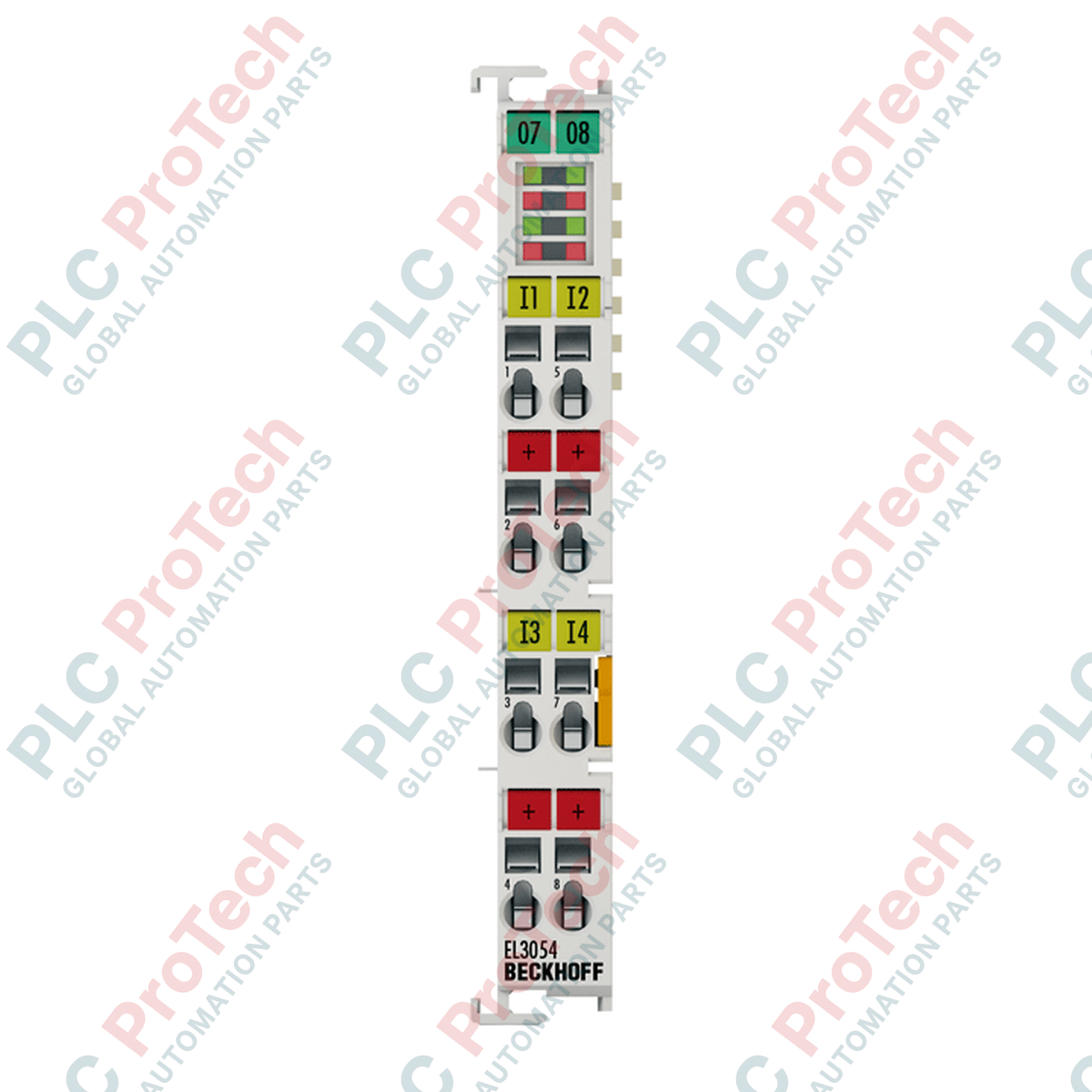
Le EL3054 (EL3054) est un bornier d'entrée analogique 4 canaux à haute densité conçu pour le système EtherCAT I/O. Il est conçu pour traiter des signaux de courant standard 4 à 20 mA provenant d'appareils de terrain tels que transmetteurs de pression, capteurs de niveau et débitmètres. Doté d'une résolution 12 bits, le EL3054 offre une solution économique mais précise pour les tâches d'automatisation industrielle B2B. Sa technologie single-ended permet d'intégrer quatre canaux d'entrée indépendants dans un bornier compact de 12 mm de large, maximisant ainsi l'efficacité de l'espace sur rail DIN. Les diagnostics intégrés et le filtrage du signal en font un choix fiable pour l'ingénierie des procédés et la construction générale de machines.
Configuration technique (détail)
Le EL3054 fonctionne selon une méthode de conversion multiplexée avec un temps de conversion par défaut de 0,625 ms. Cela le rend bien adapté aux variables de procédé standard où une synchronisation à très haute vitesse (Distributed Clocks) n'est pas nécessaire. Pour garantir la qualité du signal dans des environnements industriels bruyants, le bornier dispose de filtres FIR (Finite Impulse Response) et IIR (Infinite Impulse Response) configurables par logiciel, ainsi que d'un filtre d'entrée matériel avec une fréquence limite de 1 kHz.
Le bornier mappe ses données dans une image de processus de 16 octets, supportant les formats standard et compact. Il inclut également une surveillance des valeurs limites, permettant le déclenchement interne de bits d'état si un signal dépasse des seuils définis par l'utilisateur. L'appareil est conçu pour une utilisation robuste, avec une isolation électrique de 500 V et une certification ATEX pour une installation en zone dangereuse 2.
Caractéristiques techniques
| Attribut |
Détails de la spécification |
| Modèle |
EL3054 |
| Marque |
BECKHOFF |
| Nombre d'entrées |
4 (Single-ended) |
| Plage de signal |
4 à 20 mA |
| Résolution |
12 bits (présentation 16 bits) |
| Temps de conversion |
0,625 ms (par défaut, configurable) |
| Fréquence du filtre d'entrée |
1 kHz |
| Erreur de mesure |
< ±0,3 % (par rapport à l'échelle complète) |
| Résistance interne |
Typiquement 85 Ω |
| Consommation de courant (E-bus) |
Typiquement 130 mA |
| Isolation électrique |
500 V (E-bus / tension de signal) |
| Dimensions (L x H x P) |
12 mm x 100 mm x 68 mm |
| Homologations |
CE, UL, ATEX (II 3 G Ex nA IIC T4 Gc) |
FAQ techniques
Quel est l'avantage de la densité 4 canaux dans le EL3054 ?
En offrant quatre canaux dans un seul boîtier de 12 mm, le EL3054 réduit le nombre total de borniers nécessaires dans une armoire de commande. Cela est particulièrement avantageux pour les constructeurs de machines B2B cherchant à réduire les coûts matériels et la taille des panneaux sans sacrifier le nombre d'E/S.
Ce bornier prend-il en charge la détection de coupure de fil ?
Oui. Comme la plage de signal commence à 4 mA, toute lecture de courant significativement inférieure à ce seuil (par exemple, 0 mA) est immédiatement reconnue par le PLC comme une coupure de fil ou une défaillance du capteur, fournissant ainsi un diagnostic de sécurité inhérent.
Une configuration logicielle est-elle nécessaire pour le EL3054 ?
Aucune adresse ni configuration complexe n'est requise pour une utilisation basique ; le bornier est « Plug and Play » dans le réseau EtherCAT. Cependant, des fonctionnalités avancées comme les réglages des filtres FIR/IIR et des valeurs limites peuvent être facilement ajustées via les paramètres TwinCAT CoE (CanOpen over EtherCAT).
Guide d'ingénierie et d'installation
-
Câblage et intégrité du signal : Pour les signaux analogiques, l'utilisation de câblage blindé est essentielle. La tresse de blindage doit être reliée à la terre fonctionnelle (FE) via un bus de blindage ou une pince à faible impédance à l'entrée du bornier afin d'éviter que les interférences électromagnétiques ne perturbent les mesures 12 bits.
-
Connexion single-ended : En configuration single-ended, les quatre entrées partagent une masse interne commune. Assurez-vous que les capteurs connectés sont compatibles avec cette architecture à référence commune pour éviter les boucles de masse.
-
Maintenance : Le EL3054 supporte le câblage enfichable série ES, permettant de retirer l'ensemble du niveau de câblage pour maintenance ou remplacement du bornier sans déconnecter les fils individuels des capteurs. Cela réduit les temps d'arrêt et évite les erreurs de câblage lors de l'entretien.
Avantages d'ingénierie
Le EL3054 offre un équilibre idéal entre densité et performance. Sa résolution 12 bits est suffisante pour la grande majorité des tâches de surveillance industrielle, tandis que le filtre d'entrée 1 kHz atténue efficacement les bruits électriques haute fréquence. La conformité à la norme EN 61000-6-2/4 pour la compatibilité électromagnétique garantit un fonctionnement fiable même lorsqu'il est monté à proximité de composants haute puissance comme les variateurs de fréquence. Pour les ingénieurs, l'intégration dans l'écosystème Beckhoff permet une cartographie fluide des valeurs analogiques dans les variables PLC, facilitant le développement rapide d'applications sophistiquées de surveillance et de contrôle.