Présentation du produit
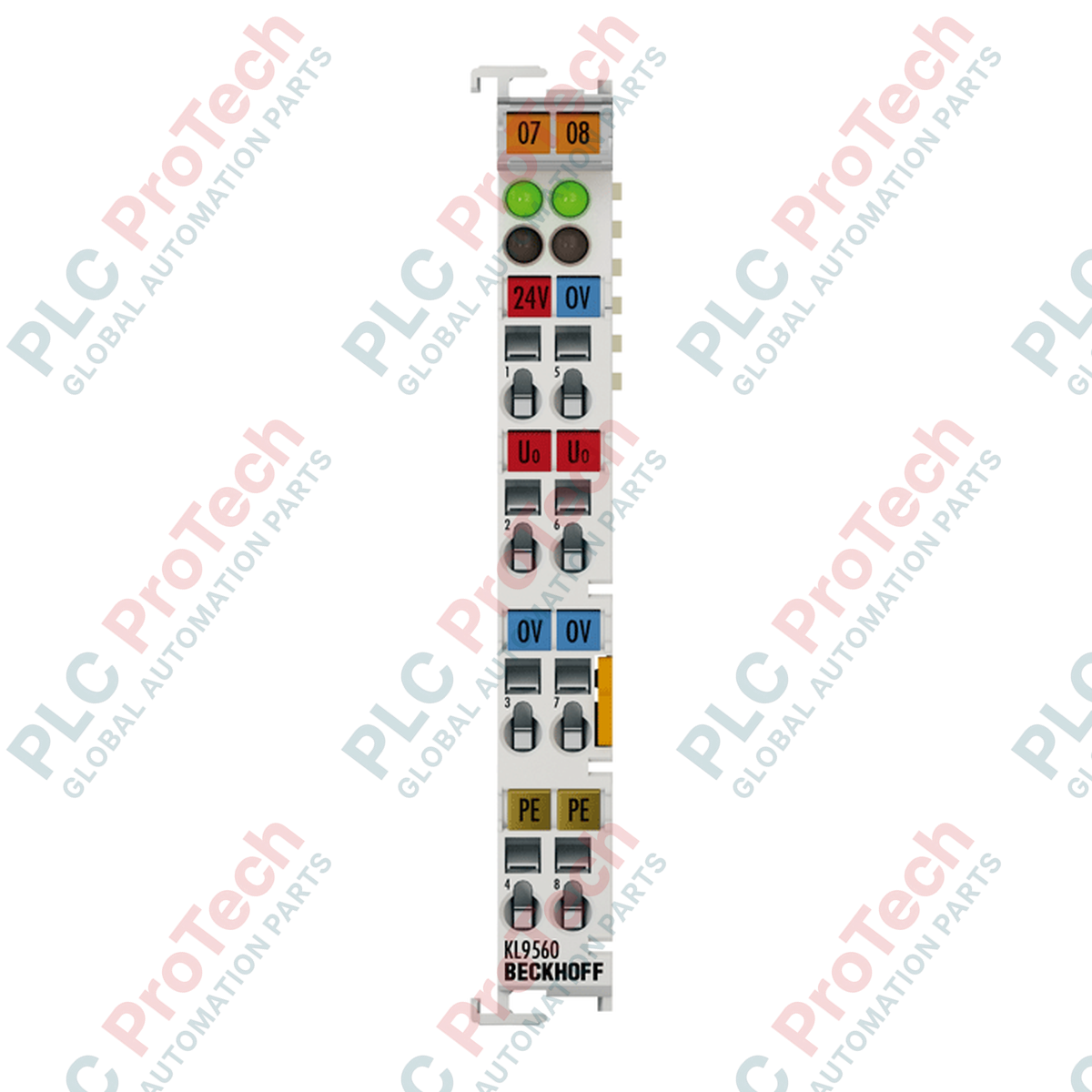
Le KL9560 (KL9560) est un terminal d'alimentation spécialisé conçu pour fournir une sortie isolée de 24 VDC à partir d'une entrée standard de 24 VDC dans le système Beckhoff Bus Terminal. Contrairement aux terminaux d'alimentation standard qui transmettent simplement la tension de terrain, le KL9560 intègre un convertisseur DC/DC de haute qualité pour créer une source de tension galvanique isolée. Ce module est essentiel pour alimenter des capteurs analogiques sensibles, des transducteurs de mesure haute précision ou des équipements électroniques spécialisés nécessitant une alimentation « propre », exempte de bruit électrique et de boucles de masse courantes sur les contacts d'alimentation industriels principaux. Avec une tension d'isolation de 1 500 V AC entre le terrain et le K-bus, il assure une protection maximale pour la logique de contrôle centrale.
Configuration technique
L'architecture matérielle du KL9560 est optimisée pour la stabilité et la visibilité diagnostique. Il fournit un courant de sortie allant jusqu'à 0,1 A, avec une protection complète contre les courts-circuits et une capacité de redémarrage automatique une fois la panne levée. Un avantage technique clé est l'intégration des diagnostics dans l'image process, permettant au contrôleur de surveiller en temps réel l'état de l'alimentation isolée. L'unité atteint environ 85 % d'efficacité et est logée dans un boîtier compact en polycarbonate de 12 mm. Elle est certifiée pour des applications marines exigeantes (DNV GL) et les zones dangereuses (ATEX), ce qui en fait un choix fiable pour les plateformes offshore et les environnements de traitement chimique où l'intégrité du signal est une exigence de sécurité.
Caractéristiques techniques
| Caractéristique |
Spécification |
| Modèle |
KL9560 |
| Marque |
BECKHOFF |
| Origine |
Allemagne |
| Tension d'entrée |
24 VDC (-15 % / +20 %) |
| Tension de sortie |
24 VDC (-15 % / +5 %) |
| Courant de sortie |
<= 0,1 A |
| Efficacité |
environ 85 % |
| Tension d'isolation |
1 500 VAC (terrain/K-bus), 500 VAC (entrée/sortie) |
| Protection contre les courts-circuits |
Oui, avec redémarrage automatique |
| Diagnostics |
Oui (disponible dans l'image process) |
| Dimensions (L x H x P) |
12 mm x 100 mm x 68 mm |
| Température de fonctionnement |
0 à +55 degrés Celsius |
| Homologations |
CE, UL, ATEX, DNV GL |
FAQ techniques
Pourquoi utiliser le KL9560 plutôt qu'un terminal d'alimentation standard ?
Les terminaux d'alimentation standard (comme le KL9100) partagent une masse commune et un potentiel électrique avec tous les autres modules sur le rail d'alimentation. Le KL9560 fournit un circuit 24 VDC séparé et isolé. Cela est crucial lors de l'utilisation de capteurs sensibles aux différences de potentiel de masse ou au bruit de commutation haute fréquence provenant de variateurs de moteurs proches.
Que se passe-t-il si le courant de sortie de 0,1 A est dépassé ?
Le terminal est protégé contre les courts-circuits. Si le courant atteint environ 0,15 A, le module s'arrête pour protéger son convertisseur DC/DC interne. Une fois la surcharge ou le court-circuit supprimé, le KL9560 redémarre automatiquement et rétablit la sortie 24 VDC.
Puis-je surveiller l'état d'alimentation depuis mon automate programmable (PLC) ?
Oui. Le KL9560 fournit des données de diagnostic directement dans l'image process. Cela permet au PLC de détecter une perte de tension de sortie ou une condition de défaut et de déclencher une alarme ou une routine d'état sûr.
Guide d'ingénierie et d'installation
-
Calcul de charge : Assurez-vous que la consommation totale des appareils connectés ne dépasse pas 100 mA (0,1 A). Ce terminal est conçu pour l'alimentation de niveau signal (capteurs, codeurs, petits relais) plutôt que pour des actionneurs ou vannes à forte puissance.
-
Mise à la terre pour isolation : Pour conserver l'avantage de l'isolation galvanique de 500 V, ne reliez pas le 0 V de sortie du KL9560 au 0 V principal du système. Cela annulerait l'isolation électrique et pourrait réintroduire le bruit que le terminal est conçu pour bloquer.
-
Conformité aux zones dangereuses : Pour les installations en zone ATEX 2 (Ex nA), assurez-vous que le module est installé dans un boîtier IP54. Vérifiez que toutes les connexions aux bornes sont bien serrées et que des embouts sont utilisés pour les fils multibrins afin d'éviter les étincelles dues aux vibrations.
-
Précision du câblage : Utilisez les bornes à ressort pour une connexion antivibrations. Une longueur de dénudage de 8 à 9 mm est requise. Pour les applications analogiques, utilisez des câbles blindés pour la tension de sortie et mettez la masse du blindage à un seul point pour garantir le meilleur rapport signal/bruit.