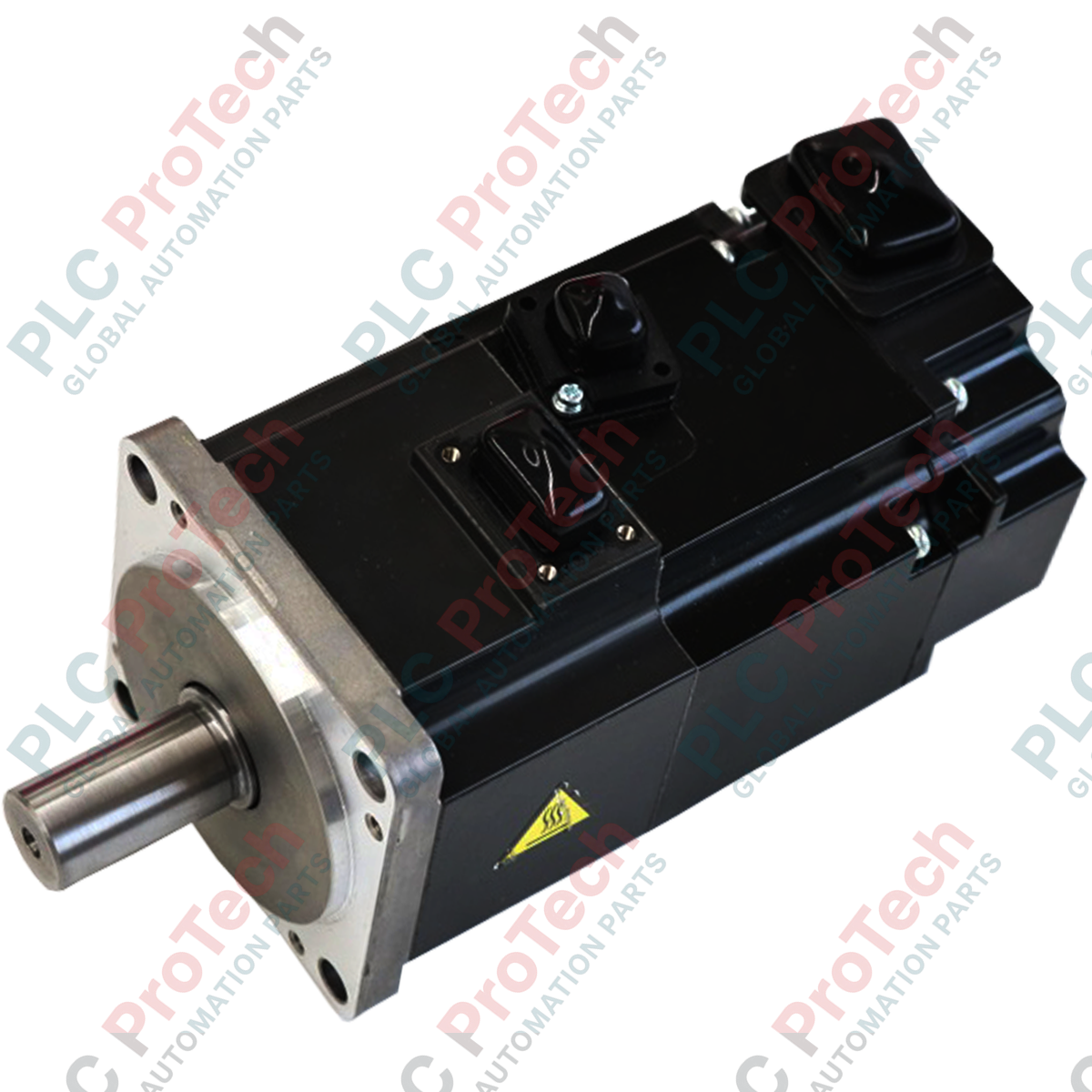
Description
Description
S’intégrant parfaitement aux systèmes de positionnement haute vitesse et haute précision, le servomoteur rotatif à faible inertie HG-KR73 de Mitsubishi Electric fournit une puissance de sortie continue de 750 W (0,75 kW) au sein de la plateforme haute performance MELSERVO-J4. Conçu pour les applications hautement dynamiques nécessitant des accélérations et décélérations rapides, ce moteur industriel intègre un encodeur absolu de 22 bits fournissant 4 194 304 impulsions par tour pour une précision exceptionnelle du positionnement en boucle fermée. Compatible avec plusieurs interfaces de commande, notamment CC-Link IE Field et SSCNET III/H via des servoamplificateurs MR-J4 compatibles, ce moteur conserve une excellente efficacité thermique et une grande stabilité de rotation dans les environnements exigeants.
- Caractéristiques principales
- Encodeur absolu/incrémental haute résolution de 22 bits pour une précision exceptionnelle du retour d’information.
- Conception du rotor à faible inertie optimisée pour les cycles marche-arrêt à haute fréquence.
- Structure totalement fermée et autorefroidie, avec un indice de protection IP65 (hors axe d’arbre).
- Intégration parfaite avec les servoamplificateurs de la série MELSERVO-J4 (tels que MR-J4-70B et MR-J4-70A).
Grande résistance aux conditions environnementales, avec un fonctionnement possible à des températures ambiantes allant jusqu’à 40 °C.
- Applications industrielles
- Systèmes d’assemblage industriels à grande vitesse de type « pick-and-place »
- Machines de fabrication de semi-conducteurs et de manutention de plaquettes
- Équipements d’emballage, d’étiquetage et de remplissage
- Tables de positionnement multiaxes X-Y
Entraînements d’alimentation pour machines textiles et petites presses d’imprimerie
| Caractéristiques techniques |
Paramètre |
| Valeur / Spécification |
Fabricant |
| Mitsubishi Electric |
Modèle / Référence article |
| HG-KR73 |
Nom de la série |
| MELSERVO-J4 |
Puissance de sortie nominale |
| 0,75 kW (750 W) |
Couple nominal |
| 2,4 N m |
Couple maximal |
| 8,4 N m |
Vitesse nominale |
| 3000 tr/min |
Vitesse de rotation maximale |
| 6000 tr/min |
4,8 A |
| Courant maximal |
17,0 A |
| Moment d’inertie du rotor |
1,26 x 10^-4 kg m2 |
| Type de détecteur |
Encodeur absolu/incrémental 22 bits (4 194 304 impulsions/tr) |
| Classe thermique |
130 (classe B) |
| Indice de protection contre les infiltrations |
IP65 (hors axe d’arbre) |
| Température ambiante de fonctionnement |
0 à 40 °C (sans gel) |
| Poids net |
2,8 kg |
| Poids d’expédition (calculé) |
4,0 kg |
Informations techniques empiriques
Modèles alternatifs et compatibilité
Le HG-KR73 est le modèle à arbre standard et à faible inertie de la classe 750 W. Si votre environnement d’installation expose le moteur à des projections d’huile, à d’importants fluides de coupe ou à une forte humidité, il faut utiliser à la place la variante HG-KR73J, dotée d’un joint d’étanchéité d’arbre intégré. En outre, ne confondez pas la série HG-KR avec la série à ultra-faible inertie HG-MR73 ; bien qu’elles soient physiquement identiques en termes de dimensions d’encombrement, elles présentent des plages d’inertie de rotor complètement différentes et nécessitent des profils de réglage dédiés dans la suite de programmation MR Configurator2.
Pièges liés à l’application et remarques techniques
Assurez-vous que le rapport d’inertie entre la charge externe et le moteur ne dépasse pas le maximum recommandé de 17 fois l’inertie du rotor du moteur. Le dépassement de cette limite sans réduction importante du gain déclenchera des oscillations de la boucle d’asservissement, des vibrations audibles à haute fréquence et, à terme, des défauts de surintensité, tels que AL.50 ou AL.51, lors des phases d’accélération rapide. Dans les armoires de commande hermétiquement fermées, vérifiez que la température ambiante du moteur ne dépasse pas le seuil de 40 degC, car un fonctionnement continu à forte charge près du couple nominal de 2.4 N m peut porter les enroulements internes à la limite thermique de la classe B.
Conseils de mise en service et de câblage
Pour éviter les pertes de communication du retour d’information, utilisez toujours des câbles de codeur dédiés à double blindage, tels que les câbles MR-EKCBL_M-H ou MR-EKCBL_M-L de Mitsubishi. Le signal de retour série haute résolution de 22 bits est sensible aux parasites électromagnétiques haute fréquence ; il est donc fortement recommandé d’acheminer séparément les câbles d’alimentation du moteur et les lignes de retour dans des conduits métalliques mis à la terre. Assurez-vous que le châssis du moteur est correctement relié à la terre, jusqu’à la borne de terre du servoamplificateur MR-J4 associé, afin de réduire les courants de fuite potentiels.
Consignes d’installation
AVERTISSEMENT CRITIQUE :
Vérifiez que l’alimentation d’entrée CA principale du servoamplificateur MR-J4 associé est complètement déconnectée et consignée. Attendez au moins 15 minutes afin de permettre la décharge complète des condensateurs internes du bus CC avant de brancher ou de débrancher les câbles d’alimentation du moteur ou du codeur. Le non-respect de cette consigne peut entraîner une électrocution mortelle et la destruction immédiate de l’électronique du codeur.
1
Fixez solidement le moteur sur une plaque de montage métallique plane et résistante aux vibrations. Nettoyez les produits anticorrosion de l’arbre avant de fixer les composants mécaniques.
2
Alignez précisément l’accouplement ; un désalignement excessif dépassera la charge radiale admissible de 392 N et la charge axiale de 147 N, entraînant une défaillance prématurée des roulements.
3
Branchez les câbles du codeur et d’alimentation, en vous assurant qu’ils s’enclenchent fermement dans leurs prises respectives. Évitez d’acheminer les câbles avec des courbures prononcées ou sous une tension mécanique.