


Derivative Action in PID Control Without Noise Problems
Learn what derivative action contributes to a PID loop, why it can amplify measurement noise and setpoint changes, and how filtering, sampling, and staged tests make D tuning safer.
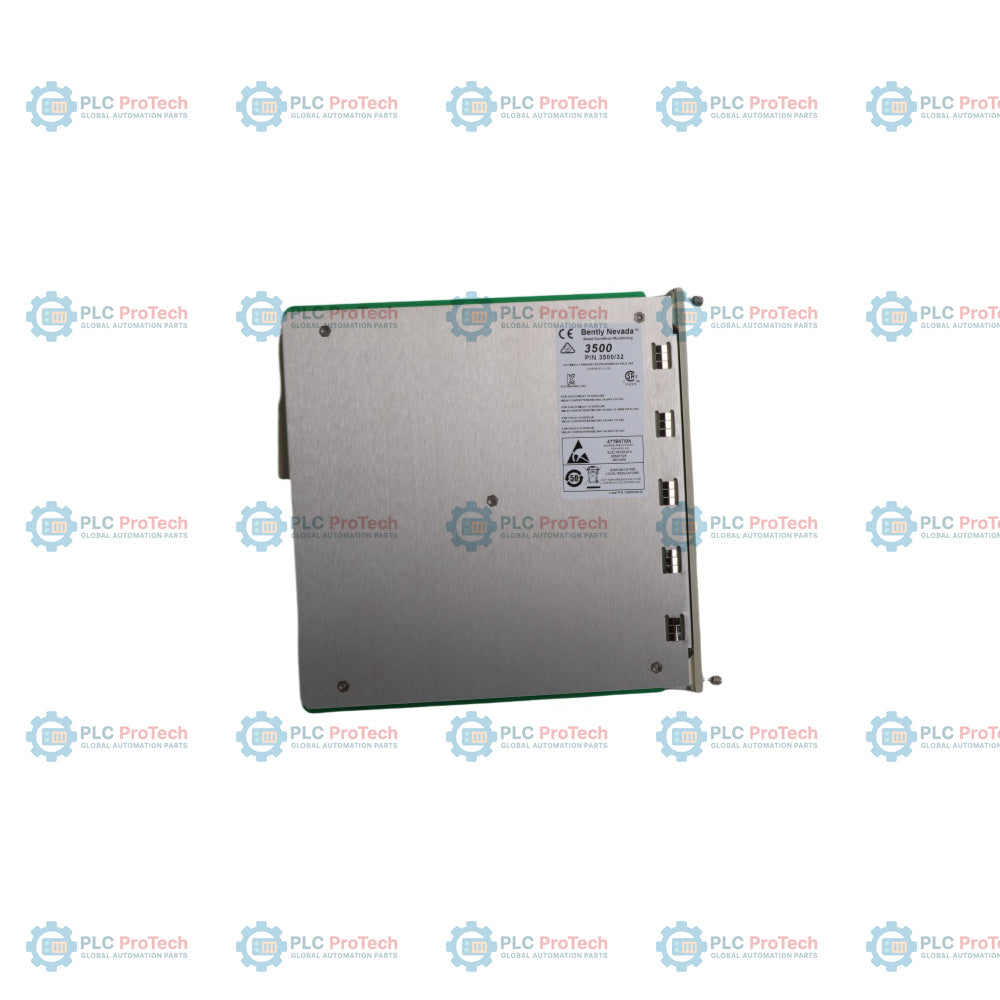
Manufacturer: Bently Nevada
Product No.: 3500/32 125712-01
Country of origin:United States
Product Type: Relay Output Modules
Barcode: 8537101190
Payment: T/T, Western Union
Weight: 700g
Dimensions: 241 mm x 24.4 mm x 242 mm
Shipping port: Xiamen
Warranty: 12 months
The 125712-01 is a full-height spare module designed to provide four independent programmable relay outputs within a machinery protection system. It functions as the core component of the 3500/32 system, allowing user-programmed voting logic to drive specific automated alarms based on machine conditions. Each output integrates Alarm Drive Logic, enabling complex configurations of AND and OR gates utilizing alert and danger inputs aggregated from any combination of monitor channels within the same rack. The module interfaces seamlessly with matching backplane termination boards to trigger safety systems, emergency shutdown mechanisms, or external indicators across various high-criticality rotating assets.
| Part Number / Option Code | Description |
|---|---|
| 3500/32-AXX-BXX | 4-Channel Relay Module complete assembly configuration. |
| A: 01 | 4-Channel Relay I/O Module. |
| B: 00 | Agency Approval Option: None. |
| B: 01 | Agency Approval Option: CSA/NRTL/C. |
| 125712-01 |
Spare Parts: Spare 4-Channel Relay Module. |
| 125720-01 |
Spare Parts: Spare 4-Channel Relay I/O Module. |
| 132319-01 |
Spare Parts: Firmware IC. |
| 00580436 |
Spare Parts: Connector Header, Internal Termination, 6-position, Green. |
| Parameter Category | Specification Details |
|---|---|
| Manufacturer | Bently Nevada |
| Model Code | 3500/32 |
| Spare Part Number |
125712-01 |
| Power Consumption | 6 Watts typical |
| Relay Configuration | Two single-pole, double-throw (SPDT) relays connected in a double-pole, double-throw (DPDT) configuration |
| Relay Sealing Type | Epoxy-sealed |
| Arc Suppressor | 250 Vrms, installed as standard |
| Contact Life | 100,000 cycles @ 5 A, 24 Vdc or 120 Vac |
| Channel Operation Mode | Switch-selectable for Normally De-energized or Normally Energized |
| Resistive Switched Power | Max dc: 120 W | Max ac: 600 VA |
| Minimum Switched Load | 100mA @ 5 Vdc |
| Maximum Switched Current | 5 A |
|
Maximum Switched Voltage |
dc: 30 Vdc | ac: 250 Vac |
| Operating Temperature | -30 degC to +65 degC (-22 degF to +150 degF) |
| Storage Temperature | -40 degC to +85 degC (-40 degF to +185 degF) |
| Humidity | 95%, non-condensing |
| Main Module Dimensions | 241 mm x 24.4 mm x 242 mm (9.50 in x 0.96 in x 9.52 in) |
| I/O Module Dimensions | 241 mm x 24.4 mm x 99.1 mm (9.50 in x 0.96 in x 3.90 in) |
| Main Module Weight | 0.7 kg (1.6 lbs.) |
| I/O Module Weight | 0.4 kg (1.0 lbs.) |
| Rack Slot Requirements | 1 full-height front slot for Main Module, 1 full-height rear slot for I/O Modules |
The interface configurations provide dedicated diagnostic readouts and contact terminals for reliable loop signaling:
| Interface Element | Function / Assignment |
|---|---|
| OK LED | Front panel indicator; remains illuminated when the internal circuit functions properly. |
| TX/RX LED | Front panel indicator; flashes continuously to show normal rack backplane communication activity. |
| CH ALARM LEDs (1 - 4) | Independent indicators; illuminate directly when the corresponding relay channel triggers an alarm state. |
| Output Terminals | Rear board wire connection blocks used to tie contact points to plant automation systems. |
| Hardware Switches | Onboard control mechanisms used to define the base operational state of output contacts. |
What is the distinct difference between this spare and a standard 3500/32 ordering code?
The 3500/32 describes the general functional family or multi-component system configuration while the distinct part number defines the individual hot-swappable front card provided as a component replacement.
Can these relay channels be manually assigned to alarms on any vibration monitor card inside the same system frame?
Yes, the internally stored processing algorithm pulls operational signals and alarm states from any combination of standard slots across the active rack configuration.
How do I adjust a relay channel between Normally Energized and Normally De-energized behaviors?
The target configuration requires the adjustment of individual physical hardware switches located on the assembly alongside parameter adjustments inside the configuration utility.
Does a standard 125712-01 component ship with its matching rear input/output module?
No, this part number specifically designates the front-facing main processor card alone; if the rear termination board is needed, it must be ordered under its individual product number.


Global Express Shipping
Returns & Warranty




| Product Image | Model Number / Title | Condition | Availability | Action |
|---|---|---|---|---|

|
Allen-Bradley 1771-OZ PLC-5 Relay Contact Output Module | Original New | In Stock | View Details |
Global Express Shipping
Returns & Warranty
Orders are processed and delivered Monday-Friday (excluding public holidays).
For full eligibility, restocking fees, and international return details, please view our official Refund & Return Policy .
| Color pattern |
Silver
|
| Country of origin |
United States
|

Learn what derivative action contributes to a PID loop, why it can amplify measurement noise and setpoint changes, and how filtering, sampling, and staged tests make D tuning safer.

A practical guide to segmenting, documenting, and testing industrial Ethernet networks so plant teams can isolate faults quickly, control change, and expand without creating fragile dependencies.

Commission IO-Link systematically from master addressing and port modes through IODD selection, PLC byte mapping, parameter backups, device validation, and failure-injection tests.

A practical PowerFlex braking guide covering regenerative energy, resistor resistance and duty cycle, thermal protection, model-specific parameters, and measured commissioning tests.

An industrial joystick is only the first element in a safe motion command chain. This guide covers sensing choices, wiring, signal validation, PLC logic, restart behavior, and commissioning for...

PID tuning becomes safer when engineers can see how proportional, integral, and derivative actions reshape error, output, and response over time. This guide turns live trends into a disciplined...