Product Overview
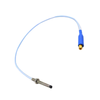
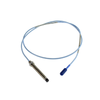
The 330101-00-11-10-02-CN is a commercial-grade, non-contacting eddy current displacement sensor engineered for the foundational Bently Nevada 3300 XL Proximity Transducer System. Operating as a critical component within machinery protection infrastructures, this 8 mm probe precisely gauges static and dynamic distances between the sensor tip and the observed rotating shaft. Heavy automated industrial application environments—including oil and gas refineries, baseload thermal power stations, and large-scale wastewater processing plants—rely on the 330101-00-11-10-02-CN to provide consistent mechanical telemetry. By tracking microscopic shaft vibration, axial thrust position shifts, and radial oil film clearances, it delivers continuous analog metrics directly to the 3500 monitoring rack. This real-time feedback allows operators to initiate defensive safety trips before unbalance or bearing wiping occurs, mitigating catastrophic asset damage and dramatically reducing unprogrammed plant downtime.
Suffix Breakdown
The exact physical attributes, thread configuration, extension length, and regulatory safety ratings of the 330101-00-11-10-02-CN sensor are specified via a structured part number matrix:
-
330101 (Base Platform): Establishes the standard 3300 XL 8 mm proximity probe configuration with 3/8-24 UNF English case threading and an unarmored coaxial cable lead.
-
00 (Unthreaded Segment): Defines an unthreaded length of 0.0 inches, meaning the entire metal outer casing features continuous 3/8-24 UNF threading.
-
11 (Overall Case Length): Specifies a short overall case length of 1.1 inches, tailored for tight mechanical spaces and shallow radial bearing housings.
-
10 (Total Length Profile): Designates a total system electrical length of 1.0 meter (3.3 feet), requiring precise integration with matching extension cables and Proximitor drivers.
-
02 (Connector Style): Outfits the standard insulation coaxial lead with a miniature coaxial ClickLoc locking connector interface.
-
CN (Regional Certification): Flags country-specific hazardous area agency approvals, matching strict localized safety standards for explosive environments.
Operational Benchmarks & Physical Dimensions
| Hardware Metric |
Certified Industrial Standard Value |
| Model Identity |
330101-00-11-10-02-CN |
| Brand Manufacturer |
Bently Nevada (Baker Hughes) |
| Control System Line |
3300 XL Proximity Transducer Series |
| Sensor Tip Diameter |
8 mm Nominal Profile Base |
| Casing Thread Pitch |
3/8-24 UNF Thread Pattern |
| Physical Cable Length |
1.0 meter (3.3 feet) Total Lead |
| Connection Mechanism |
Miniature Coaxial ClickLoc Locking Interlock |
| Excitation Source |
Driven directly via matching 3300 XL Proximitor |
| System Signal Output |
Linear Voltage Proportional to Target Gap |
| Net Component Weight |
0.323 kg Net Mass Base |
| Gross Shipping Weight |
1.50 kg Packed Transport Base |
| Operating Temperature |
-51 to +177 deg C Ambient Thermal Envelope |
| Manufacturing Origin |
Minden, Nevada, USA |
Machine Telemetry & Maintenance FAQs
What is the practical installation logic behind the 1.0-meter total length configuration?
Proximity monitoring loops depend on precise high-frequency impedance tracking calibrated to a fixed total electrical length, usually 5.0 meters or 9.0 meters. The 1.0-meter probe is engineered to match with a corresponding 4.0-meter or 8.0-meter 3300 XL extension cable, allowing the field technician to reach a remote termination junction box outside the machine casing while maintaining the proper electrical length.
Why does this model incorporate the continuous 1.1-inch threaded casing configuration?
The 00-11 suffix combination means the probe has zero unthreaded length and a brief 1.1-inch total metal body. This ultra-compact profile is ideal for internally mounted brackets or shallow radial bearing caps where a longer housing would strike internal structural obstructions or interfere with the target shaft.
Does the ClickLoc connector help preserve signal path integrity under high-vibration stresses?
Yes. The miniature coaxial ClickLoc connector integrates an automated mechanical locking detent that prevents accidental loose connections. Once fully joined, it blocks connection backing caused by low-frequency machine housing vibration, keeping the low-voltage telemetry path continuous and error-free.
Engineering & Installation Guide
-
DC Voltage Calibration and Physical Gap Optimization:
When threading the 330101-00-11-10-02-CN probe into the mounting bracket, verify the sensor face is parallel to the target. Connect a digital multimeter to the Proximitor sensor output loop and adjust the probe position until the voltage reads exactly -10.0 VDC. This reading indicates that the target sits at the true physical center of the 3300 XL 8 mm linear measurement field. Ensure the target surface area provides a smooth, homogeneous AISI 4140 steel face to prevent electrical runout anomalies.
-
Conduit Pulling Mechanics and Cable Bend Radius:
When routing the unarmored coaxial cable lead through internal machine pathways or external conduit blocks, maintain a strict minimum bend radius of 25.4 mm (1.0 inch). Never apply excessive pulling tension near the probe body junction or terminal plug, as high force can displace the internal center conductor. Use appropriate anti-seize compound on the 3/8-24 UNF threads and torque to standard specifications without over-tightening to avoid casing distortion.
-
Connector Isolation and Liquid-Tight Sealing Protection:
The ClickLoc coaxial joint must remain completely dry, free of conductive film, and isolated from structural cabinet grounds. Wrap the joined terminal securely using high-grade self-fusing silicone insulation tape or encase it within a specialized connector protector sleeve. This treatment blocks hot synthetic lubricants, atmospheric moisture, and metallic dust from penetrating the terminal threads, preventing ground loop errors or calibration drift.