


Implementing 3-Switch XOR Ladder Logic with Internal Bit
Implement a 3-SPST switch XOR light circuit in LogixPro or RSLogix 500 using an internal relay bit. Includes truth tables, boolean equations, and verified.

Designed for robust machinery protection, the Bently Nevada 330880-28-20-45-01-02 provides reliable proximity sensing within hazardous industrial environments. This integrated assembly combines a high-precision 3300 XL 8 mm proximity probe inside a specialized protective housing, allowing for precise shaft vibration and position measurements on critical rotating machinery. Designed to withstand harsh operating environments, the housing features dual NPT connections and specific dimensional options to match exact machinery casing requirements.
| Manufacturer | Bently Nevada |
| Model Number | 330880-28-20-45-01-02 |
| Series | PROXPAC XL |
| Probe Option | 3300 XL 8 mm probe with multiple approvals (Option 28) |
| Standoff Adapter (B Dimension) | 2.0 in (51 mm) (Option 20) |
| Probe Penetration (C Dimension) | 4.5 in (114 mm) (Option 45) |
| Fittings Option | One 3/4-14 NPT fitting, two plugs (Option 01) |
| Mounting Thread Option | 3/4-14 NPT (Option 02) |
| Net Weight | 1.44 kg (3.17 lbs) |
| Shipping Weight (Calculated) | 3.00 kg (6.61 lbs) |
| Country of Origin | United States (U.S.A.) |
This PROXPAC XL housing configuration utilizes standard 3300 XL series 8 mm probes. When planning field retrofits, ensure that the selected penetration depth matches your exact casing thickness. If replacing older legacy housings, confirm that the 3/4-14 NPT mounting thread option (Option 02) aligns with your existing tapped machine ports to prevent thread binding or thread mismatch.
Improper positioning or failing to account for the 2.0-inch standoff height can lead to mechanical interference between the probe tip and the target shaft during initial start-up. Always perform a mechanical physical clearance check before starting the rotating equipment. To maintain the environmental sealing rating of the PROXPAC housing, use industrial thread sealant on the NPT fitting and ensure both plugs are fully torqued into the unused entries.
When routing the internal probe cable, maintain the minimum recommended bend radius to prevent internal coaxial cable damage. Route the cable through the 3/4-14 NPT conduit fitting using proper flexible conduit to isolate the probe assembly from structural vibration and moisture ingress. Ensure clean, tight connection blocks to avoid introducing signal impedance variations that could affect calibration accuracy.
Global Express Shipping
Returns & Warranty


Manufacturer: Bently Nevada
Product No.: 330880-28-20-45-01-02
Country of origin:United States
Product Type: Proximity Transducers
Payment: T/T, Western Union
Weight: 320g
Shipping port: Xiamen
Warranty: 12 months
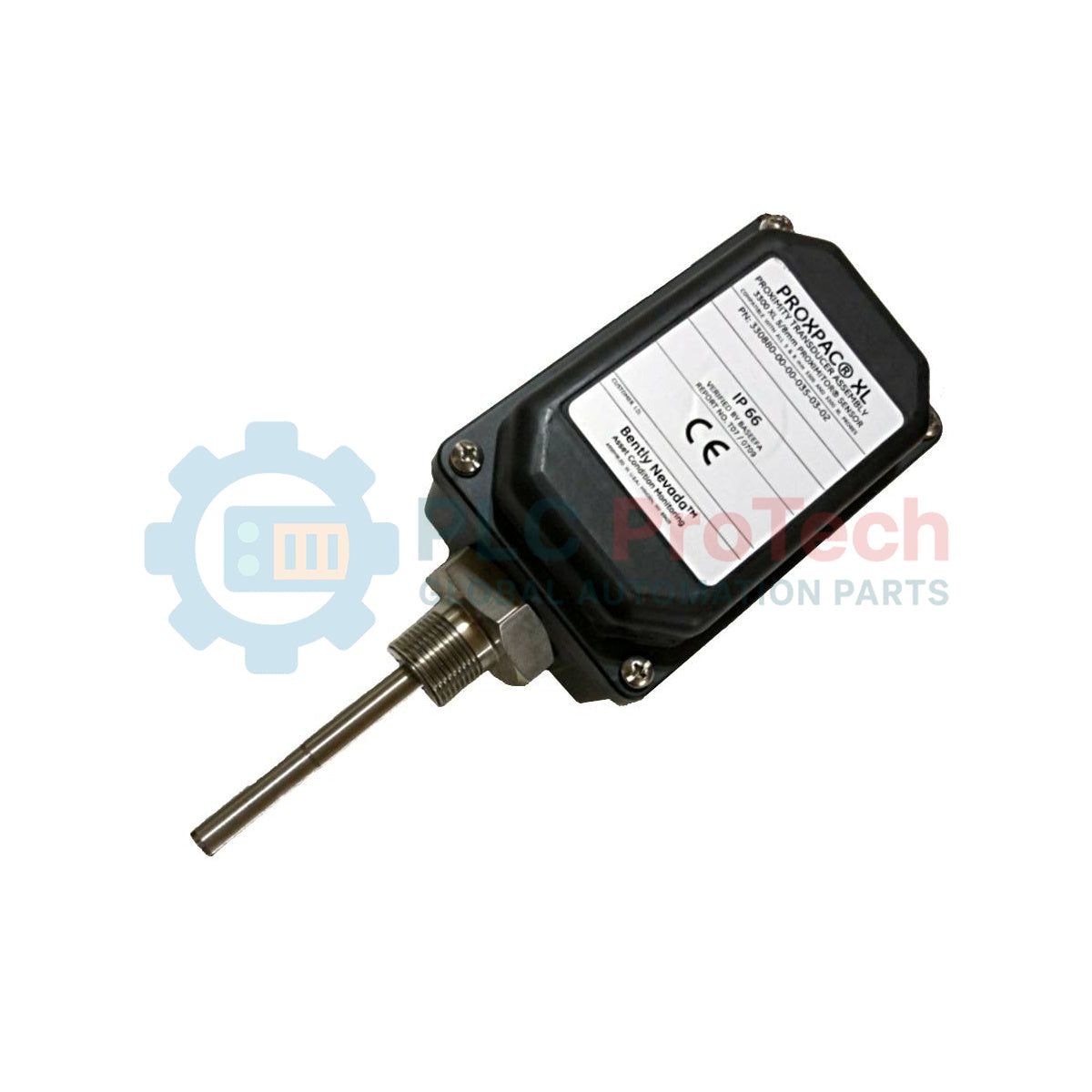
Designed for robust machinery protection, the Bently Nevada 330880-28-20-45-01-02 provides reliable proximity sensing within hazardous industrial environments. This integrated assembly combines a high-precision 3300 XL 8 mm proximity probe inside a specialized protective housing, allowing for precise shaft vibration and position measurements on critical rotating machinery. Designed to withstand harsh operating environments, the housing features dual NPT connections and specific dimensional options to match exact machinery casing requirements.
| Manufacturer | Bently Nevada |
| Model Number | 330880-28-20-45-01-02 |
| Series | PROXPAC XL |
| Probe Option | 3300 XL 8 mm probe with multiple approvals (Option 28) |
| Standoff Adapter (B Dimension) | 2.0 in (51 mm) (Option 20) |
| Probe Penetration (C Dimension) | 4.5 in (114 mm) (Option 45) |
| Fittings Option | One 3/4-14 NPT fitting, two plugs (Option 01) |
| Mounting Thread Option | 3/4-14 NPT (Option 02) |
| Net Weight | 1.44 kg (3.17 lbs) |
| Shipping Weight (Calculated) | 3.00 kg (6.61 lbs) |
| Country of Origin | United States (U.S.A.) |
This PROXPAC XL housing configuration utilizes standard 3300 XL series 8 mm probes. When planning field retrofits, ensure that the selected penetration depth matches your exact casing thickness. If replacing older legacy housings, confirm that the 3/4-14 NPT mounting thread option (Option 02) aligns with your existing tapped machine ports to prevent thread binding or thread mismatch.
Improper positioning or failing to account for the 2.0-inch standoff height can lead to mechanical interference between the probe tip and the target shaft during initial start-up. Always perform a mechanical physical clearance check before starting the rotating equipment. To maintain the environmental sealing rating of the PROXPAC housing, use industrial thread sealant on the NPT fitting and ensure both plugs are fully torqued into the unused entries.
When routing the internal probe cable, maintain the minimum recommended bend radius to prevent internal coaxial cable damage. Route the cable through the 3/4-14 NPT conduit fitting using proper flexible conduit to isolate the probe assembly from structural vibration and moisture ingress. Ensure clean, tight connection blocks to avoid introducing signal impedance variations that could affect calibration accuracy.
Global Express Shipping
Returns & Warranty
Orders are processed and delivered Monday-Friday (excluding public holidays).
For full eligibility, restocking fees, and international return details, please view our official Refund & Return Policy .
| Country of origin |
United States
|

Implement a 3-SPST switch XOR light circuit in LogixPro or RSLogix 500 using an internal relay bit. Includes truth tables, boolean equations, and verified.

Integrate Allen-Bradley CompactLogix, Caterpillar ATS, and generators into DeltaV DCS over Modbus RTU. Covers ProSoft MVI69-MCM, Miille DIN266 gateways.

ONS instruction fires but the OTE coil never latches in Studio 5000 because the one-shot is only true for one scan. Use OTL/OTU or seal-in logic instead.

Configure Allen-Bradley Kinetix 5500 servo drives on EtherNet/IP. Covers CIP Sync, IEEE 1588 V2 timing, Stratix selection, DLR topology, and HMI.

A moving-average filter is the sliding-window smoother most instrument engineers drop into DCS and PLC analog paths. Here is how the window works, how N and sample time set lag, and when a...

On Frame 5–9 gas turbines, GE Mark VI and Mark VIe run control as function-block application software. This article maps process, protection, and sequencing functions—and what Toolbox ST access...