1 de 1

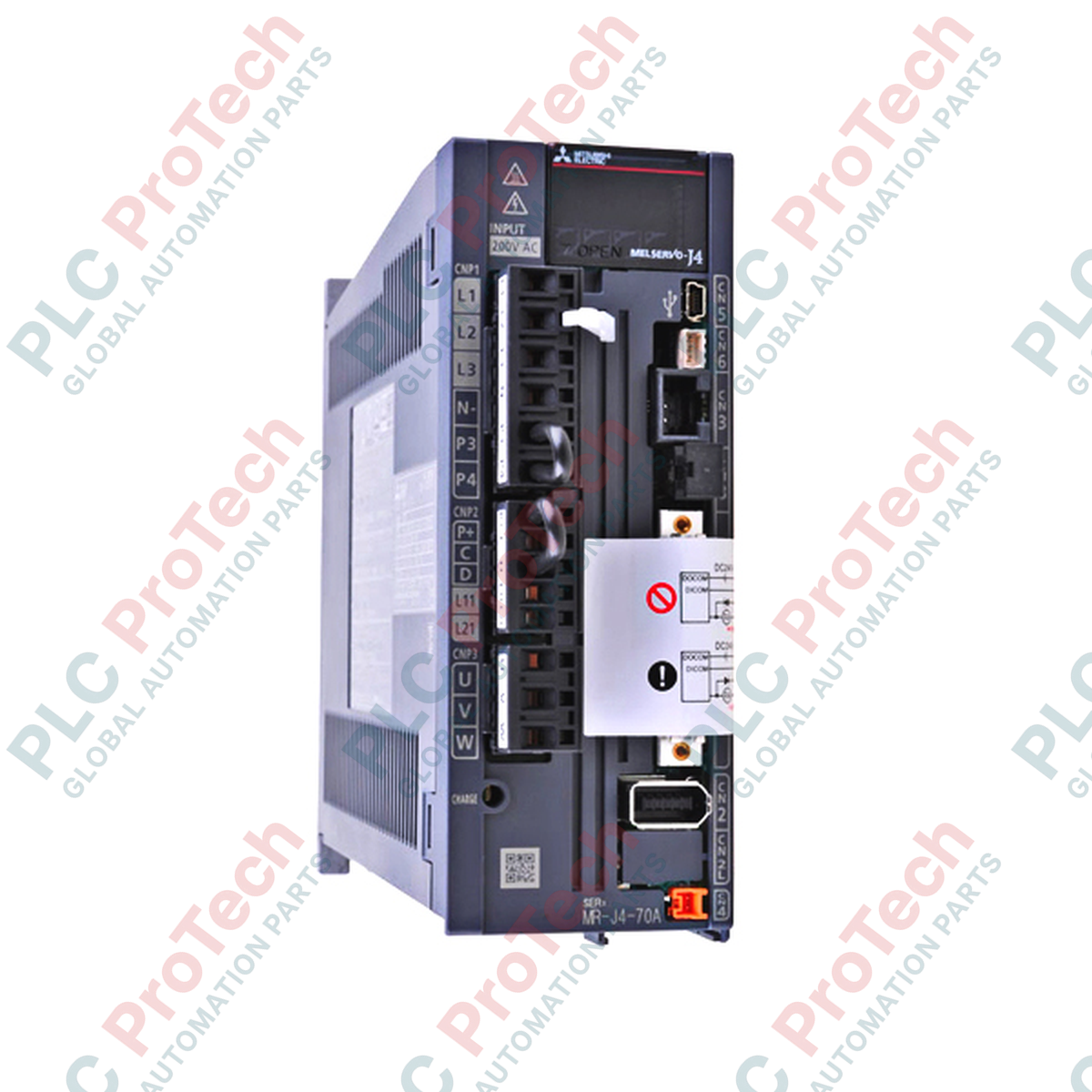
Mitsubishi Electric MR-J4-60A MELSERVO-J4 Servo Amplifier

Mitsubishi Electric MR-J4-60A MELSERVO-J4 Servo Amplifier

Apenas 10 item(ns) restante(s) em estoque
  • Fabricante: Mitsubishi Electric

  • Nº do Produto: MR-J4-60A

  • País de origem:Estados Unidos

  • Tipo de Produto: Servo Amplifiers

  • Pagamento: T/T, Western Union

  • Peso: 3000g

  • Porto de embarque: Xiamen

  • Garantia: 12 meses

Quantidade
Ver informações completas

Regulating motor velocity, torque, and position with high dynamic response, the Mitsubishi Electric MR-J4-60A is a high-performance servo drive designed for integration within the MELSERVO-J4 product family. This unit features a general-purpose interface supporting pulse train and analog voltage control inputs, making it highly compatible with a wide range of open-loop and closed-loop motion controllers. Operating on a 200 to 240 VAC input, it delivers precise current control via a sine-wave PWM system to drive compatible rotary, linear, and direct-drive servo motors up to 0.6 kW.

Key Features

  • Flexible Interface: Supports pulse train train command input (up to 4 Mpps) and analog voltage commands for speed and torque control.
  • Integrated Safety: Features built-in Safe Torque Off (STO) functionality compliant with EN ISO 13849-1 Category 3 PL e and IEC 61508 SIL 3.
  • Advanced Tuning: Real-time auto-tuning and one-touch tuning algorithms automatically suppress machine vibration and optimize loop gains.
  • High-Resolution Feedback: Compatible with 22-bit absolute encoders (4,194,304 pulses per revolution) for exceptional positioning accuracy.

Applications

  • Packaging Machinery: Precise synchronization of feed axes, sealing jaws, and labeling heads.
  • Semiconductor Manufacturing: High-speed, low-vibration wafer handling and positioning tables.
  • Textile and Printing: Tension control and precise speed matching across multiple web rollers.
  • Material Handling: Multi-axis pick-and-place gantries and automated sorting systems.

Technical Specifications

Parameter Specification Value
Manufacturer Mitsubishi Electric
Model Number MR-J4-60A
Series MELSERVO-J4
Rated Output Power 0.6 kW (600 W)
Main Circuit Power Supply 3-phase or 1-phase 200 to 240 VAC, 50/60 Hz
Control Circuit Power Supply 1-phase 200 to 240 VAC, 50/60 Hz
Interface Power Supply 24 V DC, +/-10% (Required capacity: 500 mA)
Control System Sine-wave PWM control / current control system
Safety Function (STO) EN ISO 13849-1 Category 3 PL e, IEC 61508 SIL 3
STO Response Time 8 ms or less (STO input off to energy shut off)
Overvoltage Category III (IEC/EN 60664-1)
Protection Class I (IEC/EN 61800-5-1)
Operating Temperature 0 to 55 degC (non-freezing)
Operating Humidity 5% to 90% RH (non-condensing)
Shipping Weight 3.0 kg (Calculated)

Connections and Interfaces

Connector / Terminal Function / Assignment
CN1 I/O Signal Connector (Pulse train input, analog input, digital control inputs/outputs)
CN2 Encoder Connector (Feedback connection to the servo motor encoder)
CN3 USB Communication Interface (Connection to PC running MR Configurator2)
CN8 Safety Monitor Device Connector (STO input signals and feedback)
L1, L2, L3 Main Circuit Power Input Terminals (3-phase or 1-phase 200-240 VAC)
L11, L21 Control Circuit Power Input Terminals (1-phase 200-240 VAC)
U, V, W Servo Motor Power Output Terminals (Phase outputs to motor windings)

Empirical Engineering Insights

Alternative Models & Compatibility

The MR-J4-60A serves as a direct upgrade path for legacy MR-J3-60A units. When replacing an MR-J3 series drive, physical mounting dimensions differ slightly; check for the official Mitsubishi adapter plate to avoid drilling new holes in the backplate. Parameter sets can be migrated using the conversion utility inside MR Configurator2, though manual verification of the torque limits and electronic gear ratios is highly recommended.

Application Pitfalls & Engineering Notes

When operating this drive on a single-phase 200-240 VAC supply, ensure that the power supply capacity is sized correctly. While the 600W model does not require severe derating under steady-state conditions, rapid acceleration profiles with high-inertia loads can trigger DC bus undervoltage faults (AL 10.1) if the single-phase line voltage sags. If frequent deceleration is required, consider installing an external regenerative resistor to prevent overvoltage faults (AL 30.1).

Commissioning & Wiring Tips

To minimize electrical noise injection into the CN1 control lines, always use shielded twisted-pair cables for pulse train and analog command signals. Ground the shield at the amplifier side using the grounding plate provided. Ensure that the control circuit power terminals (L11, L21) are wired upstream of any main circuit contactors; this keeps the control logic and encoder feedback active even when the main power is disconnected for safety or fault conditions.

Installation Guidelines

CRITICAL WARNING: HAZARDOUS VOLTAGE

Before commencing any installation, wiring, or maintenance work, isolate all power sources (both main circuit and control circuit). Wait at least 15 minutes after power-off and verify that the charge LED on the front panel of the amplifier is completely extinguished. Measure the DC bus voltage across terminals P+ and N- to confirm it is below 50 VDC before touching any terminals.

1
Mechanical Mounting: Install the servo amplifier vertically on a flat, metallic backplate inside an IP54-rated control enclosure. Maintain a minimum clearance of 40 mm above and below the unit, and 10 mm on the sides to ensure adequate natural convection cooling.
2
Grounding: Connect the protective earth (PE) terminal of the amplifier to the cabinet ground bar using a low-impedance conductor. Ensure the motor frame is also grounded back to the amplifier's PE terminal to prevent high-frequency leakage currents.
3
Power Wiring: Connect the main power supply to L1, L2, and L3 (or L1 and L3 for single-phase operation). Wire the control power supply to L11 and L21. Connect the motor power phases to terminals U, V, and W. Do not connect AC power directly to U, V, or W, as this will permanently damage the drive.
4
Control and Feedback: Insert the encoder cable into CN2 until it clicks. Connect the I/O command cable to CN1. If the safety function is not utilized, ensure the shorting connector is securely plugged into CN8 to allow normal operation.

What is the difference between the MR-J4-60A and MR-J4-60B models?

The MR-J4-60A features a general-purpose interface supporting pulse train and analog voltage inputs for control. The MR-J4-60B is designed for SSCNET III/H high-speed fiber optic motion network communications.

Can the MR-J4-60A run on single-phase power?

Yes, the main circuit supports both 3-phase and 1-phase 200 to 240 VAC at 50/60 Hz. For single-phase operation, connect the incoming power lines to terminals L1 and L3.

What software is required to configure this servo drive?

Configuration, parameter adjustment, and diagnostics are performed using Mitsubishi's MR Configurator2 software, which connects to the drive via the front-panel USB mini-B port.

How do I bypass the STO safety function if it is not used in my system?

If the Safe Torque Off (STO) function is not required, you must insert the shorting connector (supplied with the drive) into the CN8 connector to enable normal operation.

Envio Expresso Global

  • Entrega Padrão: 4-6 dias úteis via DHL, FedEx e UPS.
  • Despacho Expresso: Envio no mesmo dia para pedidos em estoque realizados antes das 14:00 (GMT+8).
  • Cobertura Mundial: Atendendo mais de 150 países, incluindo entrega rápida para Arábia Saudita e Emirados Árabes Unidos.

Devoluções e Garantia

  • Garantia de 30 Dias: Devoluções aceitas para produtos em estoque na embalagem original, lacrada de fábrica.
  • Garantia de 12 Meses: Cada componente industrial é coberto pela nossa garantia técnica profissional.

Os pedidos são processados e entregues de segunda a sexta-feira (exceto feriados).


Para elegibilidade completa, taxas de reabastecimento e detalhes de devolução internacional, por favor, consulte nosso oficial Política de Reembolso e Devolução .

TECHNICAL SPECIFICATIONS

Country of origin
Estados Unidos

Produtos Visualizados Recentemente

Conhecimento técnico

Lógica Booleana na Programação de CLP: Entendendo Portas Lógicas FBD

A lógica booleana é a base de todo programa PLC. Desde controles simples de máquinas até sistemas complexos de automação industrial, as portas lógicas determinam como os controladores respondem a...

Guia Completo sobre Firewalls Industriais e Segmentação de Redes OT

Firewalls industriais desempenham um papel crítico na cibersegurança OT, protegendo redes PLC, DCS e SCADA por meio de segmentação, controle de entrada/saída e integração IDS/IPS alinhada aos...

Guia de Garras Robóticas: Desde o Manuseio Delicado até a Automação Pesada

As garras robóticas modernas estão evoluindo além das mandíbulas mecânicas tradicionais. De sistemas adesivos inspirados em lagartos-gecko e garras macias de grau alimentício a ferramentas de armazém...

Retrospectiva: Como os Primeiros Motores Elétricos Mudaram a Mineração Subterrânea

De compressores CC acionados por corda a carrinhos de mina movidos a bateria, as operações de mineração iniciais marcaram um ponto de virada na eletrificação industrial. Este artigo explora como os...

Factory I/O: Uma Ferramenta Moderna de Simulação de CLP para Treinamento em Automação Industrial

Factory I/O está transformando a educação em CLP ao oferecer simulações industriais 3D imersivas para estudantes, engenheiros e equipes de manutenção. A plataforma reduz a distância entre a teoria e...

Programando Ciclos de Movimento de Eixo Único em um Servo Drive CMZ

Este tutorial examina como a funcionalidade PLC integrada dentro de um servo drive CMZ SBD pode executar programas de movimento autônomos, incluindo lógica de referência, controle de posição e...