Descrição
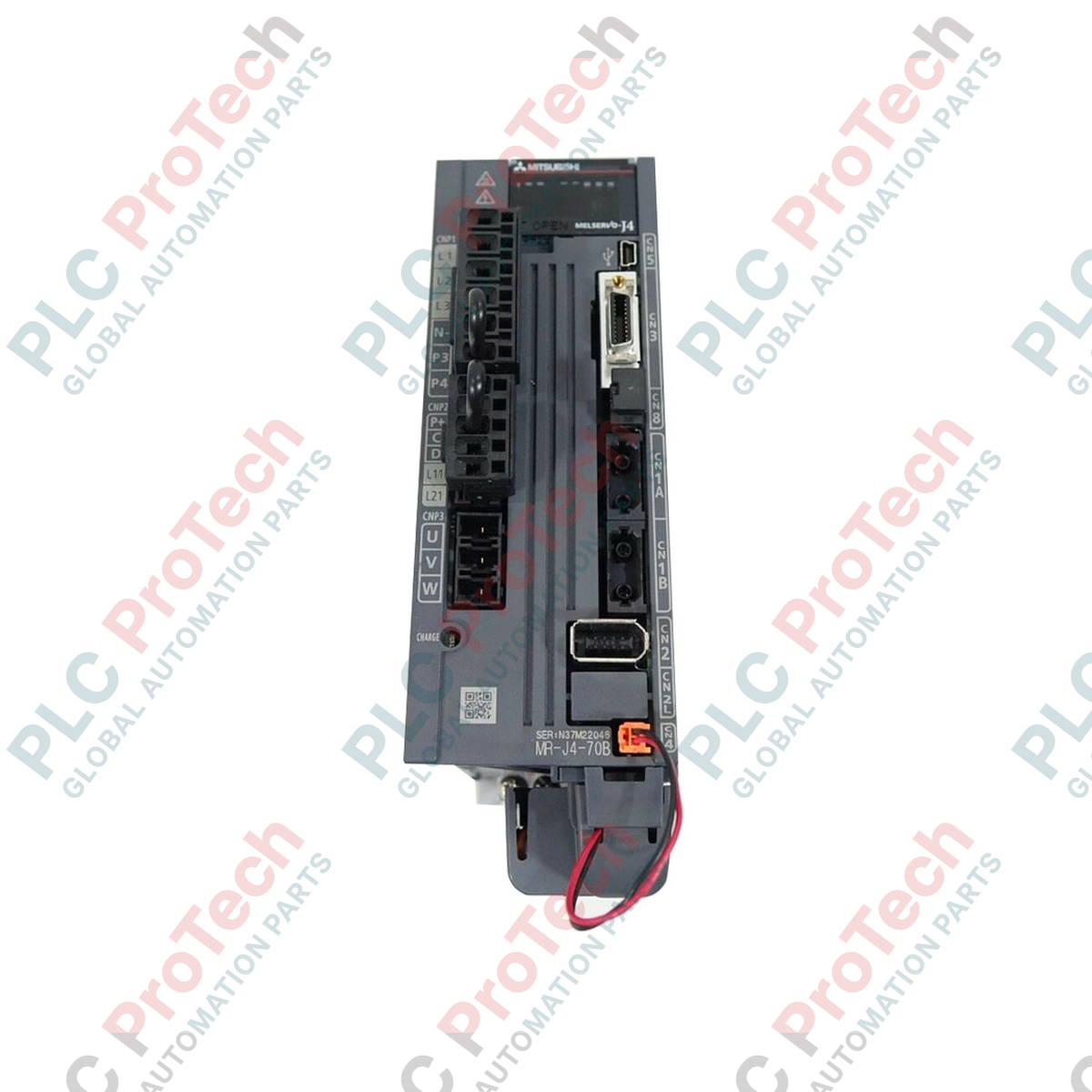
Projetado para controle de movimento de alto desempenho, o amplificador servo Mitsubishi Electric MR-J4-70B oferece controle preciso de posição, velocidade e torque no ecossistema MELSERVO-J4. Com capacidade de saída de 0,75 kW, este amplificador da classe de 200 V conecta-se nativamente a controladores de movimento usando a rede óptica síncrona ultrarrápida SSCNET III/H, otimizando os tempos de ciclo para até 0,222 ms. Sua função de segurança integrada Safe Torque Off (STO) e os filtros dinâmicos de supressão de vibrações garantem a proteção da máquina e o máximo rendimento mecânico em linhas exigentes de automação industrial.
Principais recursos
-
Interface de comando SSCNET III/H: A rede de fibra óptica permite comunicações de alta velocidade e imunes a ruídos, com ciclos de sincronização de 0,222 ms, 0,444 ms ou 0,888 ms.
-
Funções de segurança integradas: Inclui STO (Safe Torque Off) certificado conforme a EN ISO 13849-1 Categoria 3 PL e e a IEC 61508 SIL 3 para desenergização rápida da potência do motor.
-
Afinação e filtros dinâmicos: A afinação automática em tempo real, combinada com supressão adaptativa de vibrações, filtros robustos e compensação de movimento perdido, minimiza os tempos de estabilização e a ressonância da máquina.
-
Configurações de potência versáteis: Suporta configurações de entrada monofásica ou trifásica de 200 V a 240 V CA.
Aplicações
- Sistemas de posicionamento multieixos e máquinas de embalagem de alta velocidade para coleta e colocação.
- Plataformas de manuseio de semicondutores de precisão e mesas rotativas de indexação.
- Linhas de montagem automatizadas de trajetória contínua que exigem redes sincronizadas com múltiplos acionamentos.
Especificações técnicas
| Parâmetro |
Especificação |
| Fabricante |
Mitsubishi Electric |
| Número do modelo |
MR-J4-70B |
| Série do produto |
Série MELSERVO-J4 |
| Potência nominal de saída |
0,75 kW |
| Tensão nominal de saída |
CA trifásica de 170 V |
| Corrente nominal de saída |
5,8 A |
| Entrada de alimentação do circuito principal |
CA trifásica ou monofásica de 200 V a 240 V, 50 Hz / 60 Hz |
| Corrente nominal do circuito principal |
3,8 A |
| Entrada de alimentação do circuito de controle |
CA monofásica de 200 V a 240 V, 50 Hz / 60 Hz |
| Corrente e potência do circuito de controle |
0,2 A / 30 W |
| Interface de comando |
Interface SSCNET III/H |
| Método de controle |
Controle PWM de onda senoidal, sistema de controle de corrente |
| Resistor regenerativo integrado |
20 W |
| Segurança funcional |
STO (IEC/EN 61800-5-2), EN ISO 13849-1 Categoria 3 PL e, SIL 3 |
| Classe de proteção IP |
IP20 (resfriamento natural / design aberto) |
| Temperatura ambiente de operação |
0 °C a 55 °C (sem congelamento) |
| Peso |
1,4 kg |
| Peso de envio (calculado) |
4,0 kg |
Conexões e interfaces
| Conector / Bloco de terminais |
Atribuição de sinais / circuitos |
| L1, L2, L3 |
Entrada da fonte de alimentação CA do circuito principal (trifásica ou monofásica) |
| L11, L21 |
Entrada da fonte de alimentação CA do circuito de controle (monofásica) |
| U, V, W |
Saída de potência do servomotor (Fase U, Fase V, Fase W) |
| P+, C |
Conexões do resistor regenerativo externo |
| CN1A / CN1B |
Conectores de fibra óptica do barramento SSCNET III/H (Entrada / Saída) |
| CN2 |
Interface de feedback do encoder do servo motor |
| CN5 |
Porta USB para comunicação com PC (MR Configurator 2) |
| CN8 |
Conector de segurança funcional STO (Safe Torque Off) |
Insights empíricos de engenharia
Modelos alternativos e compatibilidade
O MR-J4-70B oferece um Modo de compatibilidade com J3 integrado, permitindo o comissionamento em layouts de sistemas SSCNET III mais antigos baseados no MR-J3. Isso possibilita substituições físicas e funcionais diretas do hardware em configurações de máquinas consolidadas, sem exigir reescritas imediatas do software ou do controlador mestre. Observe que, ao operar no modo de compatibilidade com J3, a velocidade de comunicação padrão é de 50 Mbps, em vez da capacidade nativa de 150 Mbps do SSCNET III/H.
Armadilhas da aplicação e observações de engenharia
Embora o MR-J4-70B possa operar com entrada CA monofásica, operar o sistema com ciclos de carga altamente dinâmicos pode sobrecarregar o banco interno de capacitores do barramento CC. Certifique-se de que o layout do painel mantenha um espaçamento mínimo de 10 mm em ambos os lados do amplificador quando várias unidades forem montadas lado a lado, pois o resfriamento por convecção natural depende estritamente de um fluxo de ar vertical desobstruído. Para ciclos de trabalho intensos ou grandes incompatibilidades de inércia, verifique se a capacidade regenerativa interna de 20 W é suficiente; caso contrário, deve ser adicionado um resistor regenerativo externo entre os terminais P+ e C, com o resistor interno desconectado.
Dicas de comissionamento e fiação
Nunca toque nas faces polidas dos cabos de fibra óptica SSCNET III/H. Poeira, umidade ou leves resíduos de óleo na superfície atenuam o sinal óptico, causando tempos limite de comunicação ou perdas intermitentes e irregulares de pacotes cíclicos. Certifique-se de que o raio de curvatura da fibra nunca seja inferior a 25 mm. Além disso, mantenha as linhas de controle e feedback de baixa tensão (CN2/CN8) isoladas da fiação de potência (U/V/W e L1/L2/L3), encaminhando-as por eletrodutos metálicos dedicados e aterrados.
Diretrizes de instalação
AVISO CRÍTICO:
PRESENÇA DE TENSÃO PERIGOSA. Desconecte e desenergize todas as alimentações principal e de controle antes da instalação física ou da ligação dos terminais. Aguarde pelo menos 15 minutos para que os capacitores do barramento interno descarreguem. Use um voltímetro digital confiável para confirmar que a tensão do barramento CC é zero entre os terminais P+ e N- antes de tocar nos terminais.
1
Monte o amplificador verticalmente em um painel traseiro plano e não inflamável, usando ferragens de montagem padrão para facilitar o fluxo de ar convectivo correto pelos canais de resfriamento.
2
Estabeleça uma conexão de aterramento de proteção sólida por meio dos terminais de terra dedicados para reduzir o ruído elétrico e evitar riscos de choque.
3
Faça a ligação da alimentação de controle (L11/L21) e dos terminais de entrada do circuito principal (L1/L2/L3), garantindo que fusíveis ou disjuntores adequados para proteção do circuito de derivação estejam instalados a montante.
4
Conecte o cabo do encoder ao CN2 e as fibras ópticas SSCNET III/H ao CN1A/CN1B, verificando se os protetores contra poeira ópticos estão limpos e armazenados com segurança.