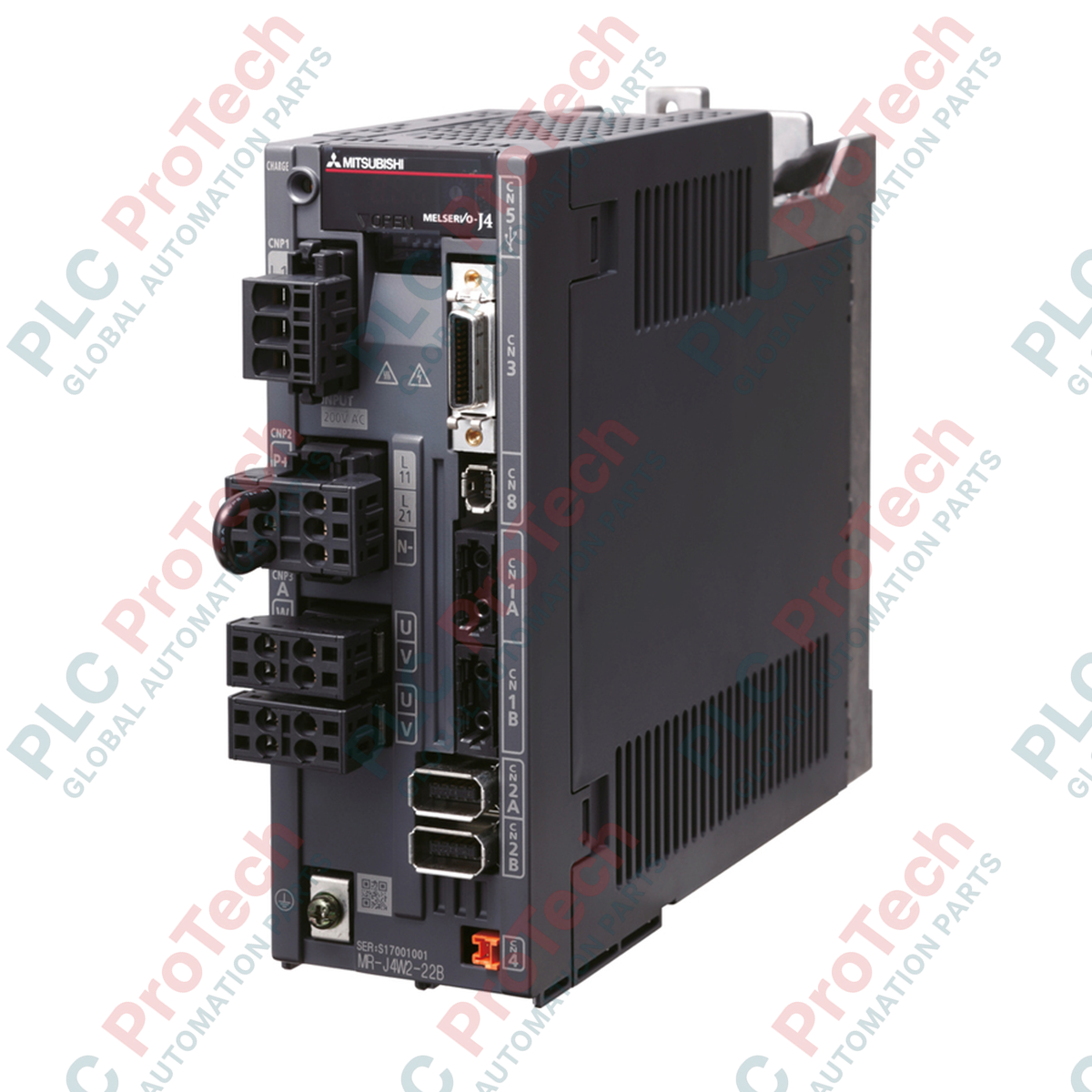
Descrição
Projetado para controle de movimento de múltiplos eixos de alto desempenho, o Mitsubishi Electric MR-J4W2-1010B é um amplificador servo CA de dois eixos da linha de produtos MELSERVO-J4. Esta unidade integra dois eixos de acionamento independentes de 1,0 kW em um único gabinete físico, reduzindo significativamente o espaço ocupado no painel e simplificando o cabeamento. Com comunicação óptica de alta velocidade por fibra SSCNET III/H, oferece controle síncrono de alta velocidade com realimentação em tempo real. O amplificador foi projetado para oferecer suporte a servomotores rotativos, lineares e de acionamento direto, adaptando-se a perfis de movimento complexos com supressão de vibração integrada e funções avançadas de ajuste.
Recursos
-
Integração de dois eixos: opera dois servomotores de 1,0 kW em uma única unidade, reduzindo o espaço de instalação em até 30% em comparação com drives individuais.
-
Protocolo SSCNET III/H: sistema de comunicação óptica de alta velocidade, operando a 150 Mbps para uma sincronização precisa e imune a ruídos.
-
Arquitetura de barramento CC compartilhado: permite que a energia regenerada durante a desaceleração de um eixo seja utilizada dinamicamente pelo outro eixo em aceleração, otimizando a eficiência energética geral.
-
Ajuste avançado com um toque: estima em tempo real a inércia da carga mecânica para definir e manter automaticamente os ganhos ideais do servo.
-
Recursos abrangentes de segurança: oferece suporte à função Safe Torque Off (STO) para atender aos padrões de segurança funcional industrial.
Aplicações
- Sistemas cartesianos de posicionamento e coleta de múltiplos eixos
- Máquinas de embalagem, empacotamento e selagem
- Linhas de montagem de semicondutores e componentes eletrônicos
- Sistemas de manuseio e classificação de materiais de precisão
Tabela de especificações técnicas
| Parâmetro |
Valor da especificação |
| Fabricante |
Mitsubishi Electric |
| Código do modelo |
MR-J4W2-1010B |
| Nome da série |
MELSERVO-J4 (Série MR-J4) |
| Número de eixos controlados |
2 eixos (Eixo A e Eixo B) |
| Potência nominal de saída |
1,0 kW (Eixo A) + 1,0 kW (Eixo B) |
| Fonte de alimentação do circuito principal |
Trifásica, 200 VAC a 240 VAC, 50/60 Hz |
| Fonte de alimentação do circuito de controle |
Monofásica, 200 VAC a 240 VAC, 50/60 Hz |
| Interface de comunicação |
SSCNET III/H (rede óptica de alta velocidade) |
| Método de controle |
Controle PWM de onda senoidal / sistema de controle de corrente |
| Método de resfriamento |
Ventilador de resfriamento forçado |
| Temperatura ambiente de operação |
0 a 55 °C (sem congelamento) |
| Umidade ambiente de operação |
5% a 90% UR (sem condensação) |
| Peso da unidade |
2,3 kg |
| Dimensões (L x A x P) |
85 mm x 168 mm x 195 mm |
Conexões e interfaces
| Terminal / porta de conexão |
Função / atribuição do circuito |
| CN1A |
Conexão frontal SSCNET III/H (entrada óptica do controlador ou do drive anterior) |
| CN1B |
Conexão traseira SSCNET III/H (saída óptica para o próximo drive na linha de rede) |
| CN2A |
Conector de entrada do encoder do eixo A |
| CN2B |
Conector de entrada do encoder do eixo B |
| L1, L2, L3 |
Terminais de entrada de alimentação principal (trifásica, 200–240 VAC) |
| L11, L21 |
Terminais de entrada de alimentação do controle (monofásica, 200–240 VAC) |
| U, V, W (Eixo A) |
Terminais de saída de alimentação do servomotor do eixo A |
| U, V, W (Eixo B) |
Terminais de saída de alimentação do servomotor do Eixo B |
Insights empíricos de engenharia
Modelos alternativos e compatibilidade
Ao migrar de dois amplificadores MR-J4-100B de eixo único separados para uma única unidade MR-J4W2-1010B, certifique-se de utilizar o MR Configurator2 (versão 1.20W ou superior). O software trata essa unidade de eixo duplo sob um único endereço de estação física, com guias de parâmetros para subeixos. Verifique se o mapa de configuração da rede do PLC atribuiu endereços consecutivos ao Eixo A e ao Eixo B na configuração do Simple Motion Module ou do Motion Controller.
Armadilhas da aplicação e observações de engenharia
Como o Eixo A e o Eixo B compartilham um único resistor regenerativo integrado, a desaceleração simultânea de ambas as cargas de alta inércia acionará rapidamente falhas de sobretensão regenerativa (Falha AL.30 ou AL.33). Se ambos os eixos operarem em sequências cíclicas rápidas de partida/parada, recomendamos enfaticamente instalar uma opção regenerativa externa (como o MR-RB12) para contornar os limites internos e evitar a sobrecarga térmica do barramento integrado.
Dicas de comissionamento e fiação
Os cabos de fibra óptica SSCNET III/H (CN1A e CN1B) são extremamente sensíveis à contaminação por partículas. Use fluido de limpeza específico e lenços sem fiapos nas extremidades das fibras antes de conectá-las. Uma minúscula partícula de poeira pode degradar a intensidade do sinal, resultando em erros intermitentes de comando SSCNET (AL.37 ou AL.E4). Observe o raio de curvatura mínimo de 25 mm para cabos de fibra padrão; curvaturas mais fechadas podem atenuar permanentemente o sinal do enlace óptico.
Diretrizes de instalação
AVISO CRÍTICO
Isole e bloqueie todos os circuitos da rede trifásica (L1/L2/L3) e da alimentação de controle (L11/L21) antes de manusear a fiação. Uma carga de alta tensão permanece armazenada nos capacitores do barramento CC interno após a desconexão da alimentação. Aguarde sempre no mínimo 15 minutos e verifique se a tensão entre os terminais P+ e N- está abaixo de 50 VCC usando um multímetro digital com classificação adequada antes de iniciar a manutenção.
1
Monte o amplificador verticalmente em uma placa metálica de montagem sem pintura, dentro de um painel de controle limpo, garantindo uma superfície de aterramento sólida e contínua. Deixe uma folga de 10 mm em cada lado do chassi e folgas de 40 mm na parte superior e inferior para garantir uma convecção térmica adequada.
2
Conecte o terminal PE ao barramento principal de aterramento do gabinete usando um fio terra espesso e de baixa impedância. O aterramento correto evita interferências eletromagnéticas e perdas da realimentação do encoder causadas por ruído.
3
Conecte os cabos de alimentação do motor (U, V, W), identificando especificamente o Eixo A e o Eixo B. A conexão incorreta dos cabos do motor aos sinais de realimentação dos encoders errados causará uma condição imediata de runaway sem controle e uma falha de realimentação na inicialização.
4
Insira os conectores de fibra óptica SSCNET III/H nas portas CN1A e CN1B até ouvir um clique mecânico firme. Prenda as presilhas da tampa do conector para evitar conexões frouxas causadas por vibrações.