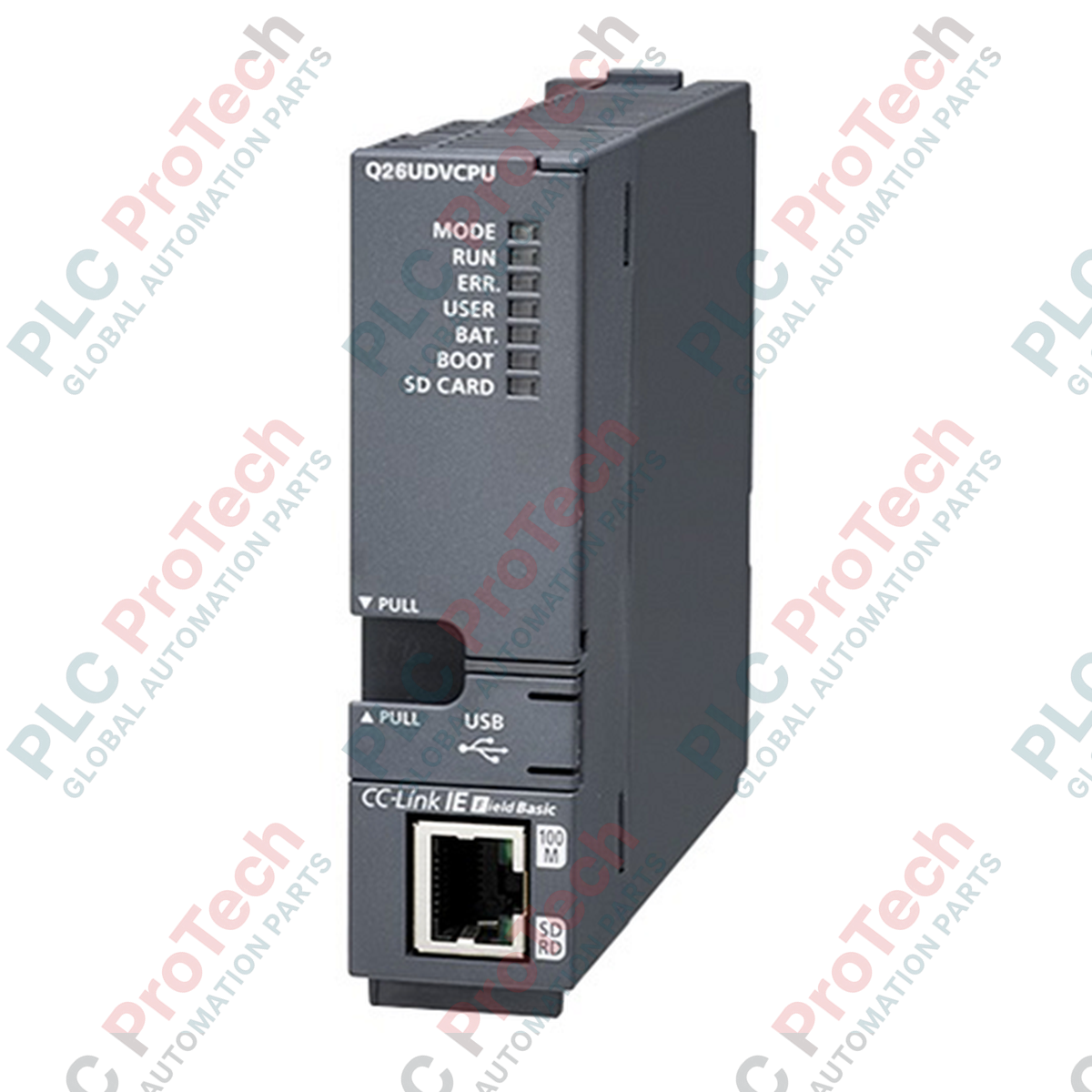
Descrição
Projetada para execução de sequências em alta velocidade e integração perfeita à rede da planta, a unidade central de processamento Mitsubishi Electric Q03UDVCPU atua como uma CPU de alto desempenho na plataforma de automação MELSEC Q Series. Essa CPU universal de alta velocidade foi projetada para atender às exigências rigorosas de sistemas de fabricação complexos, oferecendo uma velocidade ultrarrápida de execução de instruções de 1,9 ns para operações LD básicas. Com sua porta Ethernet RJ45 integrada, o módulo permite comunicação robusta em nível de dispositivo, telemetria de diagnóstico e acesso à programação sem exigir interfaces de rede dedicadas. Sua arquitetura é compatível com uma capacidade substancial de programa de 30 mil passos, além de escalabilidade com dois slots por meio de cartões SD/SDHC padrão, tornando-o ideal para registro de dados intensivo e coordenação de controle de movimento de precisão em arquiteturas industriais modernas.
Recursos
-
Processamento ultrarrápido: Alcança um tempo de execução de 1,9 ns para instruções LD básicas e de 3,9 ns para instruções MOV, minimizando os tempos de varredura do controlador.
-
Interface Ethernet integrada: A porta RJ45 integrada de 10/100 Mbps é compatível com até 16 conexões de soquete simultâneas, protocolo MC e conexões MELSOFT.
-
Arquitetura de memória flexível: Oferece capacidade de programa de 120 KB e 192 KB de RAM padrão, expansível com cassetes SRAM estendidos.
-
Suporte integrado a SD/SDHC: O slot para cartão integrado é compatível com mídias de armazenamento padrão de até 32 GB para registro seguro de dados, gerenciamento de receitas e backups automatizados do sistema.
-
Programação multilíngue: Totalmente compatível com texto estruturado (ST), blocos de função, SFC (MELSAP 3) e lógica ladder tradicional.
Aplicações
- Sistemas de embalagem sincronizados multieixos de alta velocidade.
- Rastreamento de linhas de montagem automotiva e células de manuseio de componentes.
- Infraestrutura distribuída de tratamento de água utilizando sistemas de telemetria.
- Máquinas de processamento térmico e indexação de semicondutores de alta precisão.
Especificações técnicas
| Parâmetro |
Valor da especificação |
| Fabricante |
Mitsubishi Electric |
| Código do modelo |
Q03UDVCPU |
| Método de controle |
Operação de iteração do programa armazenado |
| Capacidade do programa |
30 mil passos (120 KB) |
| Velocidade da instrução LD |
1,9 ns |
| Pontos físicos de E/S |
4096 pontos |
| RAM / ROM padrão |
192 KB / 1025,5 KB |
| Consumo de corrente interno (5 VCC) |
0,58 A (unidade básica) / 0,60 A (com cassete SRAM) |
| Armazenamento compatível |
Cartão de memória SD/SDHC (até 32 GB) |
| Portas integradas |
Ethernet RJ45, Mini-USB, slot para cartão SD |
| Temperatura ambiente de operação |
0 a 55 °C |
| Peso líquido |
0,20 kg |
| Dimensões (W x A x P) |
27,4 mm x 98 mm x 115 mm |
| Peso de envio (calculado) |
1,20 kg |
Informações práticas de engenharia
Modelos alternativos e compatibilidade
A Q03UDVCPU representa a evolução universal de alta velocidade da antiga Q03UDECPU. Ao atualizar sistemas legados existentes, observe que a série V utiliza um slot integrado para cartões SD/SDHC, em vez das opções legadas de cartões CompactFlash ou PCMCIA. Para garantir que a lógica do sistema e a alocação de tarefas sejam compiladas corretamente, sua equipe de engenharia deve atualizar o tipo de CLP de destino para 'Q03UDV' no GX Works2 (versão 1.98C ou superior) ou no GX Works3 antes de realizar o download do código.
Armadilhas de aplicação e observações de engenharia
Embora a memória do programa seja não volátil, a retenção de parâmetros, registros (D, W) e dados do relógio interno mantidos depende da bateria de backup de lítio Q6BAT. Em ambientes com temperaturas operacionais ambientes consistentemente superiores a 45 °C, a curva de degradação da bateria se acelera. Recomenda-se enfaticamente monitorar o registro especial SD8005 (flag de bateria fraca) por meio do seu sistema SCADA ou HMI local para programar a manutenção preventiva antes que ocorra perda de dados.
Dicas de comissionamento e fiação
Para garantir uma conectividade Ethernet confiável, certifique-se de que o cabeamento industrial RJ45 seja blindado (S/FTP) e esteja afastado dos cabos de saída do inversor de alta tensão. Ao configurar os parâmetros da Ethernet integrada no software GX de programação, verifique novamente se o intervalo de endereços IP não entra em conflito com as rotas IP ativas na rede da sua empresa. Além disso, conecte sempre o terminal de terra funcional (FG) da unidade de base diretamente a um aterramento de baixa impedância para proteger contra ruídos de comutação transitórios de alta frequência.
Diretrizes de instalação
ADVERTÊNCIA CRÍTICA DE SEGURANÇA
Sempre isole todas as fontes de alimentação elétrica principal que alimentam o conjunto do backplane (como as unidades de base principais Q38B ou Q312B) antes de inserir ou remover o módulo Q03UDVCPU. Tentar fazer uma troca a quente ou manusear a CPU enquanto a unidade de alimentação estiver ativa causará danos imediatos à interface do barramento do backplane e poderá provocar a falha dos módulos de E/S adjacentes.
1
Certifique-se de que o módulo da fonte de alimentação principal instalado na unidade de base esteja totalmente desligado e verifique isso usando um voltímetro calibrado.
2
Alinhe o gancho inferior da Q03UDVCPU com o orifício-guia do módulo localizado na posição do slot 0 da unidade de base da série MELSEC Q.
3
Empurre firmemente a parte superior do módulo em direção ao backplane até que a trava superior se encaixe com segurança; em seguida, aperte o parafuso de fixação do módulo (M3) com um torque de 0,36 a 0,48 N-m.
4
Insira o cartão SD, se necessário, verifique se a trava do cartão de memória está acionada e conecte o cabo de comunicação RJ45 blindado à porta Ethernet integrada antes de restaurar a alimentação de controle.