


IC693CPU360 vs IC693CPU364 : Ethernet et budget d’alimentation
Comparez les IC693CPU360 et IC693CPU364 selon l’interface Ethernet, la charge en +5 VDC, la mémoire, les limites de rack et les vérifications de remplacement.
Fabricant : BECKHOFF
N° de produit : CX8031
Pays d'origine :Allemagne
Type de produit : PC embarqués
Paiement : Virement bancaire, Western Union
Poids : 500g
Dimensions : 64 mm x 100 mm x 73 mm
Port d'expédition : Xiamen
Garantie : 12 mois
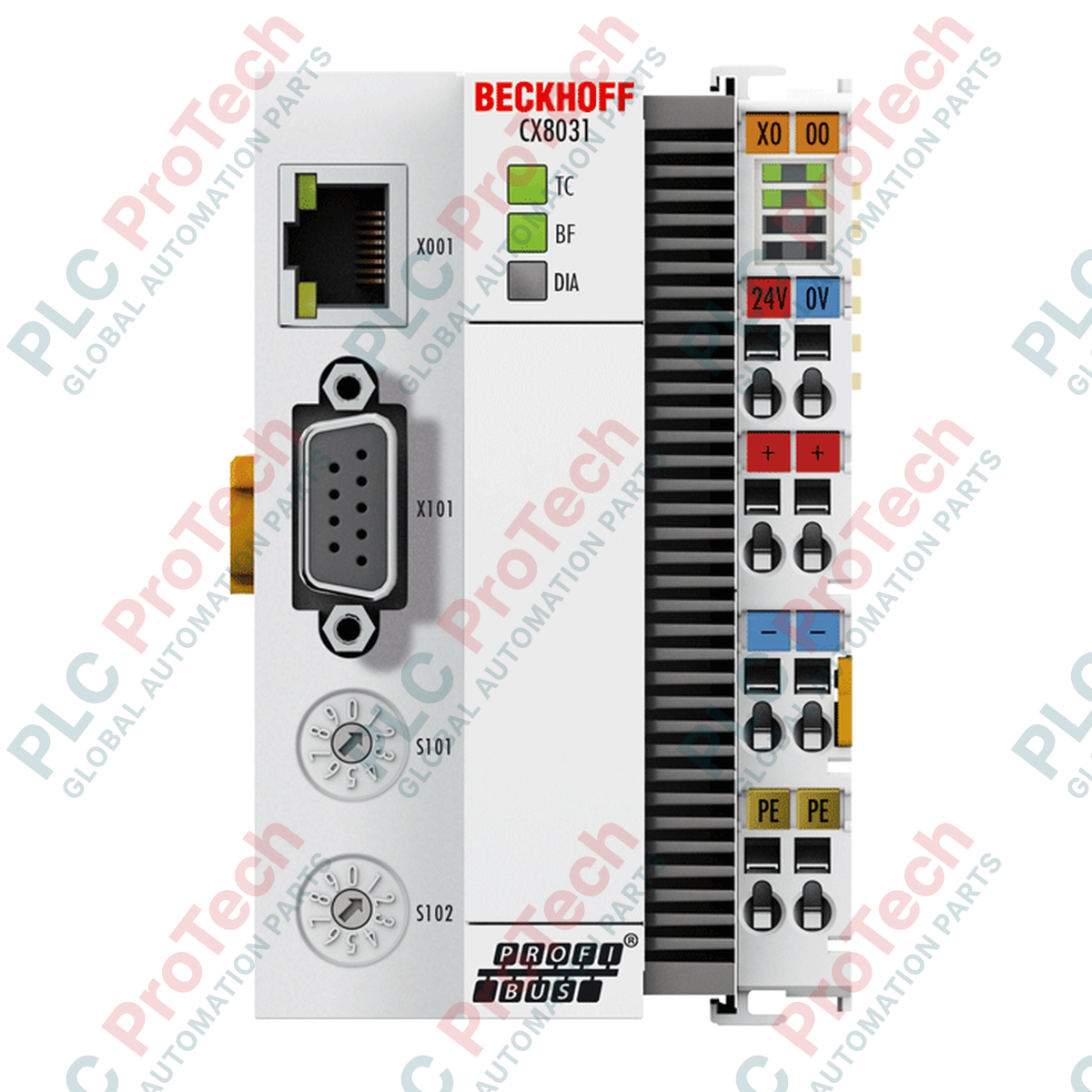
Conçu pour faire le lien entre un contrôle local haute vitesse et des réseaux de bus de terrain existants, le Beckhoff CX8031 est un PC embarqué très compact monté sur rail DIN, équipé d’une interface esclave PROFIBUS DP intégrée. Ce contrôleur est conçu pour traiter la logique d’automatisation locale de manière autonome, tout en maintenant une communication directe et déterministe avec un système PROFIBUS maître. Doté d’un processeur ARM9 à 400 MHz, l’appareil exécute Windows Embedded CE 6 et est optimisé pour l’environnement de programmation TwinCAT 2, permettant l’exécution rapide d’applications API directement au niveau de la machine ou du terrain.
| Paramètre de spécification | Valeur / classification |
|---|---|
| Fabricant | Beckhoff |
| Numéro de modèle | CX8031 |
| Type de processeur | ARM9, 400 MHz (1 cœur) |
| Mémoire flash | 512 Mo de microSD (extensible en option) |
| Mémoire principale | 64 Mo de RAM DDR2 (non extensible) |
| Mémoire persistante | UPS de 1 seconde (enregistre jusqu’à 1 Mo de données persistantes) |
| Système d’exploitation | Windows Embedded CE 6 |
| Logiciel de commande | API TwinCAT 2 |
| Interfaces physiques | 1 x RJ45 (10/100 Mbit/s), 1 x USB périphérique (derrière le volet avant de protection) |
| Interface de bus | 1 prise D-sub 9 broches, blindée, esclave PROFIBUS DP |
| Type de connexion E/S | E-bus (EtherCAT) ou K-bus (terminaux de bus), reconnaissance automatique |
| Alimentation du courant du bus | 2 A maximum |
| Consommation électrique maximale | 3 W |
| Affichage des diagnostics | 1 voyant d’état TC, 2 voyants d’état du bus |
| Horloge temps réel | Horloge interne avec batterie remplaçable (derrière le volet avant) |
| Dimensions (L x H x P) | 64 mm x 100 mm x 73 mm |
| Poids de l’unité | 180 g |
| Température de fonctionnement | 0 à 55 degC |
| Température de stockage | -25 à +85 degC |
| Humidité relative | 95 %, sans condensation |
| Indice de protection | IP20 |
| Marquage ATEX | II 3 G Ex nA IIC T4 Gc / II 3 D Ex tc IIIC T135 degC Dc |
| Marquage IECEx | Ex nA IIC T4 Gc / Ex tc IIIC T135 degC Dc |
| Marquage cFMus | Classe I, Division 2, Groupes A, B, C, D / Classe I, Zone 2, AEx ec IIC T4 Gc |
| Poids d’expédition (calculé) | 2,0 kg |
| Type d’interface | Connecteur / format | Affectation fonctionnelle |
|---|---|---|
| Port Ethernet | RJ45 (10/100 Base-T) | Programmation, mise en service du réseau et configuration du système |
| Esclave PROFIBUS DP | D-sub 9 broches (femelle), blindé | Intégration standard d’un maître PROFIBUS (adressage matériel) |
| Port USB périphérique | USB Type B (sous le volet avant) | Interface de configuration locale pour la gestion du système d’exploitation et les diagnostics |
| Contacts du bus d’E/S | Contacts à ressort (côté droit) | Connexion automatique aux terminaux EtherCAT standard (E-bus) ou aux terminaux de bus (K-bus) |
Le CX8031 est spécifiquement conçu pour les environnements TwinCAT 2 et n’est pas compatible avec les environnements d’exécution TwinCAT 3 en raison de son architecture matérielle ARM9 sous-jacente. Pour les applications nécessitant la compatibilité avec TwinCAT 3 ou un traitement multicœur moderne, les développeurs doivent spécifier les contrôleurs des séries CX8100 ou CX8200. Lors du passage du K-bus (terminaux de bus standard) à l’E-bus (EtherCAT) sur le même CX8031, l’unité détecte automatiquement la topologie physique du bus de fond de panier au démarrage, sans modification manuelle des commutateurs DIP.
Bien que le CX8031 fournisse jusqu’à 2 A directement au fond de panier E-bus/K-bus, les intégrateurs système doivent calculer la consommation totale de tous les modules d’E/S connectés. Le dépassement de cette limite déclenchera un arrêt du système ou provoquera des anomalies de communication instables. Lors de la mise en œuvre de configurations à forte densité de modules, prévoyez un module d’alimentation intermédiaire, tel que l’EL9410, afin d’injecter une alimentation supplémentaire sur le bus.
L’adresse de nœud PROFIBUS est configurée manuellement à l’aide des sélecteurs rotatifs d’adresse physiques situés derrière le volet avant. Les modifications apportées à ces sélecteurs rotatifs ne sont pas prises en compte en temps réel ; le CX8031 doit effectuer un redémarrage à froid complet (cycle de mise hors puis sous tension) pour enregistrer la nouvelle adresse matérielle. Assurez-vous que le blindage du câble PROFIBUS D-Sub à 9 broches est mis à la terre aux deux extrémités afin d’éliminer les interférences électromagnétiques industrielles haute fréquence.
AVERTISSEMENT CRITIQUE
Isolez toutes les sources d’alimentation électrique avant de procéder à l’installation mécanique ou au câblage physique des bornes. Assurez-vous que les lignes d’alimentation sont consignées conformément aux procédures de sécurité industrielles standard. Le fait de ne pas déconnecter les lignes sous tension peut endommager le cœur du processeur ARM9, corrompre la partition système de la carte microSD ou entraîner de graves dommages matériels.

Livraison express mondiale
Retours et garantie
Expédition express mondiale
Retours et garantie
Les commandes sont traitées et livrées du lundi au vendredi (hors jours fériés).
Pour connaître l'éligibilité complète, les frais de restockage et les détails des retours internationaux, veuillez consulter notre site officiel Politique de remboursement et de retour .
| Country of origin |
Allemagne
|

Comparez les IC693CPU360 et IC693CPU364 selon l’interface Ethernet, la charge en +5 VDC, la mémoire, les limites de rack et les vérifications de remplacement.

Une séquence de diagnostic sur le terrain pour les problèmes de sortie analogique du 1756-OF4 : mode de canal, bornier amovible, mise à l’échelle et contrôles électriques contrôlés.

Une comparaison directe du nombre de sorties, du regroupement commun, du courant du fond de panier et des limites de charge avec déclassement thermique de 1746-OA8 et 1746-OA16.

Une liste de contrôle sur le terrain pour consigner la série matérielle 1761-NET-DNI, le firmware, le fichier EDS, les paramètres DF1, l’adresse DeviceNet et la configuration de messagerie avant le...

L’EL3062 est un terminal EtherCAT 0–10 V. L’EL3062-0030 est une variante 0–30 V. Cette liste de contrôle couvre l’identification, la mise à l’échelle et la mise en service.

Une liste de contrôle sur le terrain pour remplacer les modules de sortie à relais Allen-Bradley 1769-OW8 sans perdre les informations relatives aux groupes de charges, au câblage et à la mise en...