
1 of 1

EL3602 | BECKHOFF | Terminal EtherCAT

EL3602 | BECKHOFF | Terminal EtherCAT

Il ne reste que 10 article(s) en stock
  • Fabricant : BECKHOFF

  • N° de produit : EL3602

  • Pays d'origine :Allemagne

  • Type de produit : Bornier EtherCAT

  • Paiement : Virement bancaire, Western Union

  • Poids : 2000g

  • Dimensions : 120 mm x 80 mm x 25 mm

  • Port d'expédition : Xiamen

  • Garantie : 12 mois

Quantité
Voir les détails complets

Description

Designed for high-accuracy voltage measurement within automated control topologies, the Beckhoff EL3602 is a dual-channel analog input terminal operating on the EtherCAT protocol. This high-precision module processes differential input signals across several user-configurable voltage ranges, providing reliable 24-bit resolution to the central control system. Optimized for applications requiring exceptional signal fidelity, it features electrical isolation and robust integrated filters to manage electrical noise in demanding industrial environments.

Features

  • Two independent, differential analog input channels.
  • Parameterizable measurement ranges: +/-10 V, +/-5 V, +/-2.5 V, and +/-1.25 V.
  • Exceptional 24-bit resolution (including sign) for microscopic voltage tracking.
  • Extremely low measurement error of less than +/-0.01 percent at 25 degC (relative to full scale).
  • Galvanic isolation of 500 V between the internal E-bus and the input channels.
  • Configurable conversion times ranging from 1 ms to 400 ms (20 ms default).

Applications

  • High-precision automated test benches and calibration systems.
  • Process monitoring in semiconductor manufacturing and laboratory environments.
  • Tension and load monitoring loops requiring highly stable differential voltage feedback.
  • Multi-axis motion systems needing micro-positioning analog feedback.

Technical Specifications

Specification Parameter Value
Manufacturer Beckhoff
Model Series EL3602 (EtherCAT Terminal Series)
Number of Inputs 2 (Differential)
Signal Voltage Ranges -10 to +10 V, -5 to +5 V, -2.5 to +2.5 V, -1.25 to +1.25 V
Resolution 24 bits (including sign)
Internal Resistance Greater than 200 kOhm
Input Filter Limit Frequency 3 kHz
E-bus Current Consumption Typically 190 mA
Common-Mode Voltage (Ucm) Maximum 35 V
Crosstalk Attenuation Greater than 60 dB
Electrical Isolation 500 V (E-bus / signal voltage)
Operating Temperature -25 to +60 degC
Storage Temperature -40 to +85 degC
Relative Humidity 95 percent, non-condensing
Protection Rating IP20
Approvals & Markings CE, UL, ATEX (II 3 G Ex nA IIC T4 Gc)
Housing Dimensions 12 mm x 100 mm x 68 mm
Net Module Weight 60 g
Shipping Weight (Calculated) 0.15 kg
Package Dimensions (Calculated) 120 mm x 80 mm x 25 mm
Country of Origin Germany

Connections and Interfaces

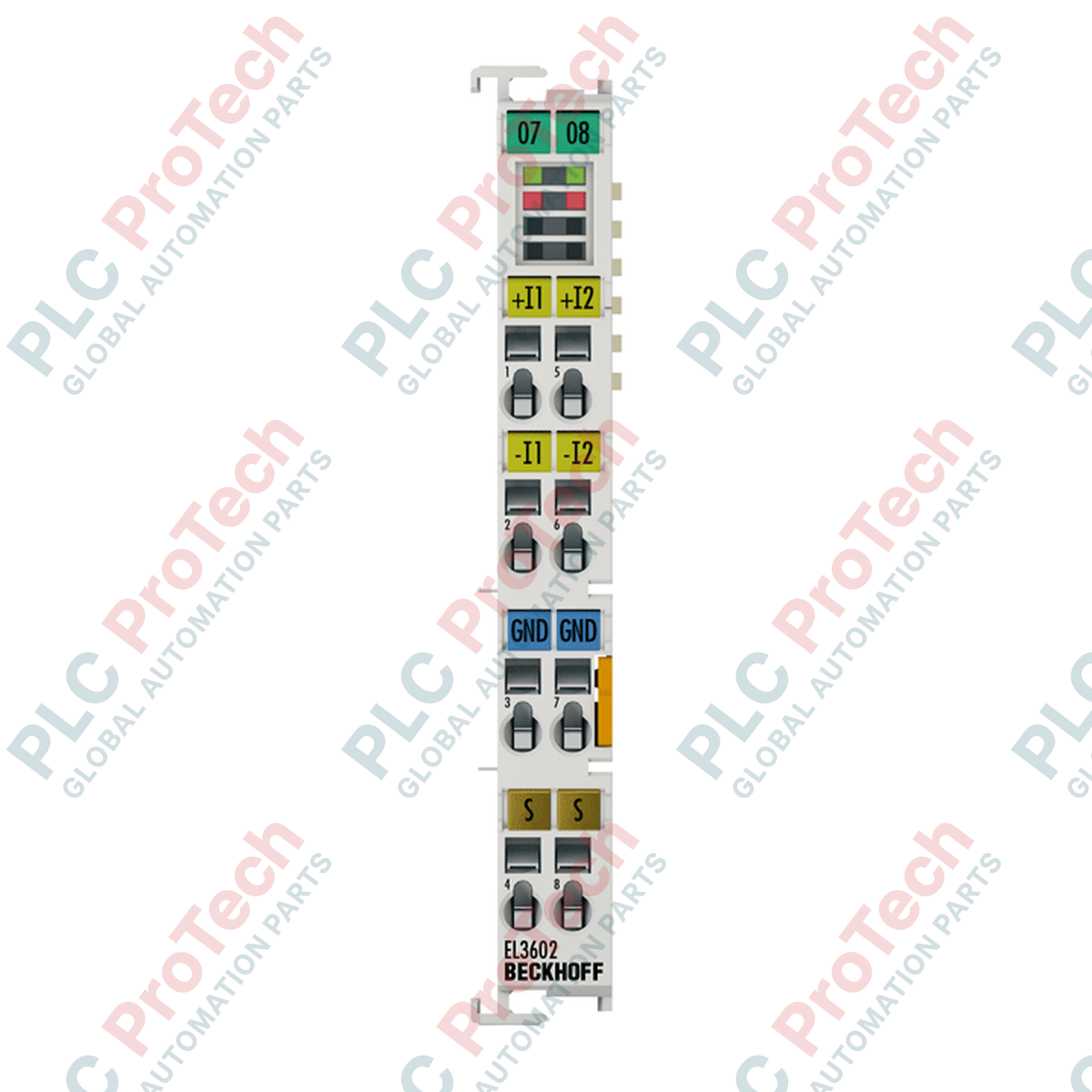
Terminal Point Signal Assignment (Channel 1) Terminal Point Signal Assignment (Channel 2)
1 Input + 2 Input +
5 Input - 6 Input -
3 Shield 7 Shield
4 Analog Ground (AGND) 8 Analog Ground (AGND)

Empirical Engineering Insights

Alternative Models & Compatibility

When replacing or integrating the EL3602, verify the TwinCAT software version and active EtherCAT XML Device Description (ESI) files. The EL3602 features dynamic configuration via CoE (CAN over EtherCAT) variables. Ensure that older systems designed for the calibrated alternative EL3602-0010 are checked, as scaling and calibration coefficients differ within the PLC program. When using multiple EL series modules, verify that the total E-bus current budget does not exceed the limits of the coupler or the power supply terminal; the EL3602 draws a sustained 190 mA from the E-bus.

Application Pitfalls & Engineering Notes

The common-mode voltage (Ucm) must be kept strictly below 35 V relative to the internal E-bus ground to prevent measurement errors and potential damage. Ground loops are the primary source of drift in 24-bit applications. If measuring floating voltage sources, ensure the AGND terminal is linked to a clean, stable system reference to prevent the differential inputs from drifting into saturation. Additionally, allow a 15-minute thermal stabilization period after powering the cabinet to ensure the internal reference reaches equilibrium for 24-bit resolution stability.

Commissioning & Wiring Tips

Use twisted-pair shielded cabling for all analog signals. The shield should be terminated directly at the terminal (Terminal 3 or 7) for best high-frequency performance. In high-interference environments, utilize the TwinCAT system manager to activate the 50 Hz or 60 Hz notch filter inside the module's CoE registers. This significantly attenuates electrical line noise and maintains the module's ultra-low measurement error rating.

Installation Guidelines

CRITICAL WARNING

Always isolate the power supply of the entire EtherCAT station before inserting or removing terminals. Failure to de-energize the E-bus could cause damage to the internal contact pins or result in system communication failures.

1

Align the terminal onto the 35 mm DIN rail (conforming to EN 60715) and slide it to lock into the adjoining module using the double slot and key connection.

2

Push the terminal forward until the orange locking slide snaps securely over the rail.

3

Insert a flathead screwdriver into the spring-actuated terminal openings to wire connections. Solid or stranded conductors (0.08 to 2.5 mm2, AWG 28-14) must be stripped exactly 8 to 9 mm.

4

Verify connection status using the integrated LEDs before applying full system logic power.

Loading product navigation…

What is the default conversion time of the EL3602, and can it be adjusted?

The default conversion time is 20 ms. However, it is fully parameterizable via CoE (CAN over EtherCAT) settings between 1 ms and 400 ms.

What is the maximum common-mode voltage allowed on this analog module?

The maximum common-mode voltage (Ucm) is 35 V. Exceeding this rating can lead to saturated analog signals, measurement errors, or terminal damage.

Does the EL3602 require an external power supply connection?

No, the EL3602 receives its operational power entirely from the internal E-bus connection, drawing typically 190 mA.

Can I configure the channels for single-ended voltage measurement?

The EL3602 features dedicated differential inputs. For single-ended measurements, you must connect the negative terminal to the reference ground (AGND) while verifying you do not violate the 35 V common-mode limit.

Expédition express mondiale

  • Livraison standard : 4 à 6 jours ouvrables via DHL, FedEx et UPS.
  • Expédition express : Expédition le jour même pour les commandes en stock passées avant 14h00 (GMT+8).
  • Couverture mondiale : Service dans plus de 150 pays, avec livraison rapide en Arabie Saoudite et aux Émirats arabes unis.

Retours et garantie

  • Garantie de 30 jours : Retours acceptés pour les produits en stock dans leur emballage d'origine scellé en usine.
  • Garantie de 12 mois : Chaque composant industriel est couvert par notre garantie technique professionnelle.

Les commandes sont traitées et livrées du lundi au vendredi (hors jours fériés).


Pour connaître l'éligibilité complète, les frais de restockage et les détails des retours internationaux, veuillez consulter notre site officiel Politique de remboursement et de retour .

TECHNICAL SPECIFICATIONS

Country of origin
Allemagne

Produits récemment consultés

Connaissances techniques

Actionneurs électriques conçus pour remplacer les systèmes à fluide : un guide pratique d'automatisation industrielle

Cet article explique comment les actionneurs électriques intégrés, tels que la série e-Actuator de SMC, transforment le contrôle du mouvement industriel en remplaçant les systèmes pneumatiques et...

Opérations mathématiques avec OpenPLC pour les applications d'automatisation industrielle

Cet article explique comment les systèmes PLC réalisent des opérations mathématiques de base telles que l'addition, la soustraction, la multiplication, la division, le modulo et l'exponentiation dans...

Logique booléenne avancée avec la programmation FBD PLC : applications industrielles pratiques au-delà de la logique de base

L'article explique plusieurs fonctions avancées de la logique booléenne utilisées en programmation d'automates programmables industriels (API) au-delà des opérations de base ET, OU et NON. Il aborde...

Logique booléenne en programmation PLC : comprendre les portes logiques FBD

La logique booléenne est la base de tout programme PLC. Des commandes machines simples aux systèmes d'automatisation industrielle complexes, les portes logiques déterminent comment les contrôleurs...

Guide approfondi sur les pare-feux industriels et la segmentation des réseaux OT

Les pare-feux industriels jouent un rôle crucial dans la cybersécurité OT, protégeant les réseaux PLC, DCS et SCADA grâce à la segmentation, au contrôle des entrées/sorties et à l’intégration IDS/IPS...

Guide des pinces robotiques : de la manipulation délicate à l'automatisation lourde

Les pinces robotiques modernes évoluent au-delà des mâchoires mécaniques traditionnelles. Des systèmes adhésifs inspirés des geckos aux pinces souples de qualité alimentaire, en passant par des...