Présentation du produit
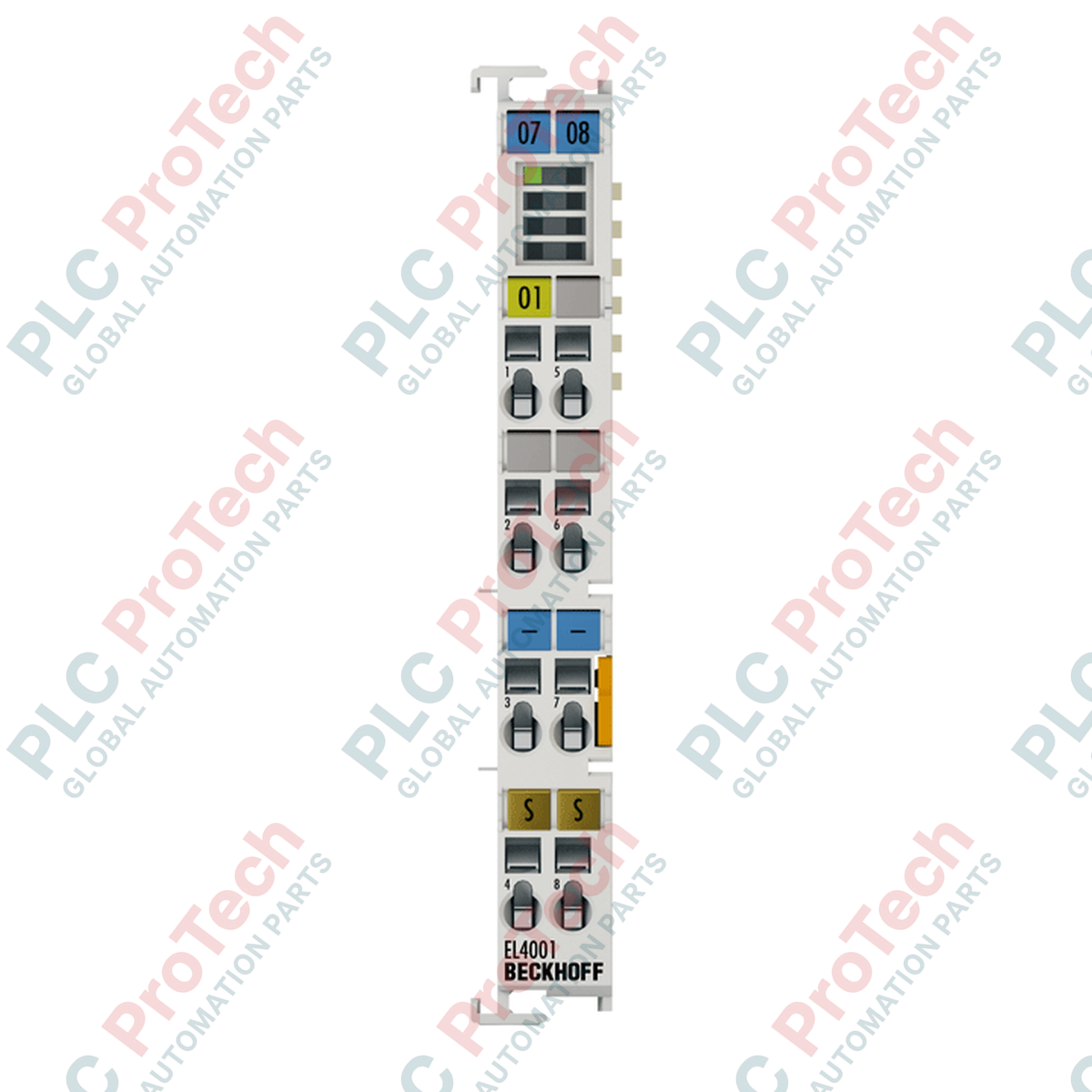
Le EL4001 (EL4001) est une sortie analogique de précision à 1 canal conçue pour le système EtherCAT I/O, fournissant un signal de tension stable de 0 à 10 V. Conçu pour des applications industrielles à grande vitesse telles que le contrôle de vannes proportionnelles, la spécification de consignes pour variateurs de fréquence et la régulation climatique en salles blanches, ce module offre une résolution de 12 bits pour un positionnement précis des actionneurs. En utilisant la technologie EtherCAT Distributed Clocks (DC), le EL4001 atteint une synchronisation ultra-précise avec un jitter inférieur à 1 microseconde, ce qui le rend indispensable pour les systèmes multi-axes coordonnés et les boucles de contrôle déterministes. Son format compact de 12 mm et sa sortie protégée contre les courts-circuits garantissent une grande fiabilité et une efficacité d’espace dans les armoires de commande denses.
Configuration technique
Le matériel du EL4001 utilise une technologie de connexion asymétrique à 2 fils, tirant son alimentation directement des contacts d’alimentation 24 VDC. L’étage de sortie est très robuste, supportant des charges supérieures à 5 kOhm tout en maintenant une erreur de sortie inférieure à 0,1 %. Une caractéristique clé de ce terminal est la fonction watchdog intégrée ; en cas de défaillance de la communication sur le bus de terrain, la sortie peut être programmée pour passer à une valeur de sécurité définie par l’utilisateur ou suivre une rampe spécifique, protégeant ainsi le matériel mécanique contre les arrêts brusques. L’image process est représentée par une valeur AO 1 x 16 bits, permettant une intégration transparente dans TwinCAT ou tout maître EtherCAT standard.
Caractéristiques techniques
| Caractéristique |
Spécification |
| Modèle |
EL4001 |
| Marque |
BECKHOFF |
| Origine |
Allemagne |
| Type de sortie |
Sortie analogique 1 canal, tension 0-10 V |
| Résolution |
12 bits |
| Temps de conversion |
env. 100 microsecondes |
| Erreur de sortie |
< 0,1 % (par rapport à la valeur finale) |
| Distributed Clocks |
Oui, précision << 1 microseconde |
| Alimentation |
24 VDC via contacts d’alimentation |
| Consommation de courant (E-bus) |
typ. 140 mA |
| Isolation électrique |
500 V (E-bus/tension signal) |
| Dimensions (L x H x P) |
12 mm x 100 mm x 68 mm |
| Température de fonctionnement |
-25 à +60 degrés Celsius |
| Poids |
0,06 kg |
FAQ techniques
Le EL4001 nécessite-t-il une alimentation externe pour le signal de sortie ?
Oui, le terminal tire son alimentation 24 VDC via les contacts d’alimentation de la ligne EtherCAT. Assurez-vous qu’un terminal d’alimentation (comme l’EK1100 ou l’EL9100) fournit la tension nécessaire au rail d’alimentation.
Comment la résolution 12 bits est-elle mappée dans l’image process 16 bits ?
La valeur numérique 12 bits est alignée à gauche dans l’entier 16 bits (sortie AO 1 x 16 bits) de l’image process. Cela permet au système de rester compatible avec les types de données 16 bits standard tout en offrant 4096 paliers de tension distincts entre 0 et 10 V.
La sortie est-elle protégée contre les erreurs de câblage ?
Le EL4001 est protégé contre les courts-circuits. Si la résistance de charge descend en dessous de 5 kOhm ou qu’un court-circuit direct se produit, le terminal limite le courant pour éviter des dommages internes, bien que la tension de sortie ne reflètera plus précisément la valeur process.
Guide d’ingénierie et d’installation
-
Intégrité du signal et mise à la terre : Pour minimiser la chute de tension et les interférences électromagnétiques, utilisez des câbles blindés à paires torsadées (STP) pour le signal 0-10 V. La tresse de blindage doit être mise à la terre au point d’entrée de l’armoire de commande. Étant donné qu’il s’agit d’une sortie asymétrique, assurez-vous que la masse de référence (0 V) est commune entre le EL4001 et l’appareil récepteur afin d’éviter les boucles de masse.
-
Configuration du watchdog : Dans TwinCAT System Manager, accédez aux paramètres CoE (CanOpen over EtherCAT) pour configurer le comportement du watchdog. Pour les vannes critiques, définissez une « Valeur de sécurité » qui amène le process à un état contrôlé plutôt que de simplement laisser la tension tomber à 0 V en cas de perte de communication.
-
Conformité de la charge : Assurez-vous que l’impédance d’entrée de l’appareil connecté est d’au moins 5 kOhm. Connecter des charges à faible impédance surcharge l’étage de sortie et peut entraîner un comportement non linéaire du signal ou une coupure thermique du canal.
-
Synchronisation DC : Pour exploiter la précision sub-microseconde, la fonction « Distributed Clocks » doit être activée dans les paramètres du maître EtherCAT. Ceci est particulièrement important lors de la synchronisation de la sortie analogique avec des axes de mouvement à grande vitesse ou des terminaux d’entrée en suréchantillonnage.