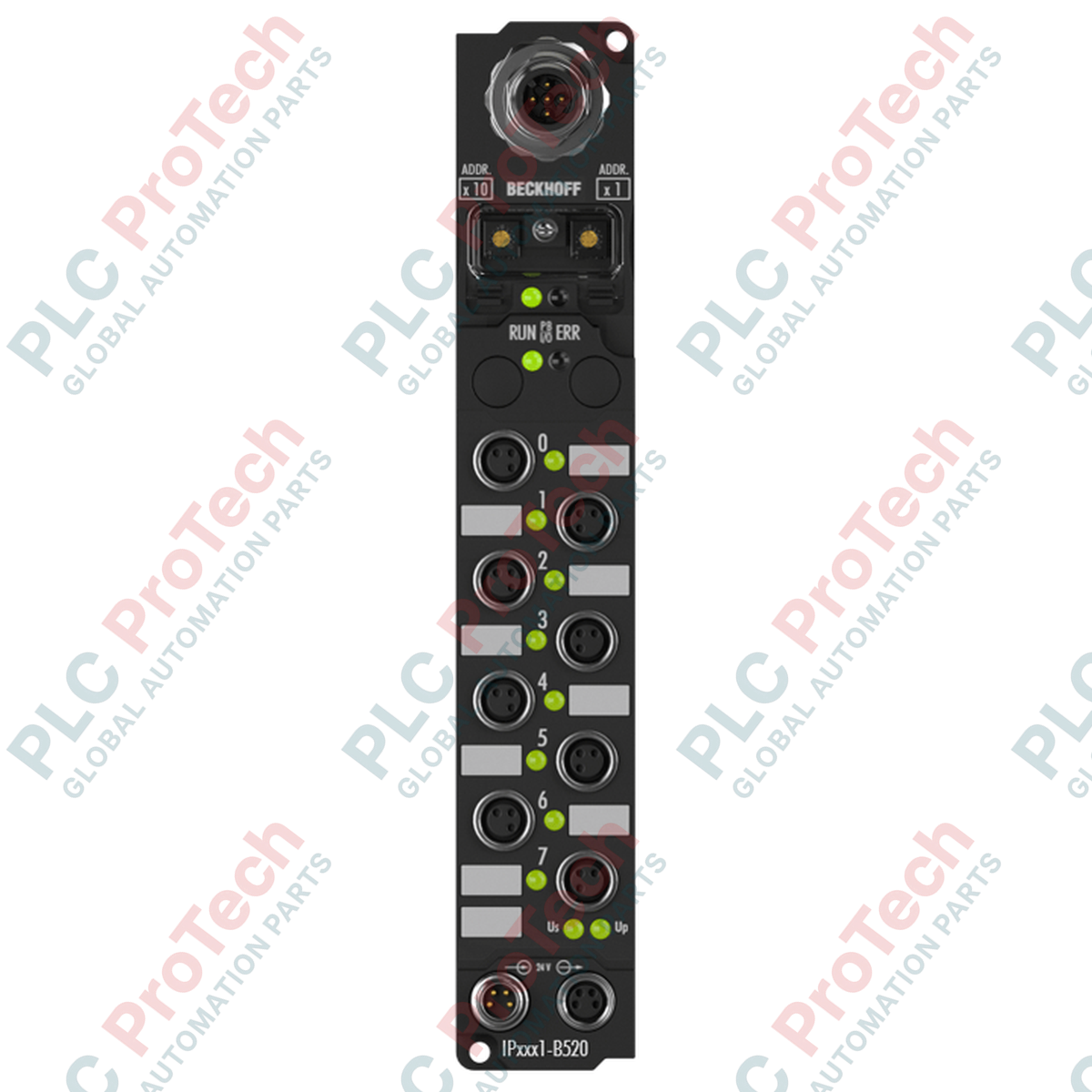
Description
Conçu pour simplifier les architectures de commande décentralisées, le Beckhoff IP2331-B520 assure une liaison robuste entre des modules périphériques certifiés IP67 et un réseau industriel DeviceNet standard. En permettant le traitement déporté des E/S directement au niveau de la machine, ce module élimine le besoin d’armoires de commande de protection et d’un câblage parallèle étendu. Il gère dynamiquement les signaux périphériques numériques et analogiques, en s’adaptant automatiquement aux exigences des interfaces d’extension connectées. La configuration du réseau est facilement gérée à l’aide de l’outil logiciel KS2000 ou par messagerie explicite via le contrôleur hôte.
Fonctionnalités
-
Débit automatique DeviceNet : détecte automatiquement le débit de transmission jusqu’à 500 kbaud pour une intégration rapide au bus de terrain.
-
Cartographie flexible des signaux : adapte automatiquement le traitement des signaux périphériques numériques et analogiques en fonction des modules d’E/S actifs.
-
Alimentations de circuits indépendantes : utilise des circuits isolés de 24 V CC pour la commande et l’alimentation de charge afin de protéger la logique interne contre les charges importantes des actionneurs et les arrêts de sécurité.
-
Format robuste IP67 : sa construction étanche à la poussière et à l’humidité permet un montage direct sur les machines dans les zones de traitement industriel difficiles.
-
Modes de communication polyvalents : prend en charge les principales structures de messagerie DeviceNet, notamment les modes cyclique, changement d’état (COS), bit strobe et interrogation.
Applications
-
Lignes d’assemblage automobile : coordination distribuée des capteurs et des actionneurs directement sur les bras robotisés et les machines d’assemblage lourdes.
-
Conditionnement et manutention des matériaux : commande localisée des convoyeurs et réseaux de capteurs dans des installations de tri à grande vitesse.
-
Fabrication de machines-outils : installation sans armoire sur des centres d’usinage des métaux et des centres CNC exposés aux fluides de coupe et aux vibrations.
Spécifications techniques
| Paramètre |
Spécification |
| Fabricant |
Beckhoff |
| Référence du modèle |
IP2331-B520 |
| Interface de bus de terrain |
DeviceNet |
| Connexion au bus |
1 connecteur M12, 5 broches |
| Débit de transfert des données |
Détection automatique jusqu’à 500 kbaud |
| Alimentation de la tension de commande |
24 V CC (-15 % / +20 %) |
| Alimentation de la tension de charge |
Dépend du type d’E/S connecté |
| Consommation de courant du boîtier interne |
45 mA + courant des capteurs (0,5 A max.) |
| Raccordements d’alimentation |
Alimentation : 1 connecteur M8 mâle (4 broches) ; aval : 1 connecteur M8 femelle (4 broches) |
| Tension d’isolement |
500 V (tension de commande / bus de terrain) |
| Température de fonctionnement |
0 à +55 °C |
| Température de stockage |
-25 à +85 °C |
| Indice de protection |
IP65 / IP66 / IP67 (conforme à la norme EN 60529) |
| Conformité aux normes |
Vibrations EN 60068-2-6, chocs EN 60068-2-27, CEM EN 61000-6-2/4 |
| Homologations |
CE, UL |
| Poids d’expédition (calculé) |
2,0 kg |
Connexions et interfaces
| Type de connexion |
Repérage et affectation des broches |
| Connecteur de bus DeviceNet M12 (5 broches) |
Broche 1 : blindage | Broche 2 : V+ | Broche 3 : V- | Broche 4 : CAN_H | Broche 5 : CAN_L |
| Alimentation M8 mâle (4 broches) |
Broche 1 : alimentation 24 V CC commande | Broche 2 : alimentation 24 V CC charge | Broche 3 : GND commande | Broche 4 : GND charge |
| Alimentation en aval M8 femelle (4 broches) |
Broche 1 : boucle 24 V CC commande | Broche 2 : boucle 24 V CC charge | Broche 3 : GND commande | Broche 4 : GND charge |
Observations techniques empiriques
Modèles alternatifs et compatibilité
L’IP2331-B520 assure une compatibilité fonctionnelle ascendante avec l’ancienne série de modèles IP2330. Toutefois, afin de maintenir une communication de diagnostic hautement fiable sous DeviceNet, les maîtres réseau doivent être mis à jour avec le fichier EDS (Electronic Data Sheet) approprié correspondant à la révision du micrologiciel du B520. Les mises à niveau du système doivent vérifier les fichiers de configuration des appareils avant leur déploiement.
Pièges liés à l’application et remarques techniques
Lors de la mise en cascade de l’alimentation entre plusieurs modules via les connecteurs M8, veillez à ce que le courant total traversant la chaîne ne dépasse pas la limite absolue de 4 A. Le dépassement de ce seuil peut entraîner une dégradation thermique localisée à l’intérieur du boîtier de raccordement et provoquer des pertes de communication imprévues. Des lignes d’alimentation isolées distinctes doivent être utilisées pour les réseaux de commande afin d’éviter la réinjection de bruit électrique à forte inductance sur le bus de données.
Conseils de mise en service et de câblage
Pour réussir la détermination automatique du débit en bauds, au moins un nœud doit transmettre activement des données sur le réseau DeviceNet. Terminez toujours les deux extrémités de la dorsale physique par une résistance de 120 ohms. Lors du dépannage des signaux du bus de terrain, vérifiez les LED d’état intégrées afin de détecter les problèmes courants de couche physique DeviceNet, tels que les différences de potentiel de mise à la terre entre des points d’alimentation distants.
Directives d’installation
AVERTISSEMENT CRITIQUE : Mettez hors tension toutes les sources d’alimentation principales, auxiliaires et des actionneurs avant toute opération de câblage ou d’installation sur le nœud de bus de terrain. Une isolation incomplète des alimentations de commande et de charge peut provoquer des courts-circuits dangereux, endommager définitivement les émetteurs-récepteurs ou entraîner le démarrage dangereux des machines.
1
Fixez le Fieldbus Box sur une surface propre et plane à l’aide de deux boulons M4, en les serrant à un couple de 1,2 Nm afin d’éviter toute contrainte structurelle sur le boîtier en plastique.
2
Configurez l’adresse physique du nœud DeviceNet à l’aide des sélecteurs rotatifs matériels ou des commutateurs DIP avant de mettre le système sous tension.
3
Serrez fermement à la main les câbles DeviceNet M12 et d’alimentation M8 afin de préserver l’intégrité de leur étanchéité environnementale IP67 ; n’utilisez pas de pince, car elle pourrait fissurer les raccords filetés.
4
Appliquez d’abord la tension de commande afin de vérifier les communications, puis activez la boucle d’alimentation de la charge pour mettre sous tension les capteurs périphériques et les actionneurs de terrain.