


IC693CPU360 vs IC693CPU364 : Ethernet et budget d’alimentation
Comparez les IC693CPU360 et IC693CPU364 selon l’interface Ethernet, la charge en +5 VDC, la mémoire, les limites de rack et les vérifications de remplacement.
Fabricant : Omron
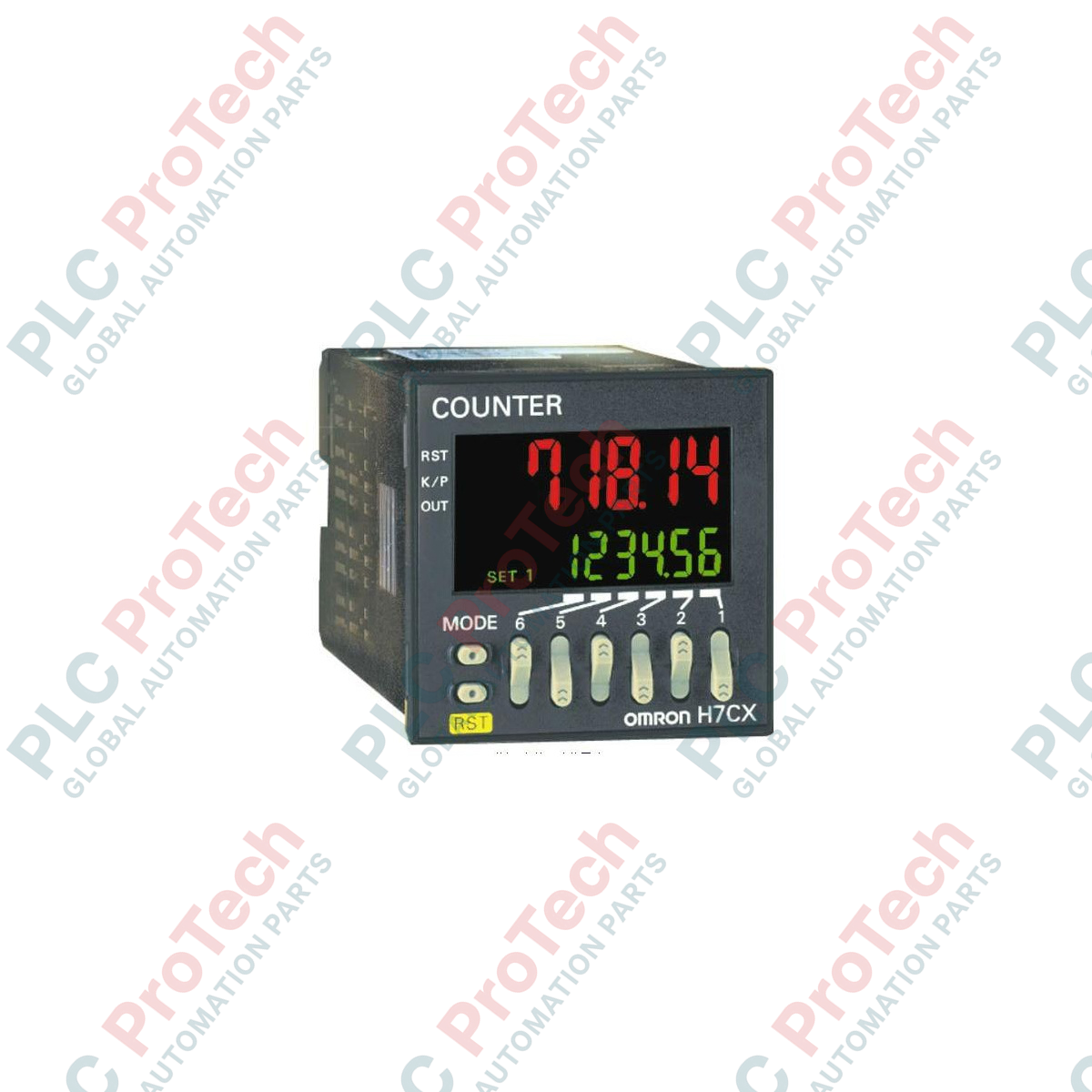
N° de produit : H7CX-A11D1-N
Pays d'origine :Japon
Type de produit : Compteurs multifonctions
Paiement : Virement bancaire, Western Union
Poids : 2000g
Dimensions : 4,8 cm x 8,41 cm x 4,8 cm
Port d'expédition : Xiamen
Garantie : 12 mois
Intégré en toute transparence aux lignes de production modernes, le Omron H7CX-A11D1-N fonctionne comme un compteur numérique et un tachymètre haute précision au format 1/16 DIN, conçus pour la surveillance rapide des impulsions et la coordination des sorties. Doté d’un affichage lumineux des caractères PV bicolores, ce contrôleur multimode permet au personnel d’exploitation de suivre les comptages, les lots et les mesures de vitesse sur un panneau compact unique. L’appareil prend en charge un bus de commande multension et intègre des voies de sortie flexibles à contact et statiques pour piloter les processus d’automatisation secondaires de manière sûre et fiable.
| Paramètre de spécification | Valeur d’ingénierie |
|---|---|
| Fabricant | Omron |
| Référence du modèle | H7CX-A11D1-N |
| Nombre de chiffres de l’affichage | 6 chiffres (−99999 à 999999) |
| Tension d’alimentation | 12 à 24 VCC / 24 VCA à 50/60 Hz |
| Connexions externes | Schéma de raccordement de la prise à 11 broches |
| Vitesse de traitement des entrées | 30 Hz ou 5 kHz (sélection par commutateur DIP) |
| Types de sorties | Contact (SPDT : 250 VCA, 3 A résistifs) et transistor (collecteur ouvert NPN/PNP : 30 VCC, 100 mA) |
| Plage de protection des touches | Verrouillage physique par niveaux de micrologiciel internes |
| Limite de température de fonctionnement | −10 à 55 °C (sans gel ni condensation) |
| Indice de protection de la façade | IP66 / NEMA 4X (étanche à la poussière et protégé contre les gouttes) |
| Poids d’expédition (calculé) | 2,0 kg (y compris les couches de la boîte de protection) |
| Dimensions de la façade (calculées) | 48,0 mm × 48,0 mm (format de montage sur panneau 1/16 DIN) |
| Profondeur d’insertion du boîtier | 84,1 mm |
| Bornier à 11 broches | Attribution des fonctions |
|---|---|
| Broche 1 | Commun des entrées (GND) |
| Broche 2 | Entrée d’alimentation (12–24 VCC / 24 VCA) |
| Broche 3 | Entrée de comptage 1 (entrée du signal CP1) |
| Broche 4 | Entrée de comptage 2 (entrée du signal CP2) |
| Broche 5 | Entrée de réinitialisation / signal de commande de la passerelle |
| Broche 6 | Émetteur de sortie du transistor / commun |
| Broche 7 | Entrée d’alimentation (12–24 VCC / 24 VCA) |
| Broche 8 | Collecteur de sortie transistor (option NPN/PNP) |
| Broche 9 | Commun (COM) du relais de sortie à contact |
| Broche 10 | Relais de sortie à contact normalement fermé (NC) |
| Broche 11 | Relais de sortie à contact normalement ouvert (NO) |
Les variantes portant le suffixe -N remplacent directement les anciens modèles H7CX à 11 broches. Bien que les affectations des broches restent strictement identiques, notez que les paramètres de programme internes par défaut peuvent varier entre les versions standard et les révisions plus récentes. Vérifiez la configuration des commutateurs DIP sur le boîtier latéral afin de vous assurer que les rapports de division internes, les modes de comptage et les profils de réponse correspondent à la configuration historique de l’installation.
Lors de la configuration à la vitesse de comptage maximale de 5 kHz, veillez à ce que les signaux d’entrée proviennent de capteurs de proximité statiques sans contact ou de codeurs rotatifs. Les entrées à contacts mécaniques subiront des rebonds de contact physiques, entraînant des comptages élevés erratiques et erronés. Si une interface à commutateur mécanique doit être utilisée, réduisez la vitesse maximale de comptage d’entrée à 30 Hz à l’aide des commutateurs DIP physiques afin d’activer le filtre antibruit passe-bas interne.
Veillez à ce que tous les câbles haute tension (notamment les contacts de sortie commutant des charges inductives importantes) soient physiquement séparés des lignes des capteurs d’entrée. Utilisez des câbles blindés à paire torsadée pour les entrées CP1, CP2 et Reset, en reliant le blindage à la terre exclusivement au niveau du bornier du panneau afin de limiter le bruit électromagnétique induit par les variateurs et appareillages de commutation actifs environnants.
Préparez une découpe de panneau standard de 45,0 mm x 45,0 mm, conforme aux spécifications DIN standard.
Fixez le joint étanche autour de l’épaulement du boîtier avant afin d’assurer une protection NEMA 4X / IP66 de la face avant.
Insérez le module par l’avant dans la découpe du panneau, puis faites glisser le support d’adaptation de montage sur le châssis par l’arrière, en serrant les vis du panneau à la main.
Configurez le bloc de commutateurs DIP physiques situé sur le panneau arrière ou latéral en fonction de la fonction requise, de la logique d’entrée (NPN ou PNP) et des exigences de vitesse du capteur.
Vérifiez les boucles de connexion par rapport au schéma de configuration des broches de la prise à 11 broches, fixez la prise sur l’unité et appliquez les lignes d’alimentation pour lancer la mise en service.

Livraison express mondiale
Retours et garantie
Expédition express mondiale
Retours et garantie
Les commandes sont traitées et livrées du lundi au vendredi (hors jours fériés).
Pour connaître l'éligibilité complète, les frais de restockage et les détails des retours internationaux, veuillez consulter notre site officiel Politique de remboursement et de retour .
| Country of origin |
Japon
|

Comparez les IC693CPU360 et IC693CPU364 selon l’interface Ethernet, la charge en +5 VDC, la mémoire, les limites de rack et les vérifications de remplacement.

Une séquence de diagnostic sur le terrain pour les problèmes de sortie analogique du 1756-OF4 : mode de canal, bornier amovible, mise à l’échelle et contrôles électriques contrôlés.

Une comparaison directe du nombre de sorties, du regroupement commun, du courant du fond de panier et des limites de charge avec déclassement thermique de 1746-OA8 et 1746-OA16.

Une liste de contrôle sur le terrain pour consigner la série matérielle 1761-NET-DNI, le firmware, le fichier EDS, les paramètres DF1, l’adresse DeviceNet et la configuration de messagerie avant le...

L’EL3062 est un terminal EtherCAT 0–10 V. L’EL3062-0030 est une variante 0–30 V. Cette liste de contrôle couvre l’identification, la mise à l’échelle et la mise en service.

Une liste de contrôle sur le terrain pour remplacer les modules de sortie à relais Allen-Bradley 1769-OW8 sans perdre les informations relatives aux groupes de charges, au câblage et à la mise en...