Description
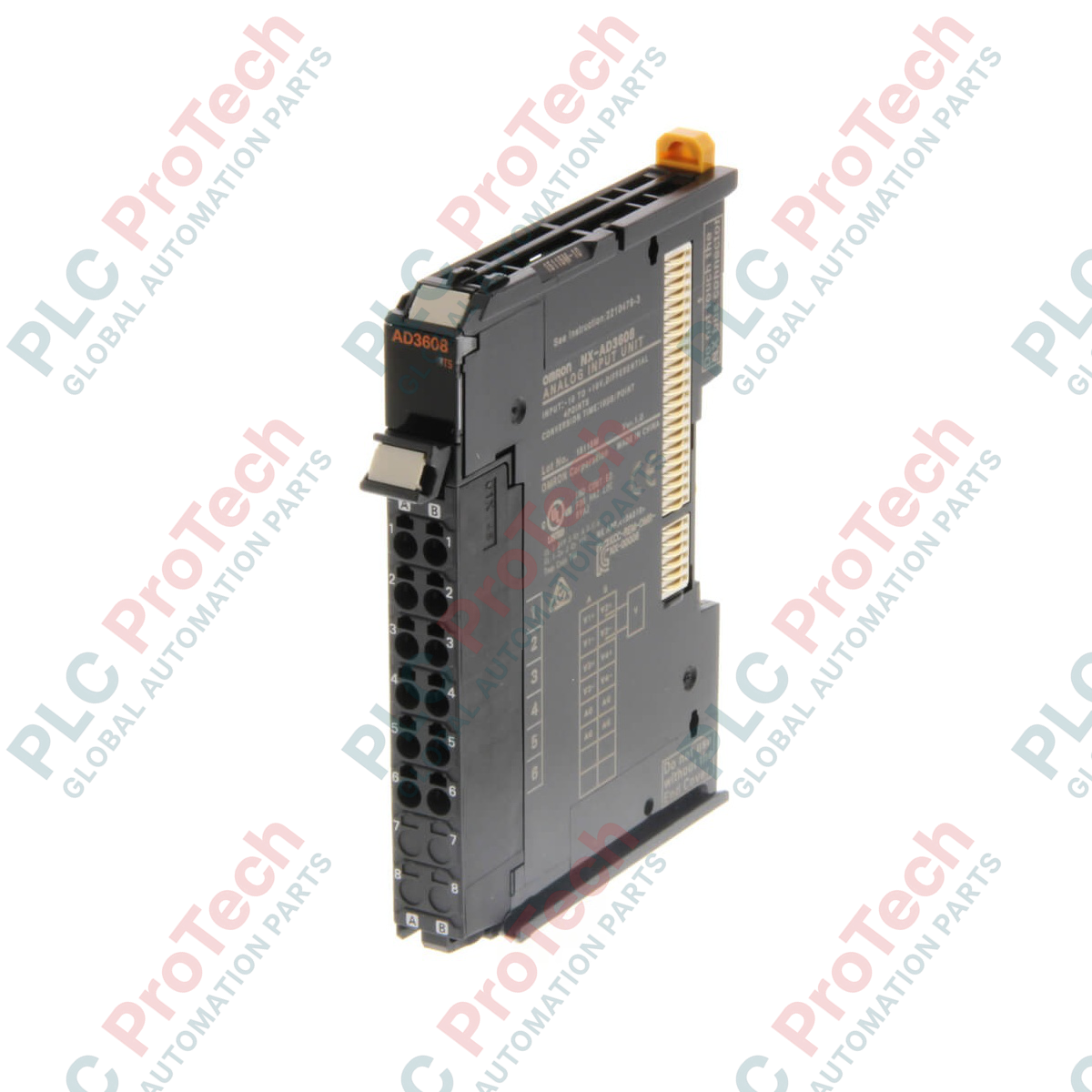
Pour l’acquisition de données de tension rapide et précise au sein des architectures d’automatisation Sysmac, l’Omron NX-AD3608 fournit quatre voies d’entrées analogiques différentielles haute résolution. Cette unité s’intègre parfaitement au système d’E/S de la série NX, offrant une résolution exceptionnelle de 1/30000 et une vitesse de conversion ultra-rapide de 10 microsecondes par point. Conçue pour traiter des signaux de tension de -10 à +10 V CC, elle prend en charge les modes de rafraîchissement des E/S synchrone et en fonctionnement libre, garantissant une synchronisation précise avec le CPU hôte ou l’unité coupleur EtherCAT. Le câblage de terrain sécurisé et résistant aux vibrations est assuré par le bornier Push-In Plus intégré à 12 bornes, sans vis.
Fonctionnalités
- Quatre voies d’entrée analogique différentielles dédiées aux signaux de tension.
- Plage flexible de tension d’entrée de -10 à +10 V CC, avec une plage de conversion d’entrée de -5 % à 105 %.
- Cycle de conversion haute vitesse de 10 microsecondes par point pour les processus très dynamiques.
- Rafraîchissement des E/S synchrone et en fonctionnement libre sélectionnable pour répondre aux exigences du système.
- Isolation par transformateur et isolateur numérique entre les voies d’entrée et le bus NX interne.
- Bornier Push-In Plus sans outil (à serrage sans vis) à 12 bornes pour une installation rapide et la maintenance du câblage.
- Indicateur d’état TS intégré pour un diagnostic rapide du module sur site.
Applications
- Systèmes de contrôle en boucle fermée haute vitesse de la tension et de la pression.
- Surveillance en temps réel du retour analogique dans les machines d’emballage et de transformation.
- Suivi de position de précision à l’aide de capteurs analogiques de déplacement.
- Configurations d’acquisition de données nécessitant une synchronisation à l’échelle de la microseconde sur des réseaux EtherCAT.
Caractéristiques techniques
| Fabricant |
Omron |
| Modèle / référence |
NX-AD3608 |
| Série |
E/S de la série NX |
| Type d’entrée |
Tension analogique |
| Nombre de points |
4 points |
| Plage d’entrée |
-10 à +10 V CC |
| Résolution |
1/30000 |
| Temps de conversion |
10 microsecondes/point |
| Méthode d’entrée |
Différentielle |
| Impédance d’entrée |
1 MΩ minimum |
| Plage de conversion d’entrée |
-5 % à 105 % (pleine échelle) |
| Valeur nominale maximale absolue |
±15 V |
| Précision globale (à 25 °C) |
±0,1 % (pleine échelle) |
| Précision globale (de 0 à 55 °C) |
±0,2 % (pleine échelle) |
| Méthode de rafraîchissement des E/S |
Rafraîchissement des E/S synchrone avec la commutation et rafraîchissement en fonctionnement libre |
| Méthode d’isolation |
Entre l’entrée et le bus NX : alimentation = transformateur, signal = isolateur numérique (aucune isolation entre les voies d’entrée) |
| Résistance d’isolement |
20 MΩ minimum entre les circuits isolés (à 100 V CC) |
| Rigidité diélectrique |
510 V CA entre les circuits isolés pendant 1 minute (courant de fuite de 5 mA max.) |
| Consommation électrique de l’unité NX |
1,45 W max. (connecté au CPU ou à l’unité CCU) ; 1,10 W max. (connecté au coupleur) |
| Bornes externes |
Bornier de raccordement à serrage sans vis (12 bornes) |
| Dimensions (L x H x P) |
12 mm x 100 mm x 71 mm |
| Poids net |
0,07 kg |
| Poids d’expédition (calculé) |
1,0 kg |
Connexions et interfaces
| Borne |
Nom du signal |
Borne |
Nom du signal |
| A1 |
V1+ (tension d’entrée 1 +) |
B1 |
V3+ (tension d’entrée 3 +) |
| A2 |
V1- (tension d’entrée 1 -) |
B2 |
V3- (tension d’entrée 3 -) |
| A3 |
V2+ (tension d’entrée 2 +) |
B3 |
V4+ (tension d’entrée 4 +) |
| A4 |
V2- (tension d’entrée 2 -) |
B4 |
V4- (tension d’entrée 4 -) |
| A5 |
NC (non connecté) |
B5 |
NC (non connecté) |
| A6 |
NC (non connecté) |
B6 |
NC (non connecté) |
Informations techniques issues de l’expérience
Modèles alternatifs et compatibilité
Le NX-AD3608 fait partie de l’écosystème Omron Sysmac. Lors de la planification de migrations ou d’ajouts, assurez-vous que votre unité CPU de série NX1P2, NX102 ou NJ utilise un micrologiciel compatible prenant en charge les E/S synchrones à grande vitesse. Notez que le rafraîchissement synchrone ne fonctionne que lorsque ce module est monté à côté d’une unité CPU ou d’un coupleur EtherCAT (tel que le NX-ECC203) prenant en charge nativement les horloges distribuées (DC).
Pièges d’application et remarques techniques
Comme ce module utilise une conception à entrée différentielle sans isolation entre les voies, toutes les connexions des bornes négatives (V1- à V4-) doivent rester dans la plage de tension en mode commun. En présence d’une différence de potentiel élevée entre les masses de vos sources de signal, un courant de boucle de masse circulera, provoquant de graves erreurs de mesure, voire une défaillance matérielle. Assurez-vous que les sources de signal sont soit complètement flottantes, soit reliées à un seul point de référence commun avant leur raccordement au module.
Conseils de mise en service et de câblage
Pour protéger la résolution très sensible de 1/30000, utilisez toujours des câbles à paires torsadées blindées (STP) de haute qualité pour toutes les lignes analogiques. Reliez les blindages des câbles en un seul point sur la barre de terre fonctionnelle de votre tableau de commande. Pour une immunité maximale au bruit, faites passer les câbles de signaux analogiques dans une goulotte dédiée, séparée des lignes d’alimentation triphasées et des câbles de sortie des variateurs de fréquence (VFD).
Directives d’installation
AVERTISSEMENT CRITIQUE
Débranchez toutes les sources d’alimentation de l’unité NX, de l’unité CPU et de toutes les lignes d’alimentation externes des E/S avant d’installer, de retirer ou de câbler le module. Une mise hors tension incomplète de l’ensemble peut entraîner des dommages immédiats à l’équipement ou un comportement imprévisible du système lors de la mise en service.
1
Montez le NX-AD3608 sur le rail DIN en faisant coulisser fermement le crochet de guidage de l’unité jusqu’à son enclenchement. Un clic net indique que le verrou coulissant est engagé.
2
Enfoncez le bornier bien droit sur l’avant du module jusqu’à ce qu’il se verrouille correctement. Vérifiez l’alignement mécanique des détrompeurs.
3
Préparez votre fil rigide ou votre fil toronné avec embout, puis insérez-le bien droit dans l’orifice de la borne. Aucun tournevis n’est requis pour l’utilisation standard d’une borne Push-In Plus.
4
Vérifiez l’état de la connexion à l’aide du logiciel Sysmac Studio, en observant l’état du voyant LED TS. Un voyant vert fixe indique une communication normale et un état correct du module.