BECKHOFF

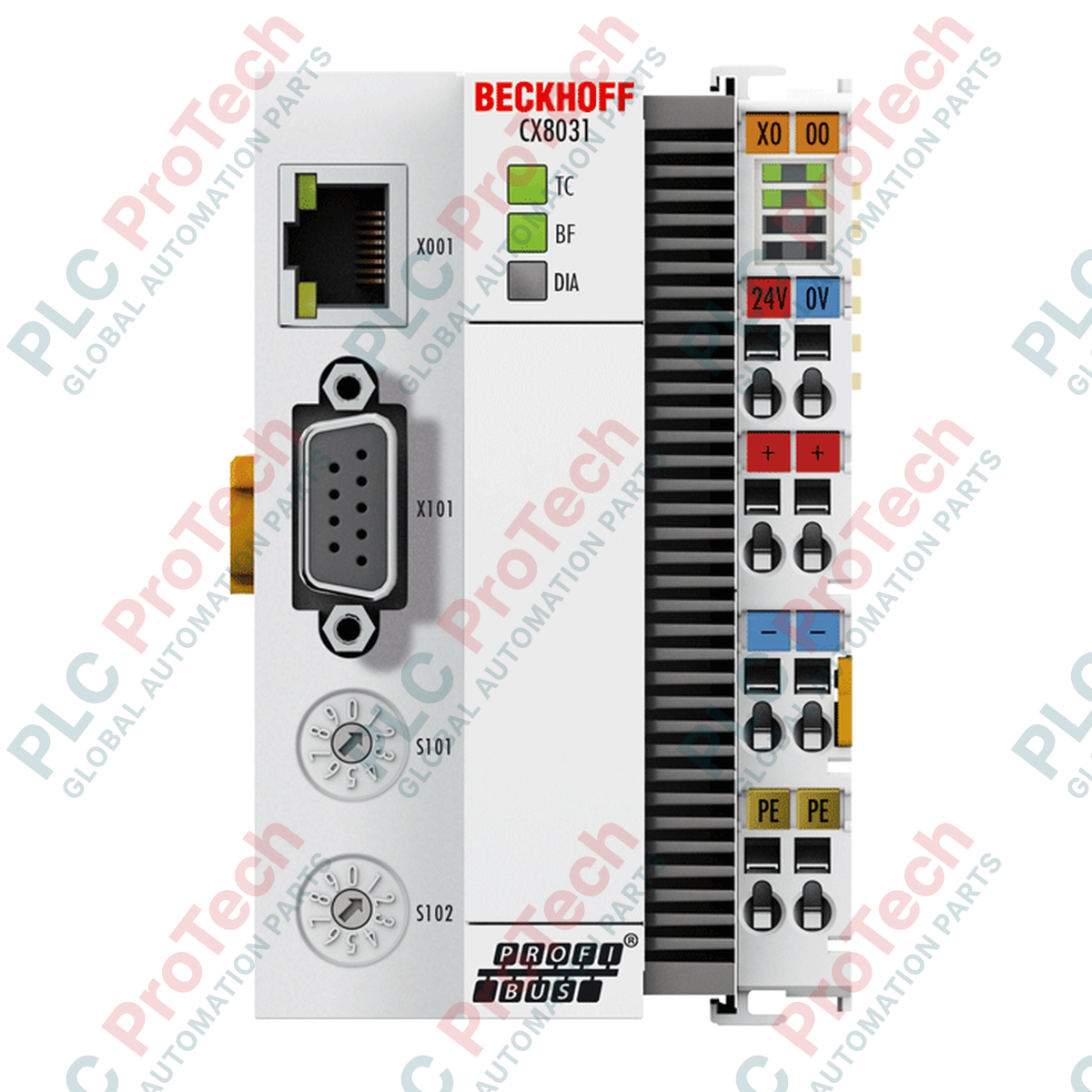
Beckhoff CX8031 CX8000 Series Embedded PC with PROFIBUS Slave

SKU CX8031

In stock
  • 12-month warranty
  • Free returns within 30 days
  • Manufacturer: BECKHOFF
  • Product No.: CX8031
  • Origin Germany
  • Product Type: Embedded PCs
  • Payment: T/T, Western Union
  • Weight: 0.5 kg
  • Dimensions: 64 mm x 100 mm x 73 mm
  • Shipping port: Xiamen
  • Warranty: 12 months

Tags

Quantity

Product Description

Description

Designed to bridge high-speed local control with legacy fieldbus networks, the Beckhoff CX8031 is a highly compact, DIN-rail-mounted Embedded PC equipped with an integrated PROFIBUS DP slave interface. This controller is engineered to process local automation logic independently while maintaining direct, deterministic communication with a master PROFIBUS system. Powered by an ARM9 400 MHz processor, the unit runs Windows Embedded CE 6 and is optimized for the TwinCAT 2 programming environment, allowing for rapid execution of PLC applications directly at the machine or field level.

Features

  • Integrated Fieldbus Interface: Features a dedicated 9-pin D-sub PROFIBUS DP slave socket with robust electrical shielding.
  • Dual Bus Support: Offers automatic recognition and direct connection of both E-bus (EtherCAT Terminals) and K-bus (standard Bus Terminals) for flexible I/O configurations.
  • Persistent Data Security: Built-in 1-second UPS ensures up to 1 MB of critical persistent variables are saved to flash memory in the event of a power interruption.
  • Highly Efficient Architecture: Consumes a maximum of 3 W, reducing thermal dissipation inside sealed industrial enclosures.
  • Hazardous Location Certification: Fully approved for demanding environments with ATEX, IECEx, and cFMus Class I Division 2 ratings.

Applications

  • Decentralized control stations interfacing with main Siemens, Beckhoff, or third-party PROFIBUS masters.
  • Sub-assembly machine control requiring localized logic handling and high-density terminal options.
  • Ex Zone 2 hazardous areas across chemical, petrochemical, and oil and gas processing facilities.
  • Infrastructure control projects with space-restricted control panels requiring native EtherCAT or Bus Terminal expansion.

Technical Specifications Table

Specification Parameter Value / Rating
Manufacturer Beckhoff
Model Number CX8031
Processor Type ARM9, 400 MHz (1 Core)
Flash Memory 512 MB microSD (optionally expandable)
Main Memory 64 MB DDR2 RAM (non-expandable)
Persistent Memory 1-second UPS (saves up to 1 MB persistent data)
Operating System Windows Embedded CE 6
Control Software TwinCAT 2 PLC
Physical Interfaces 1 x RJ45 (10/100 Mbit/s), 1 x USB Device (behind protective front flap)
Bus Interface 1 x D-sub 9-pin socket, shielded, PROFIBUS DP Slave
I/O Connection Type E-bus (EtherCAT) or K-bus (Bus Terminals), automatic recognition
Bus Current Supply 2 A maximum
Max. Power Consumption 3 W
Diagnostics Display 1 x TC status LED, 2 x bus status LEDs
Real-Time Clock Internal, exchangeable battery-backed clock (behind front flap)
Dimensions (W x H x D) 64 mm x 100 mm x 73 mm
Unit Weight 180 g
Operating Temperature 0 to 55 degC
Storage Temperature -25 to +85 degC
Relative Humidity 95 %, non-condensing
Ingress Protection Rating IP20
ATEX Marking II 3 G Ex nA IIC T4 Gc / II 3 D Ex tc IIIC T135 degC Dc
IECEx Marking Ex nA IIC T4 Gc / Ex tc IIIC T135 degC Dc
cFMus Marking Class I, Division 2, Groups A, B, C, D / Class I, Zone 2, AEx ec IIC T4 Gc
Shipping Weight (Calculated) 2.0 kg

Connections and Interfaces

Interface Type Connector / Format Functional Assignment
Ethernet Port RJ45 (10/100 Base-T) Programming, network commissioning, and system configuration
PROFIBUS DP Slave 9-pin D-sub (Female), Shielded Standard PROFIBUS master integration (hardware-addressed)
USB Device Port USB Type B (under front flap) Local configuration interface for OS management and diagnostics
I/O Bus Contacts Spring-loaded contacts (right side) Automatic connection to standard EtherCAT Terminals (E-bus) or Bus Terminals (K-bus)

Empirical Engineering Insights

Alternative Models & Compatibility

The CX8031 is specifically tailored for TwinCAT 2 environments and is not compatible with TwinCAT 3 runtimes due to its underlying ARM9 hardware architecture. For applications requiring TwinCAT 3 compatibility or modern multi-core processing, developers should specify the CX8100 or CX8200 series controllers. Note that when migrating from K-bus (standard bus terminals) to E-bus (EtherCAT) on the same CX8031, the unit will automatically redetect the physical backplane bus topology on power-up without manual dip-switch changes.

Application Pitfalls & Engineering Notes

While the CX8031 provides up to 2 A of current directly to the E-bus/K-bus backplane, system integrators must compute the total current draw of all connected I/O terminals. Exceeding this limit will trigger a system shutdown or cause unstable communication anomalies. When deploying high-density terminal setups, plan for an intermediate power feed module, such as the EL9410, to inject supplementary bus power.

Commissioning & Wiring Tips

The PROFIBUS node address is manually configured using the physical address rotary switches positioned behind the front flap. Changes made to these rotary dials do not update in real-time; the CX8031 must undergo a full cold reboot (power-cycle) to register the newly assigned hardware address. Ensure that the shielding on the 9-pin D-sub PROFIBUS cable is grounded at both ends to eliminate industrial high-frequency electromagnetic interference.

Installation Guidelines

CRITICAL WARNING

Isolate all electrical power sources before executing mechanical installation or physical terminal wiring. Ensure the power lines are locked out in accordance with standard industrial safety procedures. Failure to disconnect active power lines can damage the internal ARM9 processor core, corrupt the microSD system partition, or result in severe equipment damage.

1
Latch the top edge of the CX8031 housing onto a standard 35 mm DIN rail (EN 60715) and push downwards until the lower locking clip engages with a clean mechanical click.
2
Verify the pre-configured hardware PROFIBUS node address via the rotary dials located behind the protective front flap prior to connecting the network.
3
Connect the shielded D-sub 9-pin PROFIBUS slave cable and hand-tighten the retaining screws to ensure proper grounding to the chassis connector.
4
Connect the 24V DC auxiliary power supply. Observe the localized diagnostic LEDs; the TC status LED should change from yellow to solid green when TwinCAT enters Run mode.
Shipping & Returns

Global Express Shipping

  • Standard Delivery: 4–6 business days via DHL, FedEx, and UPS.
  • Express Dispatch: Same-day dispatch for in-stock orders placed before 2:00 PM (GMT+8).
  • Worldwide Coverage: Serving over 150 countries.

Returns & Warranty

  • 30-Day Guarantee: Returns accepted for in-stock products in original, factory-sealed packaging.
  • 12-Month Warranty: Every industrial component is backed by our technical warranty.
FAQ
Can the CX8031 run TwinCAT 3 runtimes?
No, the hardware platform utilizes an ARM9 CPU architecture which does not meet the minimum requirements for TwinCAT 3. It is designed to run TwinCAT 2 PLC.
Does the controller support both EtherCAT and standard Bus Terminals?
Yes. The controller features automatic backplane detection, allowing it to interface directly with either E-bus (EtherCAT) or K-bus (standard) terminals without manual switch selection.
How do you set the PROFIBUS address on the device?
The node address is selected using two rotary address switches located behind the front protective flap. Note that a power cycle is required for address changes to take effect.
What is the purpose of the integrated 1-second UPS?
The integrated 1-second UPS provides capacitive backup power to save up to 1 MB of persistent PLC variables to the non-volatile microSD card in the event of an unexpected power outage.
Reviews

CX8031

Stock & lead time on request

Call
1 of 1

Beckhoff CX8031 CX8000 Series Embedded PC with PROFIBUS Slave

Only 10 item(s) left in stock
  • Manufacturer: BECKHOFF

  • Product No.: CX8031

  • Country of origin:Germany

  • Product Type: Embedded PCs

  • Payment: T/T, Western Union

  • Weight: 500g

  • Dimensions: 64 mm x 100 mm x 73 mm

  • Shipping port: Xiamen

  • Warranty: 12 months

Quantity
View full details

Description

Designed to bridge high-speed local control with legacy fieldbus networks, the Beckhoff CX8031 is a highly compact, DIN-rail-mounted Embedded PC equipped with an integrated PROFIBUS DP slave interface. This controller is engineered to process local automation logic independently while maintaining direct, deterministic communication with a master PROFIBUS system. Powered by an ARM9 400 MHz processor, the unit runs Windows Embedded CE 6 and is optimized for the TwinCAT 2 programming environment, allowing for rapid execution of PLC applications directly at the machine or field level.

Features

  • Integrated Fieldbus Interface: Features a dedicated 9-pin D-sub PROFIBUS DP slave socket with robust electrical shielding.
  • Dual Bus Support: Offers automatic recognition and direct connection of both E-bus (EtherCAT Terminals) and K-bus (standard Bus Terminals) for flexible I/O configurations.
  • Persistent Data Security: Built-in 1-second UPS ensures up to 1 MB of critical persistent variables are saved to flash memory in the event of a power interruption.
  • Highly Efficient Architecture: Consumes a maximum of 3 W, reducing thermal dissipation inside sealed industrial enclosures.
  • Hazardous Location Certification: Fully approved for demanding environments with ATEX, IECEx, and cFMus Class I Division 2 ratings.

Applications

  • Decentralized control stations interfacing with main Siemens, Beckhoff, or third-party PROFIBUS masters.
  • Sub-assembly machine control requiring localized logic handling and high-density terminal options.
  • Ex Zone 2 hazardous areas across chemical, petrochemical, and oil and gas processing facilities.
  • Infrastructure control projects with space-restricted control panels requiring native EtherCAT or Bus Terminal expansion.

Technical Specifications Table

Specification Parameter Value / Rating
Manufacturer Beckhoff
Model Number CX8031
Processor Type ARM9, 400 MHz (1 Core)
Flash Memory 512 MB microSD (optionally expandable)
Main Memory 64 MB DDR2 RAM (non-expandable)
Persistent Memory 1-second UPS (saves up to 1 MB persistent data)
Operating System Windows Embedded CE 6
Control Software TwinCAT 2 PLC
Physical Interfaces 1 x RJ45 (10/100 Mbit/s), 1 x USB Device (behind protective front flap)
Bus Interface 1 x D-sub 9-pin socket, shielded, PROFIBUS DP Slave
I/O Connection Type E-bus (EtherCAT) or K-bus (Bus Terminals), automatic recognition
Bus Current Supply 2 A maximum
Max. Power Consumption 3 W
Diagnostics Display 1 x TC status LED, 2 x bus status LEDs
Real-Time Clock Internal, exchangeable battery-backed clock (behind front flap)
Dimensions (W x H x D) 64 mm x 100 mm x 73 mm
Unit Weight 180 g
Operating Temperature 0 to 55 degC
Storage Temperature -25 to +85 degC
Relative Humidity 95 %, non-condensing
Ingress Protection Rating IP20
ATEX Marking II 3 G Ex nA IIC T4 Gc / II 3 D Ex tc IIIC T135 degC Dc
IECEx Marking Ex nA IIC T4 Gc / Ex tc IIIC T135 degC Dc
cFMus Marking Class I, Division 2, Groups A, B, C, D / Class I, Zone 2, AEx ec IIC T4 Gc
Shipping Weight (Calculated) 2.0 kg

Connections and Interfaces

Interface Type Connector / Format Functional Assignment
Ethernet Port RJ45 (10/100 Base-T) Programming, network commissioning, and system configuration
PROFIBUS DP Slave 9-pin D-sub (Female), Shielded Standard PROFIBUS master integration (hardware-addressed)
USB Device Port USB Type B (under front flap) Local configuration interface for OS management and diagnostics
I/O Bus Contacts Spring-loaded contacts (right side) Automatic connection to standard EtherCAT Terminals (E-bus) or Bus Terminals (K-bus)

Empirical Engineering Insights

Alternative Models & Compatibility

The CX8031 is specifically tailored for TwinCAT 2 environments and is not compatible with TwinCAT 3 runtimes due to its underlying ARM9 hardware architecture. For applications requiring TwinCAT 3 compatibility or modern multi-core processing, developers should specify the CX8100 or CX8200 series controllers. Note that when migrating from K-bus (standard bus terminals) to E-bus (EtherCAT) on the same CX8031, the unit will automatically redetect the physical backplane bus topology on power-up without manual dip-switch changes.

Application Pitfalls & Engineering Notes

While the CX8031 provides up to 2 A of current directly to the E-bus/K-bus backplane, system integrators must compute the total current draw of all connected I/O terminals. Exceeding this limit will trigger a system shutdown or cause unstable communication anomalies. When deploying high-density terminal setups, plan for an intermediate power feed module, such as the EL9410, to inject supplementary bus power.

Commissioning & Wiring Tips

The PROFIBUS node address is manually configured using the physical address rotary switches positioned behind the front flap. Changes made to these rotary dials do not update in real-time; the CX8031 must undergo a full cold reboot (power-cycle) to register the newly assigned hardware address. Ensure that the shielding on the 9-pin D-sub PROFIBUS cable is grounded at both ends to eliminate industrial high-frequency electromagnetic interference.

Installation Guidelines

CRITICAL WARNING

Isolate all electrical power sources before executing mechanical installation or physical terminal wiring. Ensure the power lines are locked out in accordance with standard industrial safety procedures. Failure to disconnect active power lines can damage the internal ARM9 processor core, corrupt the microSD system partition, or result in severe equipment damage.

1
Latch the top edge of the CX8031 housing onto a standard 35 mm DIN rail (EN 60715) and push downwards until the lower locking clip engages with a clean mechanical click.
2
Verify the pre-configured hardware PROFIBUS node address via the rotary dials located behind the protective front flap prior to connecting the network.
3
Connect the shielded D-sub 9-pin PROFIBUS slave cable and hand-tighten the retaining screws to ensure proper grounding to the chassis connector.
4
Connect the 24V DC auxiliary power supply. Observe the localized diagnostic LEDs; the TC status LED should change from yellow to solid green when TwinCAT enters Run mode.

Can the CX8031 run TwinCAT 3 runtimes?

No, the hardware platform utilizes an ARM9 CPU architecture which does not meet the minimum requirements for TwinCAT 3. It is designed to run TwinCAT 2 PLC.

Does the controller support both EtherCAT and standard Bus Terminals?

Yes. The controller features automatic backplane detection, allowing it to interface directly with either E-bus (EtherCAT) or K-bus (standard) terminals without manual switch selection.

How do you set the PROFIBUS address on the device?

The node address is selected using two rotary address switches located behind the front protective flap. Note that a power cycle is required for address changes to take effect.

What is the purpose of the integrated 1-second UPS?

The integrated 1-second UPS provides capacitive backup power to save up to 1 MB of persistent PLC variables to the non-volatile microSD card in the event of an unexpected power outage.

Global Express Shipping

  • Standard Delivery: 4-6 Business Days via DHL, FedEx, and UPS.
  • Express Dispatch: Same-day dispatch for in-stock orders placed before 2:00 PM (GMT+8).
  • Worldwide Coverage: Serving over 150 countries, including rapid delivery to Saudi Arabia and UAE.

Returns & Warranty

  • 30-Day Guarantee: Returns accepted for in-stock products in original, factory-sealed packaging.
  • 12-Month Warranty: Every industrial component is backed by our professional technical warranty.

Orders are processed and delivered Monday-Friday (excluding public holidays).


For full eligibility, restocking fees, and international return details, please view our official Refund & Return Policy .

TECHNICAL SPECIFICATIONS

Country of origin
Germany

Recently Viewed Products

Technical knowledge

Implementing 3-Switch XOR Ladder Logic with Internal Bit

Implement a 3-SPST switch XOR light circuit in LogixPro or RSLogix 500 using an internal relay bit. Includes truth tables, boolean equations, and verified.

Building a Modbus RTU Network with CompactLogix and DeltaV

Integrate Allen-Bradley CompactLogix, Caterpillar ATS, and generators into DeltaV DCS over Modbus RTU. Covers ProSoft MVI69-MCM, Miille DIN266 gateways.

ONS Instruction Not Energizing OTE in Studio 5000 Ladder Logic

ONS instruction fires but the OTE coil never latches in Studio 5000 because the one-shot is only true for one scan. Use OTL/OTU or seal-in logic instead.

Kinetix 5500 EtherNet/IP Network Switch Requirements and Topology

Configure Allen-Bradley Kinetix 5500 servo drives on EtherNet/IP. Covers CIP Sync, IEEE 1588 V2 timing, Stratix selection, DLR topology, and HMI.

Moving Average Filtering in DCS and PLC Analog Control

A moving-average filter is the sliding-window smoother most instrument engineers drop into DCS and PLC analog paths. Here is how the window works, how N and sample time set lag, and when a...

GE Mark VI Function Blocks for Gas Turbine Control Logic

On Frame 5–9 gas turbines, GE Mark VI and Mark VIe run control as function-block application software. This article maps process, protection, and sequencing functions—and what Toolbox ST access...