


Moving TwinCAT 3 Licenses with C9900-L100: Build and Device Checks
Before moving a TwinCAT 3 license with a Beckhoff C9900-L100, verify the TwinCAT build, XML device description, exact order code and cabinet limits.
Manufacturer: Bently Nevada
Product No.: 330400-01-00
Country of origin:United States
Product Type: Accelerometer
Barcode: 8537101190
Payment: T/T, Western Union
Weight: 100g
Dimensions: 23 mm x 23 mm x 59 mm (H x W x D)
Shipping port: Xiamen
Warranty: 12 months
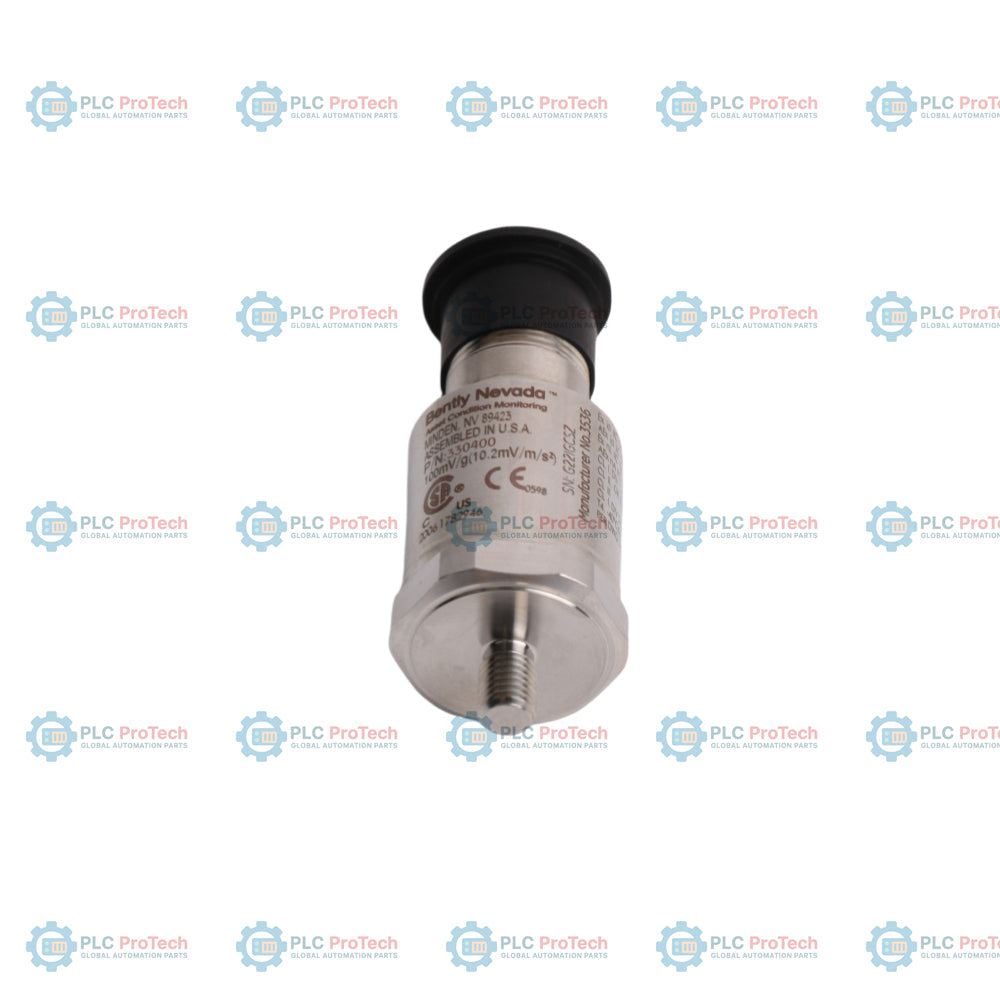
The 330400-01-00 is an industrial accelerometer designed for critical machinery casing acceleration measurements, such as gear mesh monitoring. This configuration features a 1/4-28 UNF integral mounting stud (Option 01) and no hazardous area agency approvals (Option 00), providing a standardized solution for non-hazardous monitoring environments. The transducer provides an amplitude range of 50 g peak and a sensitivity of 100 mv/g, adhering to the requirements of the American Petroleum Institute (API) Standard 670 for casing accelerometers.
Used primarily to detect malfunctions such as unbalance and misalignment, this accelerometer transmits rotor vibration signals to the bearing housing or machine casing. It is constructed from 316L stainless steel and features a 3-pin MIL-C-5015 receptacle for reliable connection to monitoring systems. The 330400 series is designed for environments where casing acceleration is a primary indicator of machinery health, ensuring compatibility with standard Bently Nevada vibration monitoring instrumentation.
| Option | Code | Description |
|---|---|---|
| Orderable Part Number | 330400-01-00 | 330400 Accelerometer, 1/4-28 UNF, No Hazardous Approval |
| A - Mounting Thread | 01 | 1/4-28 UNF integral stud |
| B - Agency Approval | 00 | None (Non-hazardous) |
| Manufacturer | Bently Nevada (Baker Hughes) |
| Part Number | 330400-01-00 |
| Sensitivity | 100 mv/g (10.2 mv/m/s2) +/- 5% |
| Acceleration Range | 50 g peak (490 m/s2) |
| Amplitude Linearity | +/- 1% to 50 g peak |
| Broadband Noise Floor | 0.01 g rms (10 Hz to 15 kHz) |
| Transverse Sensitivity | Less than 5% of axial |
| Mounted Resonant Frequency | Greater than 30 kHz |
| Operating Temperature | -55 Celsius to +121 Celsius |
| Case Material | 316L stainless steel |
| Connector Type | 3-pin MIL-C-5015 receptacle |
| Weight | 100 g (3.5 oz) typical |
| Diameter | 23 mm (0.93 in) |
| Height | 59 mm (2.3 in), including stud |
| Shock Survivability | 5000 g peak maximum |
| IP Rating | IP68 (Dust tight and watertight, sensor only) |


Global Express Shipping
Returns & Warranty


Global Express Shipping
Returns & Warranty
Orders are processed and delivered Monday-Friday (excluding public holidays).
For full eligibility, restocking fees, and international return details, please view our official Refund & Return Policy .
| Country of origin |
United States
|

Before moving a TwinCAT 3 license with a Beckhoff C9900-L100, verify the TwinCAT build, XML device description, exact order code and cabinet limits.

A field checklist for replacing a Beckhoff EL4032, covering the ±10 V load, terminal map, power contacts, EtherCAT state, and watchdog behavior.

Before replacing a Yokogawa AAI835, verify the 4-in/4-out channel map, power-loss loop behavior, barrier type, output load, cable, and redundancy.

ABB PM891K01 article 3BSE053241R1 is the non-redundant AC 800M processor kit. Use this field checklist before replacement.

Replacement checks for ABB TP853 3BSE018126R1: identify the installed CI853, CI855, CI857, or CI861 interface, record wiring, and verify communication after installation.

Engineering checks for the Allen-Bradley 5069-L330ERMS2: controller capacity, separate RTB kits, local I/O limits, network-node limits, and motion-axis count.