Description
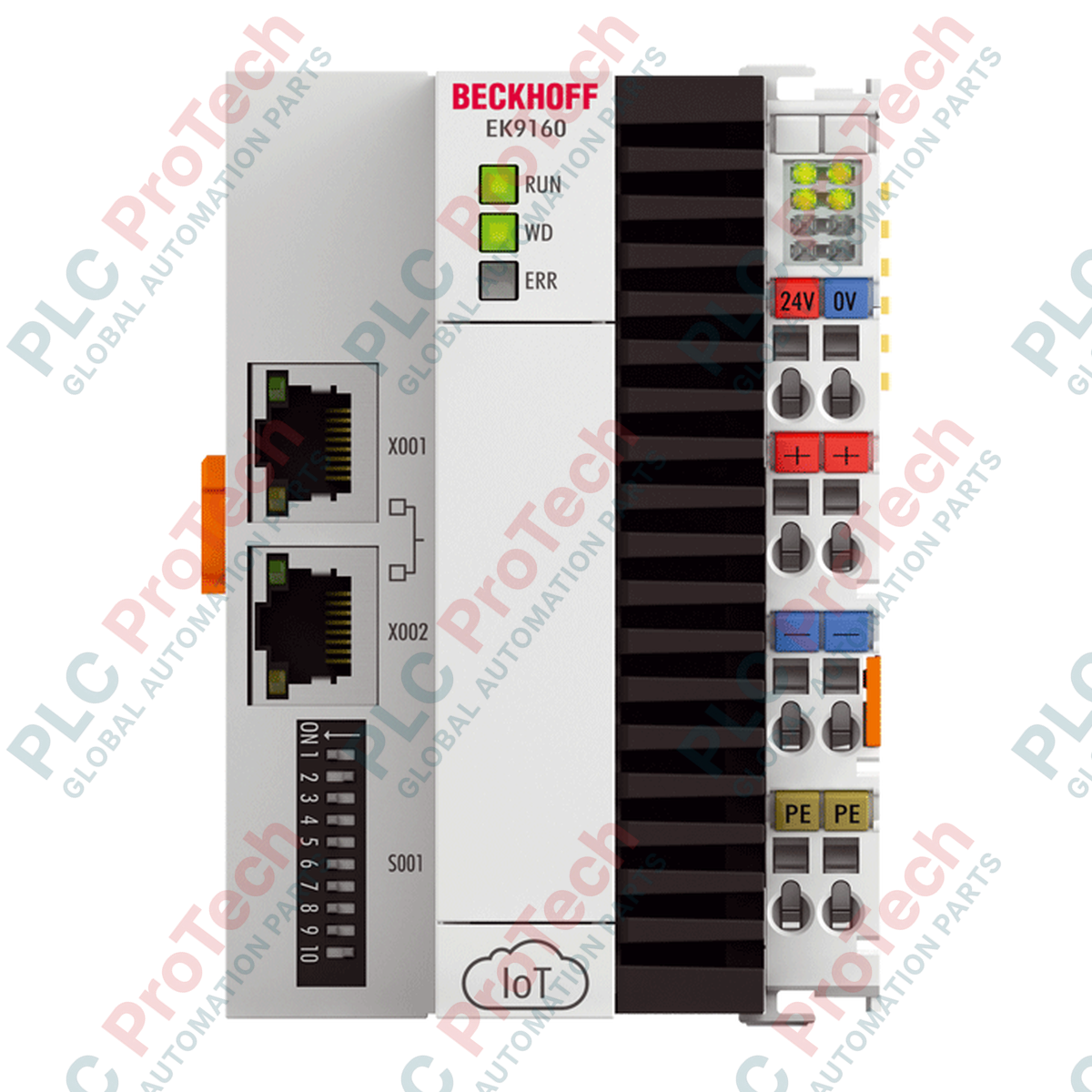
Conçu pour relier les systèmes d’E/S physiques standard aux architectures cloud, le Beckhoff EK9160 transmet les données des bornes EtherCAT numériques et analogiques directement aux plateformes IoT. Ce coupleur de bus compact intègre nativement les protocoles industriels MQTT et OPC UA, éliminant totalement le besoin d’un contrôleur intermédiaire ou d’un PC de contrôle. La configuration s’effectue entièrement via un serveur web intégré, permettant de configurer rapidement et facilement la mise en correspondance des données de terrain avec les points d’accès cloud. Un emplacement pour carte microSD dédié (équipé d’une carte de 512 Mo) offre des fonctions de mise en tampon et de stockage local, sécurisant les données de télémétrie critiques en cas de déconnexion active du réseau.
Caractéristiques principales
- Intégration directe de bornes EtherCAT numériques et analogiques standard dans les infrastructures cloud d’entreprise.
- Prend en charge les protocoles de communication industriels MQTT et OPC UA natifs.
- Serveur web intégré pour une configuration rapide via navigateur et une visualisation des diagnostics.
- Deux ports RJ45 commutés permettant des topologies flexibles de lignes Ethernet industrielles.
- Emplacement microSD intégré et extensible pour l’enregistrement local des données et les sauvegardes.
- Isolation électrique robuste séparant les contacts de puissance, les tensions d’alimentation et les ports réseau.
Applications cibles
- Architectures IoT industriel (IIoT) et analyses pour usines intelligentes.
- Systèmes SCADA distribués et unités terminales distantes (RTU) connectées au cloud.
- Installations de surveillance énergétique, d’enregistrement des données et de maintenance prédictive.
- Rétrofits nécessitant une intégration directe au cloud sans perturber les boucles de régulation existantes.
Spécifications techniques
| Fabricant |
Beckhoff |
| Référence du modèle |
EK9160 |
| Protocole système |
MQTT, OPC UA |
| Débit de transfert des données |
100 Mbit/s |
| Interface de bus |
2 x RJ45 (commutés) |
| Tension d’alimentation |
24 V CC (-15 % / +20 %) |
| Courant d’entrée |
150 mA + (courant total du bus E)/4 |
| Alimentation en courant du bus E |
2000 mA |
| Courant maximal des contacts de puissance |
24 V CC / 10 A maximum |
| Isolation électrique |
500 V (contact de puissance / tension d’alimentation / Ethernet) |
| Mémoire flash |
Emplacement microSD (carte de 512 Mo incluse, capacité extensible) |
| Température de fonctionnement |
-25 à +60 °C |
| Température de stockage |
-40 à +85 °C |
| Humidité relative |
95 %, sans condensation |
| Indice de protection IP |
IP20 |
| Matériau du boîtier |
Polycarbonate (boîtier compact avec LED d’état) |
| Format de montage |
Rail DIN de 35 mm (EN 60715) avec verrouillage |
| Certifications |
CE, UL |
| Dimensions physiques |
71 mm x 100 mm x 73 mm (l x H x P) |
| Poids d’expédition |
5,0 kg (poids approximatif du colis d’expédition) |
Spécifications de câblage
| Type de conducteur |
Plage de sections |
Compatibilité AWG |
| Fil monobrin (s) |
0,08 à 2,5 mm² |
AWG 28 à 14 |
| Fil multibrins (st) |
0,08 à 2,5 mm² |
AWG 28 à 14 |
| Flexible avec embout (f) |
0,14 à 1,5 mm² |
AWG 26 à 16 |
| Longueur de dénudage |
8 à 9 mm |
Informations techniques empiriques
Modèles alternatifs et compatibilité : L’EK9160 joue un rôle autonome distinct de celui des coupleurs EtherCAT standard tels que l’EK1100. Alors que les coupleurs standard renvoient les données à un maître API centralisé, l’EK9160 traduit directement les structures des bornes de bus EtherCAT en protocoles IoT standard (MQTT / OPC UA). Il est entièrement compatible avec les bornes numériques et analogiques standard des séries EL et ES, mais nécessite une attention particulière à la limite maximale de courant E-bus de 2000 mA. Si la consommation totale des modules dépasse 2000 mA, des bornes d’alimentation supplémentaires (telles que l’EL9400 ou l’EL9410) doivent être intercalées afin d’éviter toute instabilité de la communication.
Pièges liés à l’application et remarques techniques : Comme les données sont transmises via une infrastructure informatique standard directement vers des courtiers externes ou hébergés dans le cloud, la latence du réseau doit être prise en compte dans la logique de l’application. N’utilisez pas l’EK9160 pour une commande en boucle fermée déterministe à grande vitesse ni pour des processus critiques du point de vue de la sécurité. Veillez à sécuriser le serveur Web intégré derrière un pare-feu industriel et évitez d’exposer directement le port de configuration au WAN.
Conseils de mise en service et de câblage : Veillez à utiliser des câbles STP (paire torsadée blindée) industriels standard de catégorie 5e ou 6e pour les connexions afin d’éviter les interférences électromagnétiques provenant des systèmes d’entraînement environnants. Les conducteurs rigides ne nécessitent aucun outil et peuvent être insérés directement dans la borne à ressort, tandis que les conducteurs souples nécessitent l’ouverture active du ressort à l’aide d’un tournevis adapté. Ne dépassez pas le courant maximal de 10 A sur les contacts d’alimentation de l’ensemble monté sur rail DIN.
Directives d’installation
AVERTISSEMENT CRITIQUE : Mettez hors tension toutes les alimentations principales 24 V CC et vérifiez l’absence totale d’énergie avant de monter, câbler ou remplacer le coupleur de bus ou les bornes associées. Une décharge électrique ou un remplacement sous tension peut endommager définitivement l’ASIC interne sensible de la ligne de communication E-bus.
1
Montage sur rail DIN : Positionnez le coupleur de bus sur un rail DIN standard de 35 mm (EN 60715) et verrouillez-le fermement à l’aide du mécanisme de fixation intégré. Maintenez un espace minimal de 50 mm au-dessus et au-dessous de l’ensemble pour assurer le refroidissement par convection.
2
Assemblage des bornes : Encliquetez côte à côte les bornes EtherCAT numériques et analogiques à l’aide du système de double rainure et détrompeur jusqu’à leur verrouillage. Vérifiez la continuité de la connexion E-bus.
3
Connexion électrique : Raccordez l’alimentation système 24 V CC à l’aide de conducteurs rigides ou souples (avec une longueur de dénudage correcte de 8 à 9 mm) aux bornes d’alimentation à ressort. La charge maximale de 10 A sur les contacts d’alimentation doit être strictement respectée.
4
Connexion réseau : Connectez les câbles Ethernet industriels RJ45 aux ports du commutateur intégré. Mettez le système sous tension et configurez les mappages réseau et des protocoles via l’outil de configuration Web.