Présentation du produit
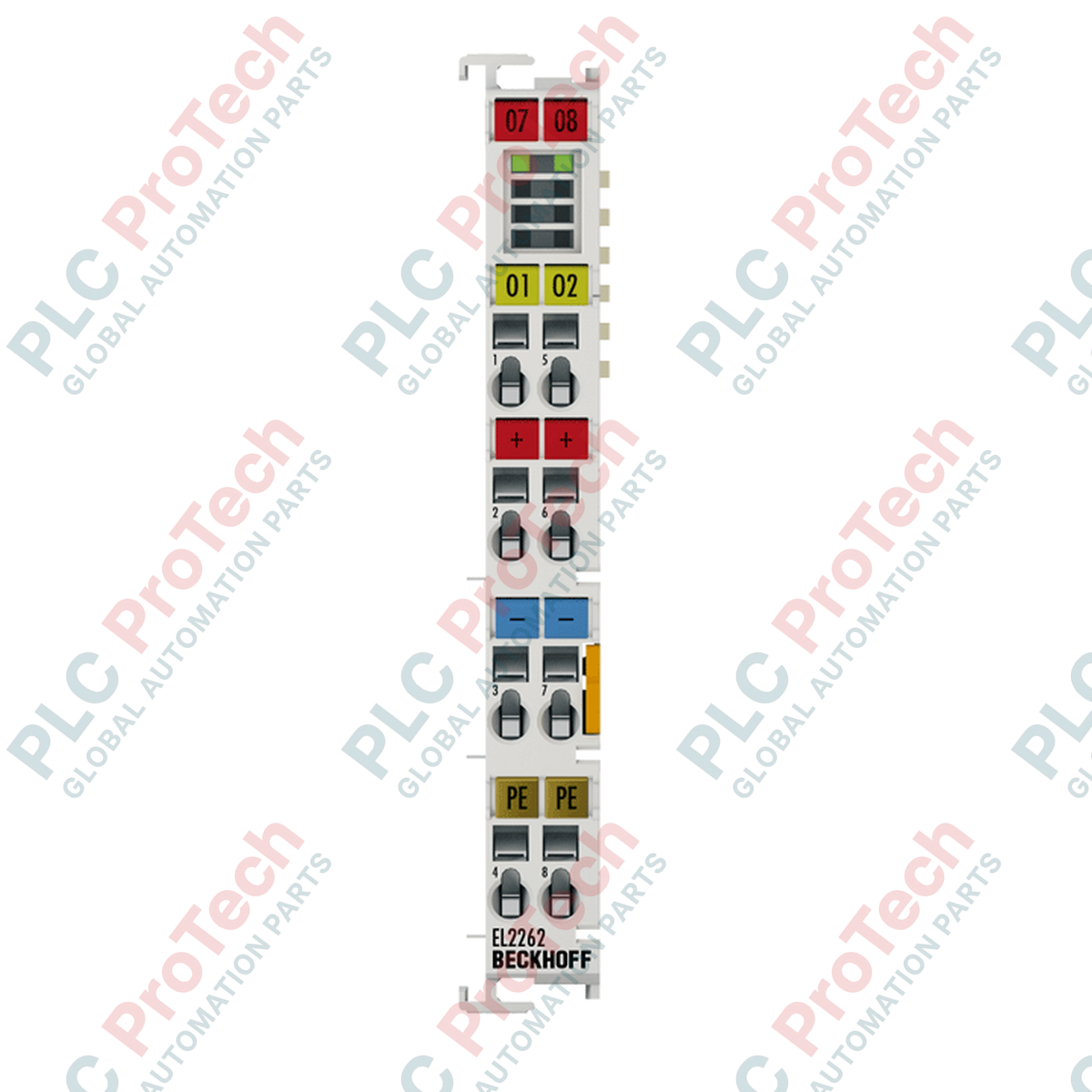
Le EL2262 (EL2262) est un terminal de sortie numérique 2 canaux ultra-rapide conçu pour des applications nécessitant une précision au niveau de la microseconde et une commutation à haute fréquence. Doté d’une technologie avancée de suréchantillonnage, le EL2262 permet un taux de sortie allant jusqu’à 1 Msample/s, permettant au contrôleur de délivrer des états numériques à des intervalles nettement plus courts que le cycle de communication EtherCAT réel. Cette capacité est essentielle pour des processus industriels haut de gamme tels que la synchronisation laser, le tri à grande vitesse et le dosage précis dans les industries pharmaceutique et des semi-conducteurs. Avec une sortie en push-pull et un support intégré des Distributed Clocks (DC), ce terminal garantit une précision de synchronisation inférieure à la microseconde, éliminant efficacement le jitter associé aux temps de cycle standard des bus de terrain.
Configuration technique
L’architecture matérielle du EL2262 est optimisée pour le traitement rapide des signaux, utilisant une technologie de connexion 4 fils pour assurer l’intégrité du signal. La fonction centrale de « suréchantillonnage » permet d’écrire un multiple entier (n = 1 à 1000) d’états de sortie au sein d’un seul cycle PLC. Le terminal dispose d’un étage de sortie push-pull robuste capable de fournir 0,5 A par canal, ce qui le rend compatible avec des charges ohmiques, inductives et lampes. Pour faciliter les tâches de synchronisation complexes, l’image de processus inclut un CycleCounter 32 bits et un StartTimeNextOutput 32 bits, fournissant au contrôleur maître un retour précis sur le moment où la prochaine séquence de sortie commencera. Le module intègre également une protection contre les courts-circuits et une protection contre les inversions de tension pour garantir une fiabilité à long terme dans des environnements électriquement bruyants.
Caractéristiques techniques
| Caractéristique |
Spécification |
| Modèle |
EL2262 |
| Marque |
BECKHOFF |
| Origine |
Allemagne |
| Nombre de sorties |
2 |
| Facteur de suréchantillonnage |
n = 1 à 1000 |
| Débit de sortie max. |
1 Msample/s (cycle min. 1 microseconde) |
| Tension nominale |
24 VDC (-15 % / +20 %) |
| Courant de sortie |
0,5 A par canal (protégé contre les courts-circuits) |
| Étage de sortie |
Push-pull |
| Temps de commutation |
typ. TON < 1 microseconde / TOFF < 1 microseconde |
| Distributed Clocks |
Oui, précision << 1 microseconde |
| Isolation électrique |
500 V (E-bus/potentiel terrain) |
| Dimensions (L x H x P) |
12 mm x 100 mm x 68 mm |
| Température de fonctionnement |
0 à +55 Celsius |
FAQ techniques
En quoi le suréchantillonnage diffère-t-il des sorties numériques standard ?
Dans une sortie standard, l’état du terminal change une fois par cycle EtherCAT. Avec le EL2262, le contrôleur envoie un « tampon » d’états (jusqu’à 1000) que le terminal exécute ensuite à un intervalle sous-cycle fixe (jusqu’à 1 microseconde), permettant une résolution temporelle bien plus élevée que le cycle du bus de terrain lui-même.
Quelles sont les conditions pour utiliser le débit de sortie de 1 Msample/s ?
Pour atteindre ce débit maximal, le maître EtherCAT doit supporter les Distributed Clocks (DC). L’utilisateur doit configurer le facteur de suréchantillonnage dans TwinCAT System Manager pour correspondre à la résolution temporelle souhaitée et s’assurer que le CPU peut traiter les tableaux de données à la vitesse requise.
Le EL2262 peut-il piloter des charges inductives sans protection externe ?
Oui, le terminal est conçu pour gérer des charges inductives. Cependant, pour des charges avec une énergie de coupure très élevée (supérieure à 150 mJ/canal), une diode de roue libre externe est recommandée pour éviter un vieillissement prématuré de l’étage de sortie.
Guide d’ingénierie et d’installation
-
Intégrité du câblage haute vitesse : À des vitesses de commutation de 1 MHz, même une faible capacité et inductance des câbles peuvent déformer la forme d’onde de sortie. Utilisez des câbles blindés de haute qualité à faible capacité et gardez la distance entre le EL2262 et la charge aussi courte que possible. Assurez-vous que la référence 0V est reliée directement au contact d’alimentation pour minimiser les perturbations de masse.
-
Configuration push-pull : Étant donné que le terminal utilise un étage de sortie push-pull, il pilote activement le signal à la fois en haut et en bas. Cela offre des fronts beaucoup plus nets et des temps de commutation plus rapides qu’une sortie classique à source unique, mais assurez-vous que la charge ne tente pas également de piloter la ligne pour éviter les conflits.
-
Gestion thermique : Le EL2262 peut générer une chaleur importante lorsqu’il commute à haute fréquence (1 Msample/s) sur des charges maximales. Si les deux canaux sont utilisés à des cycles de service élevés, assurez un espacement minimum de 10 mm avec les modules haute puissance adjacents et vérifiez que la température ambiante de l’armoire ne dépasse pas 55 Celsius.
-
Configuration TwinCAT : Vérifiez toujours le « StartTimeNextOutput » dans votre code PLC. Ce timestamp est essentiel pour synchroniser la séquence de sortie haute vitesse avec d’autres composants synchronisés DC, tels que les terminaux d’entrée suréchantillonnés EL1262 ou les axes d’entraînement.