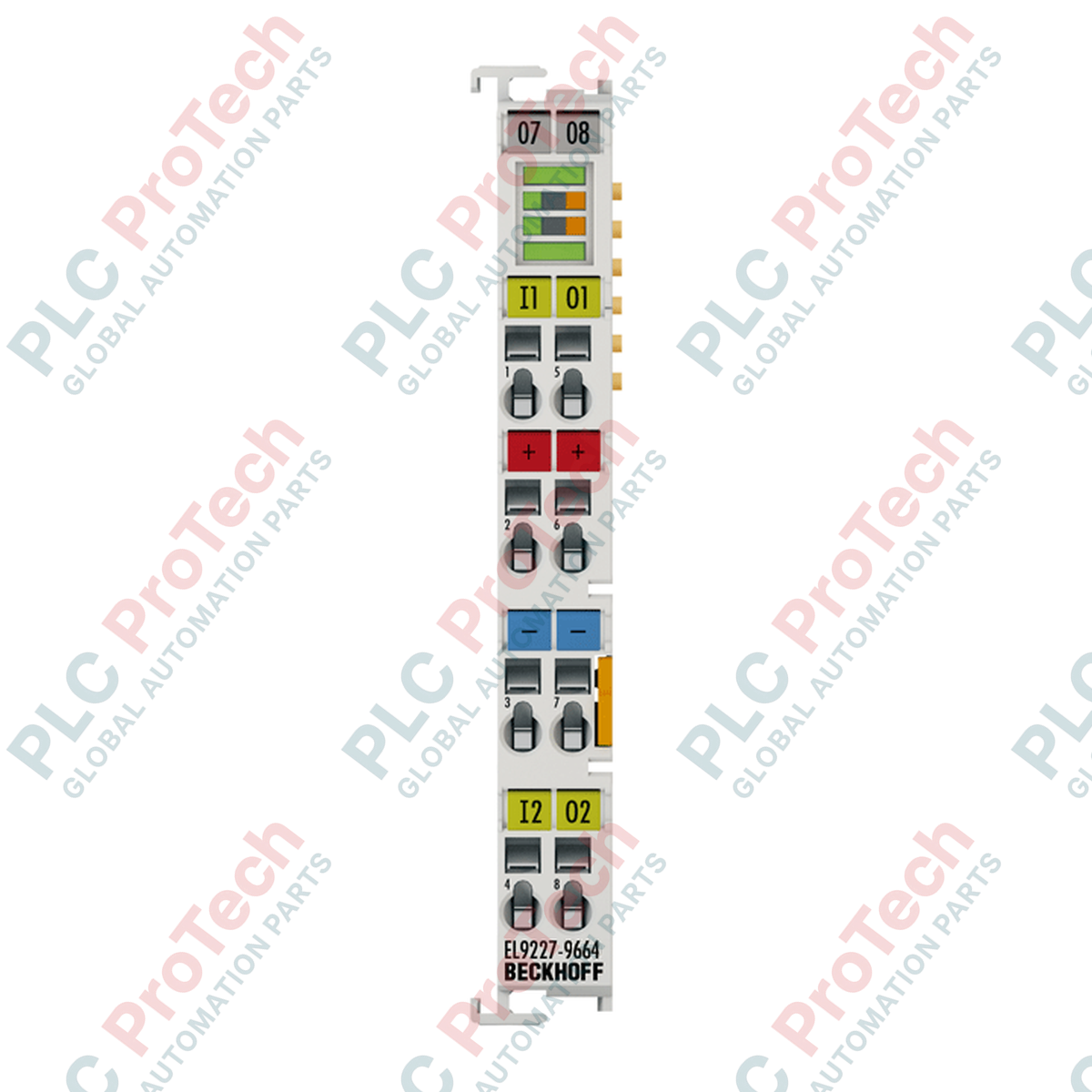
Présentation du produit
Le EL9227-9664 (EL9227-9664) est un bornier de protection contre les surintensités intelligent à 2 canaux, conçu pour le segment d’alimentation 24 VDC du système EtherCAT I/O. Contrairement aux fusibles passifs traditionnels, ce module électronique de protection contre les surintensités offre une surveillance active et des « fonctionnalités étendues » pour protéger les composants industriels sensibles. Avec des courants nominalisés de 6 A et 4 A, le EL9227-9664 est conçu pour des applications à haute fiabilité telles que la fabrication de semi-conducteurs, les cellules robotiques et les boucles de contrôle critiques où une défaillance localisée doit être isolée sans couper l’alimentation de l’ensemble du système. Ses boutons LED intégrés permettent une réinitialisation locale et une commutation manuelle, tandis que son intégration numérique fournit au maître EtherCAT des diagnostics en temps réel, incluant les niveaux de charge de courant et les avertissements de basse tension.
Configuration technique
L’architecture du EL9227-9664 combine la technologie de fusible électronique avec une communication bus de terrain à haute vitesse. Il dispose de deux canaux indépendants : la sortie 1 est acheminée exclusivement via les contacts d’alimentation pour une distribution en aval facilitée, tandis que les deux canaux bénéficient de seuils d’« avertissement anticipé » réglables. Ces avertissements peuvent être configurés pour la charge de sortie (50–100 %) et les conditions de basse tension (17–24 VDC), permettant aux équipes de maintenance d’intervenir avant une coupure complète. Le bornier inclut également une coupure arrière réglable en 3 étapes et une fonction de coupure en cas de surtension déclenchée à ≥ 32 VDC, garantissant que les appareils en aval ne soient jamais exposés à des pics de tension dommageables.
Caractéristiques techniques
| Caractéristique |
Spécification |
| Modèle |
EL9227-9664 |
| Marque |
BECKHOFF |
| Origine |
Allemagne |
| Canaux |
Protection contre les surintensités à 2 canaux |
| Tension nominale |
24 VDC |
| Courant nominal |
6 A / 4 A |
| Élément fusible intégré |
10 A (rapide) |
| Coupure en cas de surtension |
≥ 32 VDC |
| Avertissement de basse tension |
Réglable de 17 à 24 VDC |
| Avertissement de charge de sortie |
Réglable de 50 à 100 pour cent |
| Consommation de courant (E-bus) |
typ. 80 mA |
| Dimensions (L x H x P) |
12 mm x 100 mm x 68 mm |
| Température de fonctionnement |
0 à +55 degrés Celsius |
FAQ techniques
Quelles sont les « fonctionnalités étendues » mentionnées pour ce modèle ?
Cela inclut des caractéristiques de déclenchement réglables, des données de diagnostic avancées via EtherCAT (par exemple, la mesure réelle du courant par canal) et la possibilité de configurer les seuils d’avertissement pour la tension et le courant via le TwinCAT System Manager.
Comment fonctionne le bouton LED en façade du bornier ?
Le bouton LED a une double fonction : il indique l’état actuel du canal (Vert/Rouge/Clignotant) et permet à l’opérateur de basculer manuellement la sortie ou de réinitialiser le fusible électronique après un déclenchement.
Y a-t-il une période de refroidissement obligatoire après un déclenchement pour surintensité ?
Oui, le bornier inclut une période de maintien thermique de ≥ 10 secondes (selon la température ambiante) après une coupure de sortie. Cela empêche les composants électroniques de surchauffer en cas de réinitialisations rapides répétées dans un court-circuit persistant.
Guide d’ingénierie et d’installation
-
Stratégie de protection sélective : Utilisez le EL9227-9664 pour mettre en œuvre une architecture de distribution d’énergie sélective. En réglant les courbes de déclenchement électroniques plus rapides que le disjoncteur principal de l’armoire, vous garantissez que seule la branche défaillante est déconnectée, maintenant la disponibilité du reste de la chaîne EtherCAT.
-
Utilisation des contacts d’alimentation : Notez que la sortie 1 est disponible via les contacts d’alimentation. Lors de la planification de votre rail de bornier, assurez-vous que le courant total circulant dans les contacts d’alimentation ne dépasse pas la limite maximale de 10 A afin d’éviter une surchauffe localisée des barres omnibus internes.
-
Considérations sur la chute de tension : Pour les longues longueurs de câble, la fonction « Avertissement anticipé de basse tension » est cruciale. Configurez ce seuil légèrement au-dessus de la tension minimale de fonctionnement de vos capteurs/actionneurs pour détecter la dégradation des câbles ou la surcharge de l’alimentation avant une défaillance logique.
-
Sécurité du câblage : Pour les applications soumises à de fortes vibrations (par exemple, montage sur machine), utilisez des embouts à ressort avec les bornes à ressort. Veillez à ce que la longueur de dénudage soit exactement de 8 à 9 mm ; un dénudage insuffisant peut entraîner des connexions à haute résistance provoquant des avertissements thermiques prématurés.