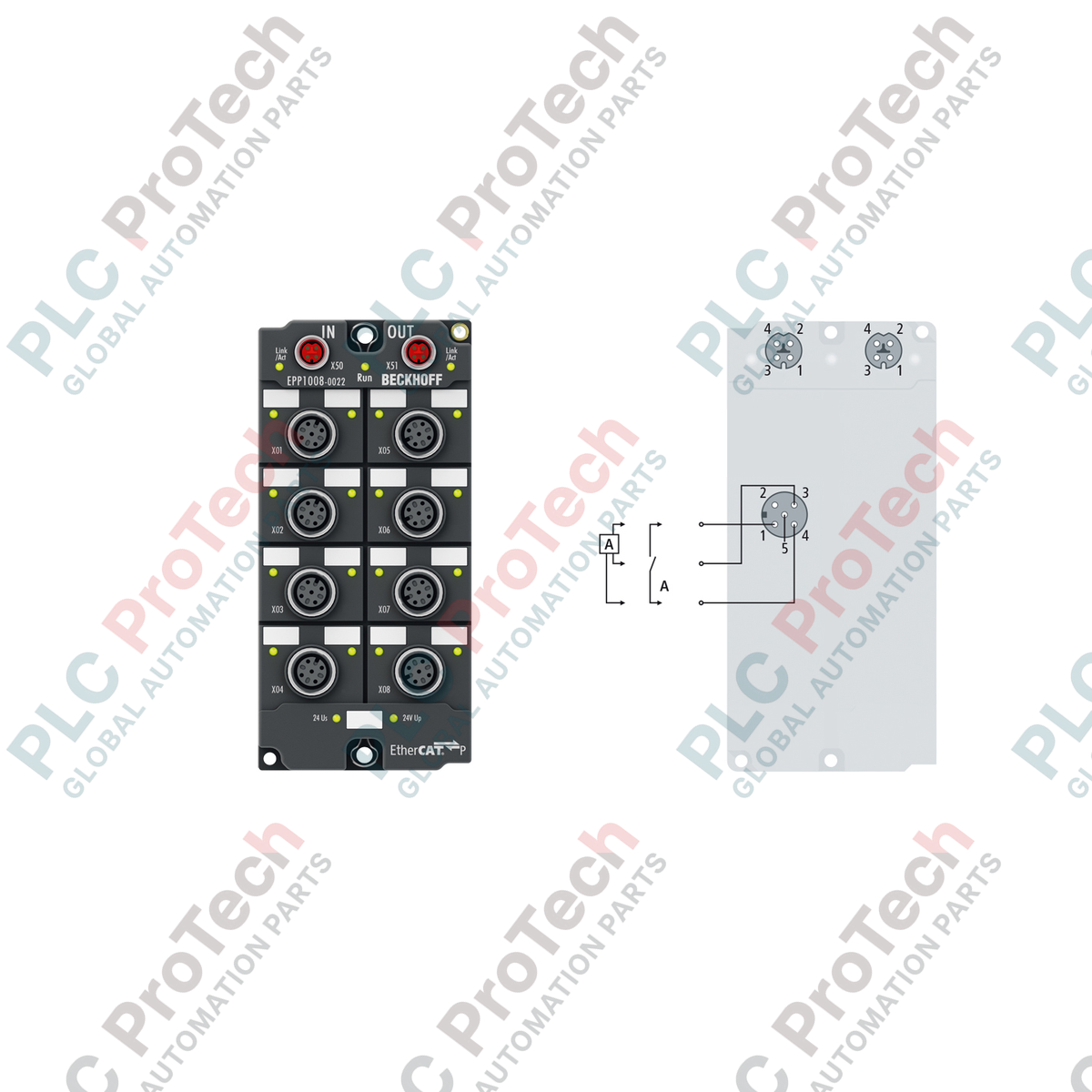
Description
Conçu pour les environnements industriels où l’espace est limité, directement sur le châssis de la machine, le Beckhoff EPP1008-0022 est un module d’entrées numériques EtherCAT P codé qui élimine le besoin de coffrets de terrain décentralisés. Il acquiert les signaux de commande numériques rapides provenant de la couche physique et les transmet à l’architecture de commande via une connexion unifiée haut débit. En intégrant les données et l’alimentation (Us et Up) dans un seul câble M8 à 4 conducteurs, codé P, ce module simplifie le câblage tout en maintenant une communication déterministe. Logé dans un boîtier robuste en polyamide, il offre une excellente résistance aux contraintes environnementales, aux vibrations et à la pénétration de l’humidité.
Caractéristiques principales
-
Interface EtherCAT P unifiée : combine la communication Ethernet EtherCAT et l’alimentation (commande 24 V CC Us et périphériques Up) sur un seul connecteur M8.
-
Acquisition robuste des signaux : 8 entrées numériques conformes aux normes EN 61131-2 de type 1/3 pour un enregistrement extrêmement fiable des signaux industriels.
-
Connecteurs M12 à entrée unique : correspondance directe 1 à 1 avec 8 connecteurs M12 A codés à 5 broches dédiés, réduisant au minimum les erreurs de câblage sur site.
-
Protection contre les courts-circuits : alimentation intégrée des capteurs de 0,5 A dérivée de la tension de commande Us, entièrement protégée contre les surintensités et les courts-circuits.
-
Boîtier de qualité industrielle : boîtier en PA6 (polyamide) conforme aux indices IP65, IP66 et IP67, conçu pour un montage direct dans des environnements difficiles, soumis au lavage ou huileux.
Applications
-
installation directe sur les châssis CNC, les unités d’emboutissage et les bras robotisés, sans coffrets de protection.
-
Lignes de convoyage et de logistique : collecte rationalisée des signaux des capteurs sur de longues distances physiques grâce au chaînage en guirlande par câble unique.
-
Systèmes d’assemblage automatisés : raccordement direct de détecteurs de proximité, de barrières photoélectriques et de fins de course mécaniques dans la zone de traitement.
-
Zones humides et soumises au lavage : lignes de conditionnement des aliments et des boissons nécessitant une résistance IP67 au nettoyage haute pression.
Spécifications techniques
| Paramètre |
Valeur de spécification |
| Fabricant |
Beckhoff Automation |
| Numéro de modèle |
EPP1008-0022 |
| Protocole |
EtherCAT P |
| Interface de bus |
2 prises M8 blindées, à vis, codées P |
| Nombre d’entrées |
8 entrées numériques (1 entrée par connecteur M12 physique) |
| Spécification des entrées |
EN 61131-2, type 1/3 |
| Connexions d’entrée |
M12 x 1, 5 broches, codage A |
| Tension d’entrée nominale |
24 V CC (-15 % / +20 %) |
| Temps du filtre d’entrée |
3,0 ms |
| Plage de tension du signal « 0 » |
-3 à +5 V CC |
| Plage de tension du signal « 1 » |
11 à 30 V CC |
| Courant d’entrée typique |
3 mA (EN 61131-2, type 3) |
| Alimentation des capteurs |
Dérivée de la tension de commande Us, max. 0,5 A, protégée contre les courts-circuits (total) |
| Consommation de courant (depuis Us) |
Généralement 100 mA |
| Isolation électrique |
500 V RMS |
| Indice de protection |
IP65 / IP66 / IP67 (conforme à la norme EN 60529) |
| Matériau du boîtier |
PA6 (polyamide) |
| Température de fonctionnement |
-25 à +60 °C |
| Température de stockage |
-40 à +85 °C |
| Dimensions physiques |
60 mm x 126 mm x 26,5 mm (W x H x D) |
| Poids |
Environ 250 g |
| Poids d’expédition (calculé) |
2,0 kg (avec emballage d’exportation protecteur volumineux) |
Connexions et interfaces
| Type de port |
Numéro de broche |
Désignation du signal fonctionnel |
| M8 (EtherCAT P) |
Broche 1 |
Données de transmission + (Tx+) / Tension de commande + (Us +24 V CC) |
| Broche 2 |
Données de réception + (Rx+) / Tension périphérique + (Up +24 V CC) |
| Broche 3 |
Données de réception - (Rx-) / GND périphérique (GNDp) |
| Broche 4 |
Données de transmission - (Tx-) / GND de commande (GNDs) |
| M12 (entrées numériques) |
Broche 1 |
Alimentation du capteur +24 V CC Us |
| Broche 2 |
Non connecté (NC) |
| Broche 3 |
Alimentation du capteur 0 V GND |
| Broche 4 |
Signal d’entrée numérique (canaux 1 à 8) |
| Broche 5 |
Terre fonctionnelle (FE) / Blindage |
Conclusions d’ingénierie empiriques
Modèles alternatifs et compatibilité
L’EPP1008-0022 utilise EtherCAT P et nécessite des connexions M8 codées P. Il n’est pas compatible broche à broche avec les modules EP1008-0002 standard, qui utilisent EtherCAT standard avec codage A et des lignes d’alimentation auxiliaire externes. En cas de migration de boîtiers EP EtherCAT standard vers des boîtiers EPP, vérifiez que la station maître intègre un répartiteur d’alimentation EP9224 ou un coupleur de jonction EK1310 afin de fournir l’alimentation combinée Us/Up sur la ligne.
Pièges liés à l’application et notes d’ingénierie
Une erreur courante lors de l’intégration système consiste à dépasser la limite de courant maximale de 3,0 A autorisée pour Us (alimentation de commande) ou Up (alimentation des périphériques) à l’intérieur d’un segment EtherCAT P monté en guirlande. Lors de la mise en œuvre de longues chaînes de modules EPP1008-0022, utilisez le logiciel TwinCAT System Manager pour calculer les chutes de tension cumulées sur la ligne. Si la tension Us descend en dessous de 20,4 V CC au niveau du dernier nœud, des interruptions intermittentes de la communication de terrain ou des pertes de capteurs se produiront.
Conseils de mise en service et de câblage
Contrairement à certains blocs M12 à entrées multiples qui partagent deux signaux par connecteur physique, l’EPP1008-0022 contient strictement une entrée par interface M12, exclusivement affectée à la broche 4. Les capteurs standard à 3 fils et à canal unique (type PNP) peuvent être câblés directement, sans répartiteurs en Y personnalisés. Vérifiez que tous les ports M12 et M8 inutilisés sont obturés avec des capuchons vissés industriels afin de préserver l’étanchéité environnementale IP67 de l’unité.
Consignes d’installation
AVERTISSEMENT CRITIQUE : Avant de monter ou de câbler physiquement l’appareil, déconnectez complètement toutes les sources d’alimentation qui alimentent la ligne EtherCAT P. Le branchement ou débranchement à chaud de modules M8 codés P sous charge peut provoquer un arc électrique, entraînant des dommages permanents aux composants internes du transceiver EtherCAT P et aux capteurs connectés.
1
Positionnez le module sur un châssis de machine plat et résistant aux vibrations. Fixez-le à l’aide des trous de fixation supérieur et inférieur. Utilisez 2 boulons M3 (pour les trous de 3,5 mm) ou 2 boulons M4 (pour les trous de 4,5 mm), serrés au couple afin d’éviter tout desserrage mécanique en fonctionnement à haute fréquence.
2
Connectez le câble EtherCAT P entrant à la prise M8 supérieure codée P, puis raccordez le segment sortant en guirlande à la prise M8 inférieure. Serrez à la main les capuchons vissés métalliques M8 afin d’assurer une connexion étanche aux gaz et l’intégrité du blindage.
3
Branchez les câbles des capteurs numériques M12 dans les ports femelles appropriés à 5 broches. Serrez les écrous métalliques moletés pour empêcher toute pénétration d’humidité. Bouchez les ports inutilisés avec des bouchons de protection afin de préserver l’indice IP67.
4
Mettez sous tension la branche EtherCAT P et vérifiez l’état des LED. Vérifiez que les indicateurs « Us » du système et de la liaison de communication s’allument en vert fixe, confirmant l’établissement de la communication de terrain et l’alimentation correcte des nœuds.