Description
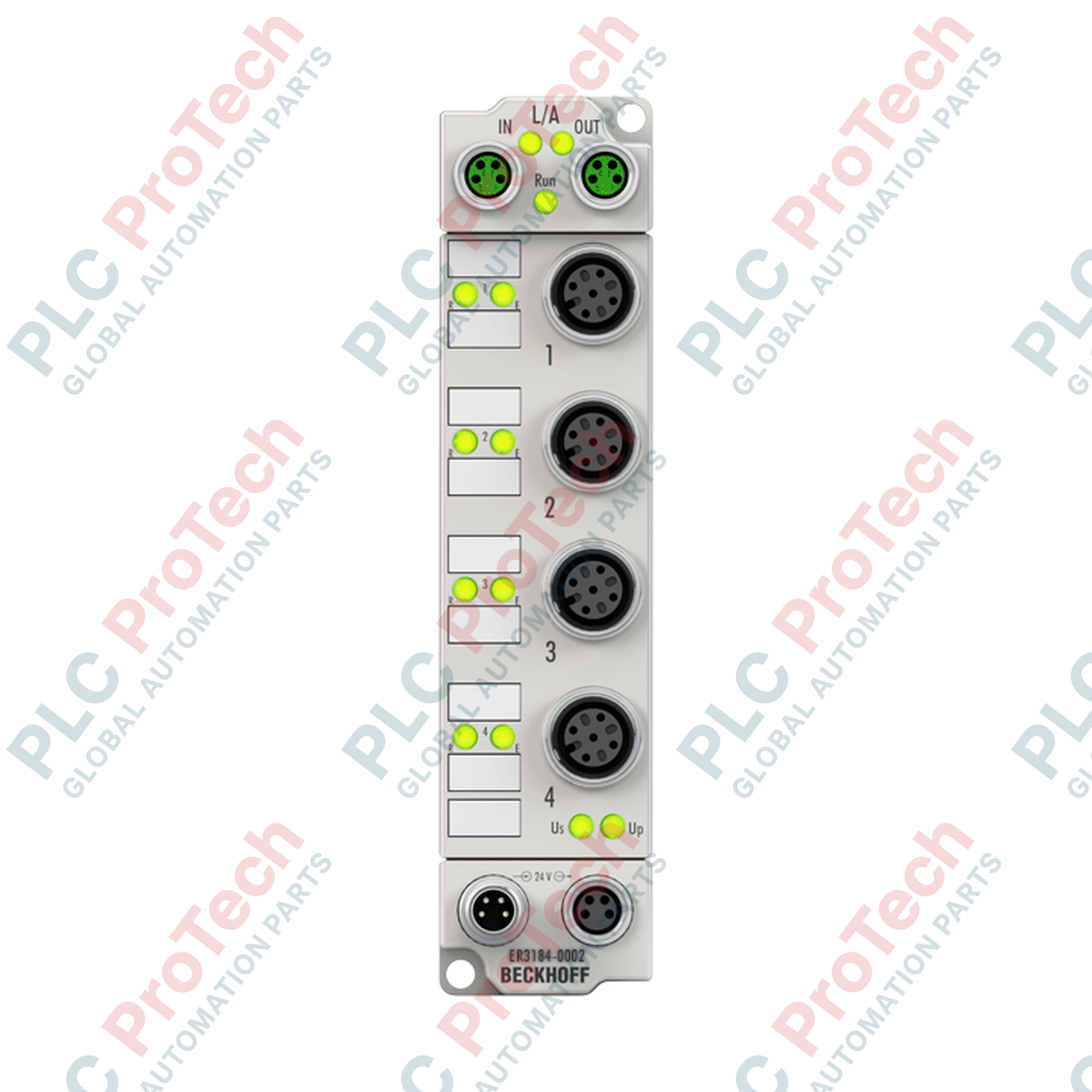
Conçu pour un déploiement direct sur le terrain sans armoire de commande, le Beckhoff ER3184-0002 EtherCAT Box assure le traitement haute précision de jusqu’à quatre signaux d’entrée analogiques dans des environnements difficiles. Ce module permet de sélectionner par logiciel, pour chaque canal, la mesure de tension (-10/0 à +10 V) ou de courant (0/4 à 20 mA). Logé dans une robuste enveloppe en zinc moulé sous pression avec un indice de protection IP67, il traite les signaux avec une résolution de 16 bits et des temps de conversion rapides, ce qui le rend idéal pour les machines distribuées et les boucles de processus nécessitant une forte immunité au bruit.
Caractéristiques
- Quatre entrées analogiques asymétriques, configurables individuellement.
- Résolution analogique-numérique de 16 bits (signe inclus) pour une grande fidélité du signal.
- Boîtier robuste avec indice de protection IP65/66/67, éliminant le besoin d’enceintes de protection sur site.
- Taux de conversion élevé d’environ 100 microsecondes par canal.
- Prise en charge des Distributed Clocks (DC) pour assurer une synchronisation précise sur l’ensemble du réseau EtherCAT.
- Filtre d’entrée configurable avec une fréquence limite allant jusqu’à 5 kHz.
- Connexions d’entrée M12 normalisées et ports de communication EtherCAT M8 fiables.
Applications
- Regroupement des capteurs directement sur les machines, sans armoire, dans les chaînes d’assemblage automobiles et industrielles.
- Surveillance distribuée des paramètres de processus, notamment des transmetteurs de débit, de température et de pression.
- Systèmes automatisés de manutention des matériaux et de convoyage fonctionnant dans des usines de traitement humides ou poussiéreuses.
- Systèmes d’enregistrement de paramètres à grande vitesse utilisant des Distributed Clocks basées sur TwinCAT.
Tableau des spécifications techniques
| Paramètre |
Spécification |
| Fabricant |
Beckhoff Automation |
| Référence du modèle |
ER3184-0002 |
| Nombre d’entrées |
4 (asymétriques) |
| Plages de signaux |
-10 à +10 V | 0/4 à 20 mA (paramétrable par canal) |
| Résolution |
16 bits (signe inclus) |
| Temps de conversion |
~ 100 microsecondes |
| Résistance interne |
> 200 kOhms (tension) | env. 85 ohms + tension de diode (courant) |
| Tension en mode commun (UCM) |
Max. 35 V |
| Incertitude de mesure |
< ±0,3 % (par rapport à la pleine échelle) |
| Distributed Clocks (DC) |
Pris en charge, synchronisation haute précision |
| Filtre d’entrée |
Configurable, fréquence limite de 5 kHz |
| Alimentation nominale |
24 V CC (-15 % / +20 %) |
| Consommation électrique |
120 mA depuis US |
| Isolation électrique |
500 V |
| Indice de protection IP |
IP65 / IP66 / IP67 (conforme à la norme EN 60529) |
| Température de fonctionnement |
0 à 55 °C |
| Température de stockage |
-25 à 85 °C |
| Poids |
Environ 265 g |
| Normes et homologations |
CE, UL |
Connexions et interfaces
| Connecteur / Broche |
Affectation fonctionnelle |
| Prises de bus M8 (2 blindées) |
EtherCAT IN / EtherCAT OUT |
| Broche 1 de la prise M12 |
Alimentation du capteur : +24 V CC (dérivée de UP) |
| Broche 2 de la prise M12 |
Entrée analogique + (Tension / Courant) |
| Broche 3 de la prise M12 |
GND (Masse de l’alimentation du capteur) |
| Broche 4 de la prise M12 |
Entrée analogique - (Masse du signal) |
| Broche 5 de la prise M12 |
Blindage / Terre fonctionnelle (FE) |
Observations techniques empiriques
Modèles alternatifs et compatibilité
L’ER3184-0002 constitue une alternative robuste, montée sur le terrain, à l’EtherCAT Box EP3184-0002 destiné aux armoires. Les deux modules présentent un comportement électronique et des registres de paramétrage identiques via TwinCAT. Toutefois, le boîtier de l’ER3184 est fabriqué en zinc moulé sous pression haute résistance, tandis que les modules de la série EP utilisent des boîtiers en plastique plus légers. La compatibilité directe des micrologiciels est assurée à partir de TwinCAT 2.11 Build 2040 et dans les versions ultérieures de TwinCAT 3.x.
Pièges d’application et remarques techniques
Lors de la configuration des voies en mode courant (0 à 20 mA ou 4 à 20 mA), le circuit d’entrée interne passe par un shunt de 85 ohms en série avec une diode de protection. Les concepteurs du système doivent s’assurer que le capteur source dispose d’une tension de conformité suffisante pour compenser la chute de tension directe de cette diode à l’intensité maximale de la boucle, en particulier lors de l’alimentation de dispositifs passifs alimentés par la boucle.
Conseils de mise en service et de câblage
Pour garantir l’étanchéité IP67 et préserver les performances de blindage, toutes les connexions M12 et M8 inutilisées doivent être obturées à l’aide de bouchons de protection Beckhoff d’origine. Reliez directement le boîtier en zinc au bâti de la machine au moyen d’une tresse de mise à la terre dédiée à faible impédance. Cela évite les boucles de masse et garantit que les parasites haute fréquence sont correctement dérivés loin des convertisseurs A/N sensibles de 16 bits.
Directives d’installation
AVERTISSEMENT CRITIQUE : Mettez hors tension toutes les alimentations principales de terrain (US et UP) avant de monter ou de raccorder l’EtherCAT Box. Des différences de potentiel de terre entre les nœuds physiques peuvent entraîner la destruction instantanée de l’interface logique ou endommager les entrées des capteurs en cas de connexion à chaud.
1
Montez l’ER3184-0002 sur une surface métallique plane à l’aide de deux vis M3 passant par les trous de fixation intégrés, afin d’établir une interface mécanique et thermique robuste.
2
Fixez les câbles de communication EtherCAT M8 (ports IN et OUT) à l’aide d’une clé dynamométrique étalonnée à 0,4 Nm afin de préserver l’intégrité de l’indice de protection.
3
Raccordez les câbles des capteurs analogiques aux voies M12 appropriées. Veillez à appliquer la configuration de brochage correcte selon les exigences de boucle de courant active ou passive.
4
Fournissez 24 V CC à l’entrée d’alimentation M8 (US et UP). Ouvrez TwinCAT, recherchez la boucle EtherCAT et configurez les variables CoE (CAN over EtherCAT) pour correspondre aux profils de tension ou de courant des capteurs.