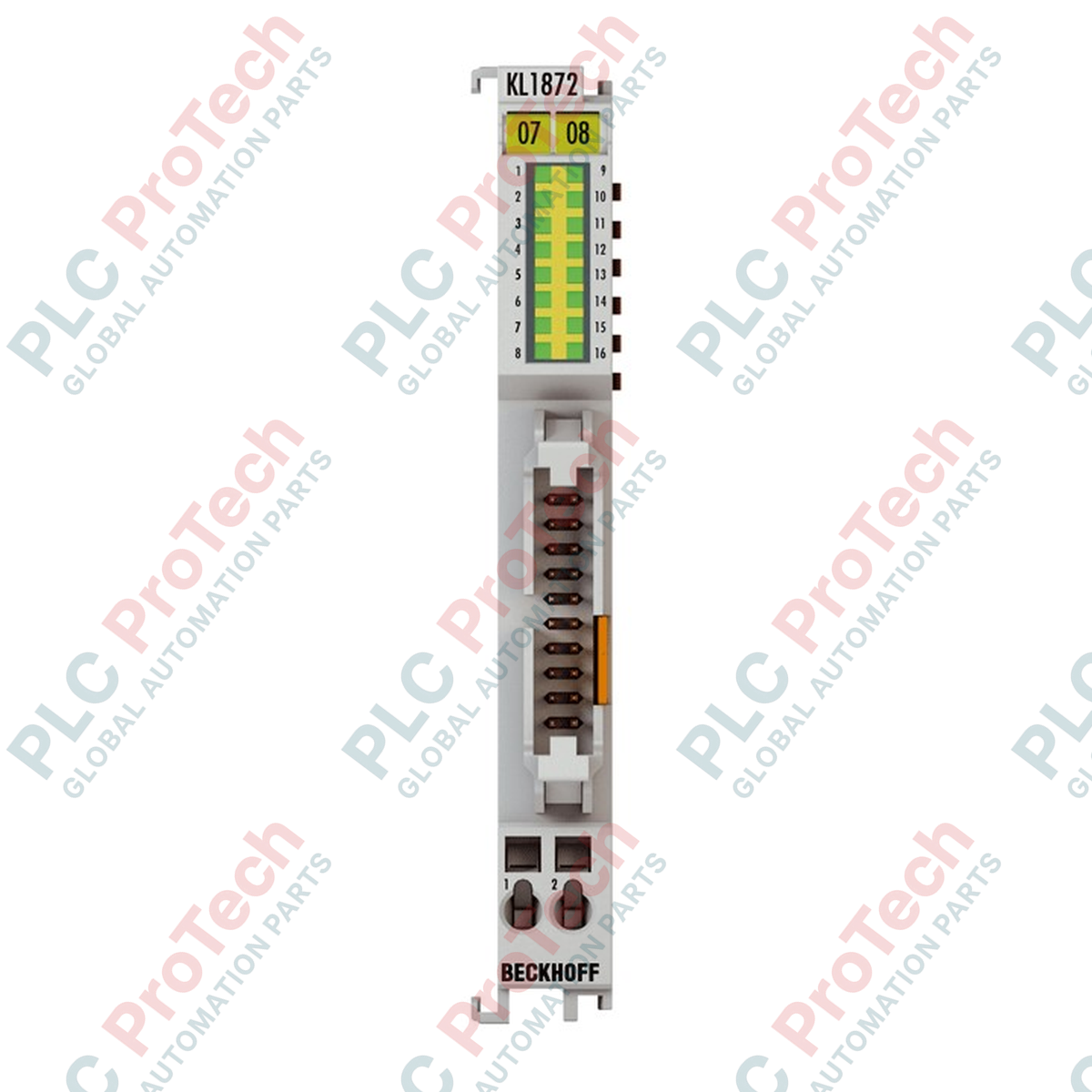
Présentation du produit
Le KL1872 (KL1872) est un terminal d'entrée numérique haute densité à 16 canaux conçu pour le système Beckhoff Bus Terminal, spécialement conçu pour les applications où l'espace est limité et pour la terminaison rapide de câbles en grand nombre. Contrairement aux terminaux standard, le KL1872 utilise une technologie de connexion par câble plat, ce qui réduit considérablement le temps d'assemblage et les erreurs de câblage lors de l'interfaçage avec des groupes de capteurs ou des cartes de distribution spécialisées. Conforme aux normes EN 61131-2 Type 1/3, ce module 24 VCC est idéal pour les lignes d'assemblage automatisées à grande vitesse, la fabrication de semi-conducteurs et les machines d'emballage complexes. En regroupant 16 entrées discrètes dans un seul boîtier de 12 mm, il maximise la densité de l'armoire de commande tout en garantissant une acquisition fiable des signaux grâce à un filtre d'entrée typique de 0,2 ms, protégeant ainsi le système contre les parasites électriques industriels et les rebonds de contact.
Configuration technique
L'architecture matérielle du KL1872 est optimisée pour le protocole de communication interne K-bus, transmettant l'état de 16 entrées numériques au coupleur de bus sous la forme d'une image de processus unique de 16 bits. L'acquisition des signaux suit la caractéristique de Type 3, avec un courant d'entrée typique de 3 mA afin de garantir une commutation fiable, même avec des capteurs électroniques. Une caractéristique technique essentielle est l'interface pour câble plat à 20 broches, qui permet une liaison directe avec des faisceaux de câbles préassemblés, éliminant ainsi le besoin d'un câblage point à point individuel pour 16 conducteurs distincts. Le module fonctionne avec une tension nominale standard de 24 VCC et assure une isolation électrique de 500 V entre le K-bus et le potentiel de terrain, protégeant le contrôleur central contre les surtensions électriques côté terrain.
Spécifications techniques
| Caractéristique |
Spécification |
| Modèle |
KL1872 |
| Marque |
BECKHOFF |
| Origine |
Allemagne |
| Nombre d'entrées |
16 |
| Technologie de connexion |
Câble plat (20 broches) |
| Tension nominale |
24 VCC (-15 pour cent / +20 pour cent) |
| Spécification du signal |
EN 61131-2, Type 1/3 |
| Filtre d'entrée |
typ. 0,2 ms |
| Courant d'entrée |
typ. 3 mA |
| Consommation de courant (K-bus) |
typ. 3 mA |
| Largeur en bits |
16 entrées (1 x 16 bits) |
| Température de fonctionnement |
0 à +55 degrés Celsius |
| Homologations |
CE, UL, ATEX, IECEx |
FAQ techniques
Le KL1872 nécessite-t-il une configuration logicielle ?
Non, le KL1872 est un module « plug-and-play ». Il ne nécessite aucun réglage d'adresse ou de configuration. Le coupleur de bus détecte automatiquement la largeur d'entrée de 16 bits et l'intègre dans l'image de processus du contrôleur.
Quel est l'avantage de la caractéristique d'entrée de Type 3 ?
La spécification de Type 3 (EN 61131-2) définit une consommation de courant plus élevée à basse tension par rapport au Type 1. Cela garantit une meilleure compatibilité avec les capteurs à 2 fils et offre une meilleure immunité au bruit dans les environnements industriels électriquement « pollués ».
Comment l'alimentation est-elle distribuée aux capteurs avec le câble plat ?
Le KL1872 est conçu pour l'acquisition des signaux. En général, l'alimentation 24 VCC des capteurs est distribuée par le faisceau de câbles plats ou par une carte de distribution externe. Le terminal lui-même n'utilise pas de contacts d'alimentation standard pour la distribution sur le terrain.
Guide d'ingénierie et d'installation
-
Intégrité du câble plat : Lors du sertissage du connecteur à 20 broches, veillez à ce que le câble soit parfaitement perpendiculaire au corps du connecteur. Un mauvais alignement peut entraîner de la « diaphonie » ou des signaux intermittents entre les bits d'entrée adjacents. Utilisez uniquement des câbles plats de haute qualité conçus pour la plage de températures industrielles (jusqu'à 105 degrés Celsius) afin d'éviter la fragilisation de l'isolant.
-
Décharge de traction : Le câble plat étant plus léger qu'un câblage industriel standard, il est sensible à la fatigue due aux vibrations. Fixez le câble plat à moins de 50 mm du terminal à l'aide d'un serre-câble ou d'un support de montage dédié afin d'éviter toute tension sur le connecteur à 20 broches.
-
Conformité aux atmosphères explosives : Le KL1872 porte les marquages ATEX et IECEx « Ex ec » (sécurité renforcée). Pour les installations en atmosphères dangereuses de zone 2, l'ensemble Bus Terminal doit être monté dans un boîtier classé IP54, et le câble plat doit être protégé contre les dommages mécaniques afin de maintenir le niveau de protection contre les explosions.
-
Filtrage des entrées : Le filtre de 0,2 ms est fixe. Si votre application implique des impulsions à grande vitesse (par exemple, provenant d'un codeur ou d'un débitmètre) dépassant 2,5 kHz, veillez à ce que la largeur d'impulsion soit nettement supérieure au temps de filtrage de 0,2 ms afin d'éviter les pertes de comptage.